

Donald Duck and Heroism: Lifeguard Daze
And the mystery of women

Fate and fortune once again hang over Carl Barks’s Lifeguard Days (WDC&S #33, June 1943), his second solo ten-pager. “Luck” per se isn’t involved the time, but the perverse moral arc of the universe asserts itself.
The flow of fate in this story, though, is bizarre. Compared to the elegance of The Rabbit’s Foot, this story is just chaotic. The same basic elements are there, minus the explicit luck totem, but they’ve been jumbled. Without the keys of Barks’s later work, it would be terminally ambiguous.
Donald begins as a very bored lifeguard—so bored that he thinks he’d even fight a shark for some excitement. The shark promptly manifests, with the nephews crying out for help. Donald immediately hurls himself into the water, and this really is Donald’s best self: fear vanishes, instinct takes over, and he goes toe-to-toe with the shark…only to realize that he doesn’t quite have the means to intimidate it.
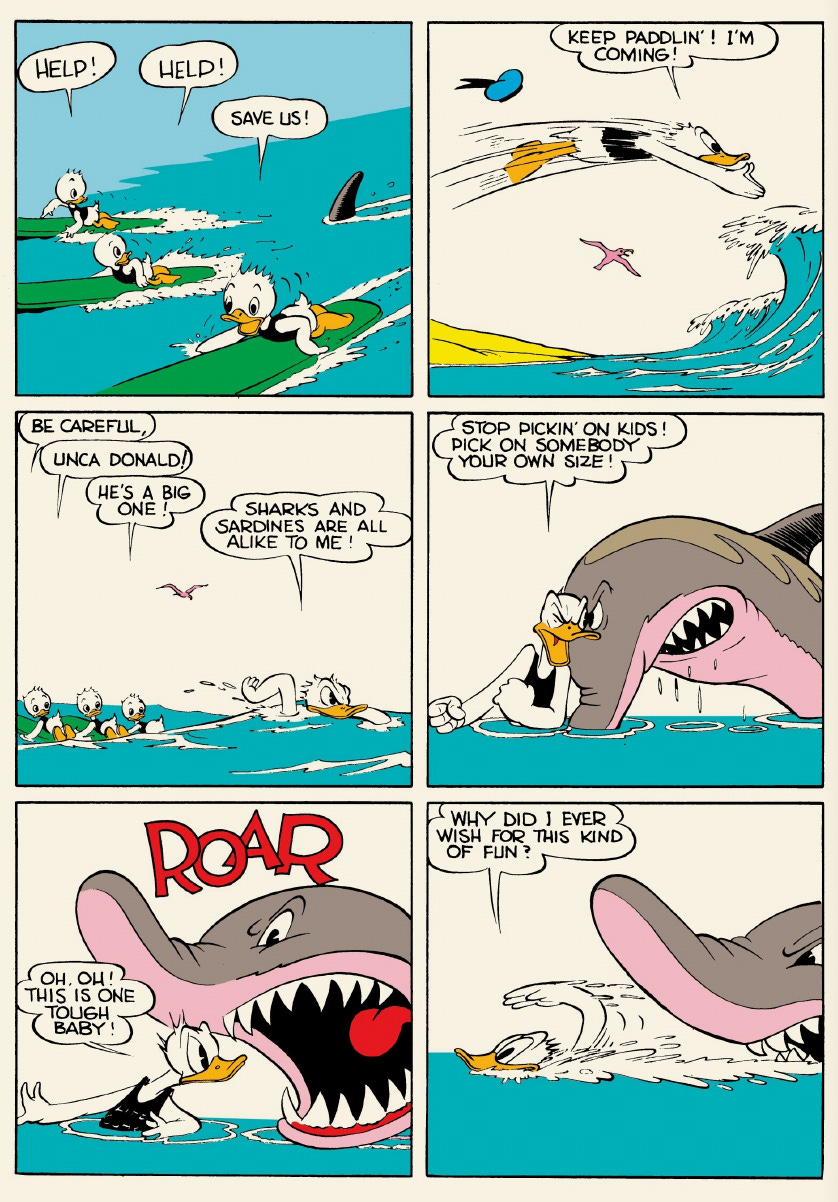
Donald is usually unlucky, but there are certain very strict conditions under which fortune may favor Donald:
His actions must spring from pure unselfish impulses.
There must be genuine effort and/or risk.
He cannot act with an ulterior motive.
It must not be for personal gain or self-aggrandizement, even secondarily.
It can’t be with the intention of “getting into fate’s good books.”
This situation meets them. Saving your family’s lives is about as pure as you can get. And so fate offers him salvation, albeit with a bit of humiliation:
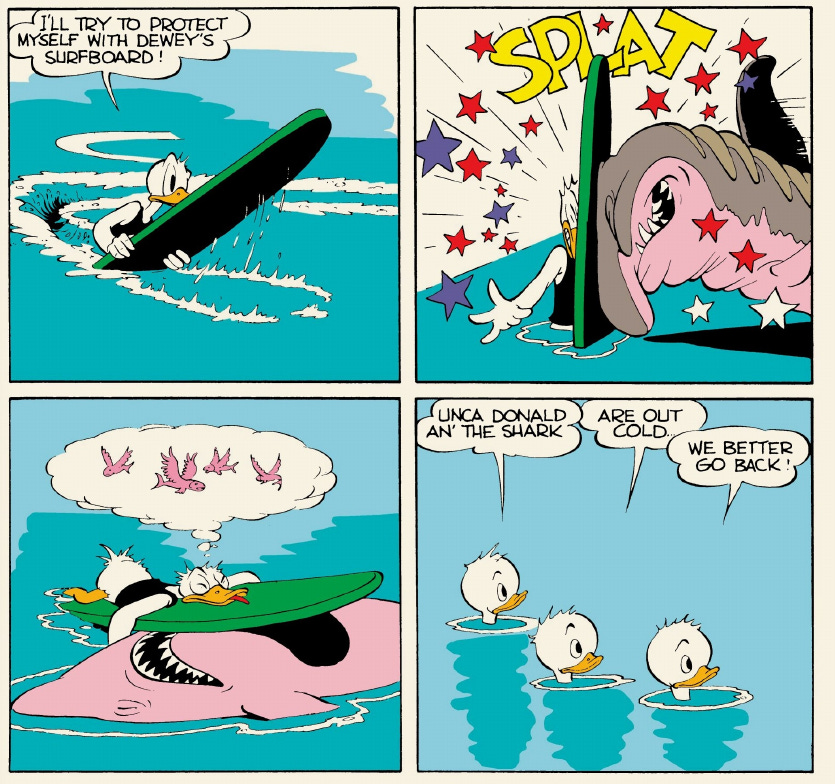
Donald and the nephews are safe, though in a way that makes the story completely useless for bragging rights, since it amounts to “I tried to fight a shark, almost died, and it killed itself smashing into a surfboard.” But a win is a win.
His heroic moment has passed. When Donald tries to tout his heroism to a passing girl on the beach, she doesn’t believe him, since how could he have possibly defeated a shark? He doesn’t quite lie, but he certainly isn’t being honest.
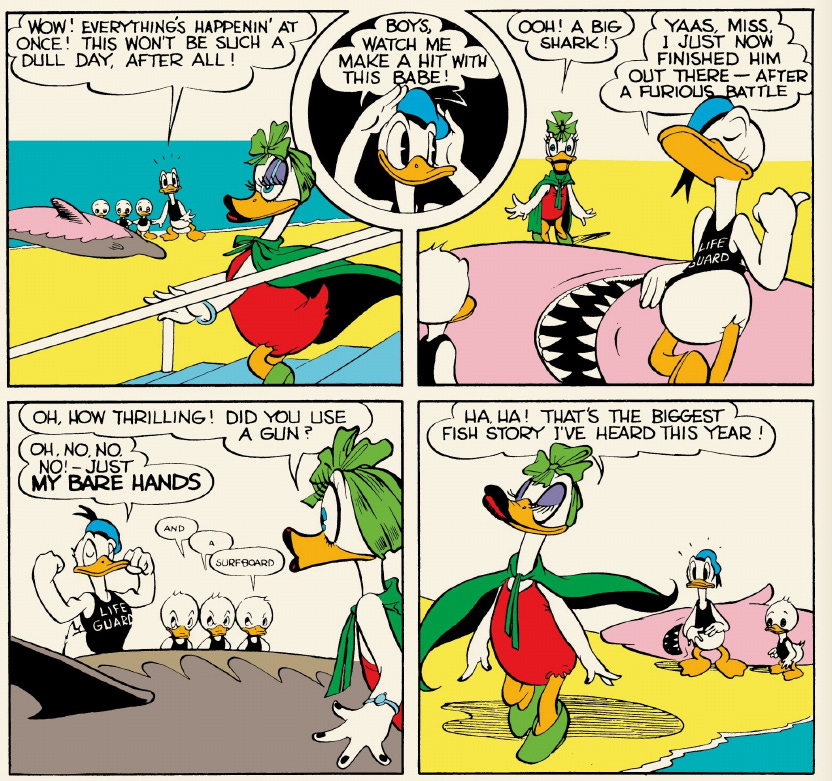
What ensues are a couple attempts by the nephews—grateful to Donald for saving their lives—to engineer fake rescue situations for him to look heroic to the girl. They all fail, naturally, leading to the girl thinking he’s even more of a posturing phony.
The difficulty is that coming after Donald’s heroism, the comic failures are anticlimactic, and Donald’s humiliation seems undeserved. He may not get the girl, but further embarrassment seems a bit excessive in light of his genuine bravery, especially when it’s the nephews and not him engineering the schemes.
And yet…fate intervenes once more:
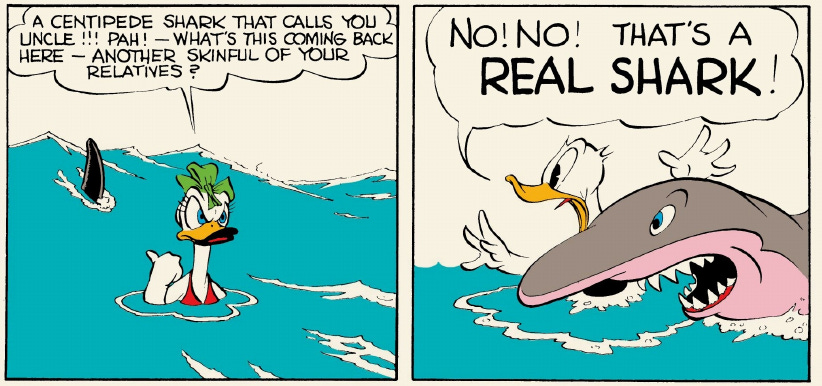
And here is where it gets strange. Donald fights the shark and wins.
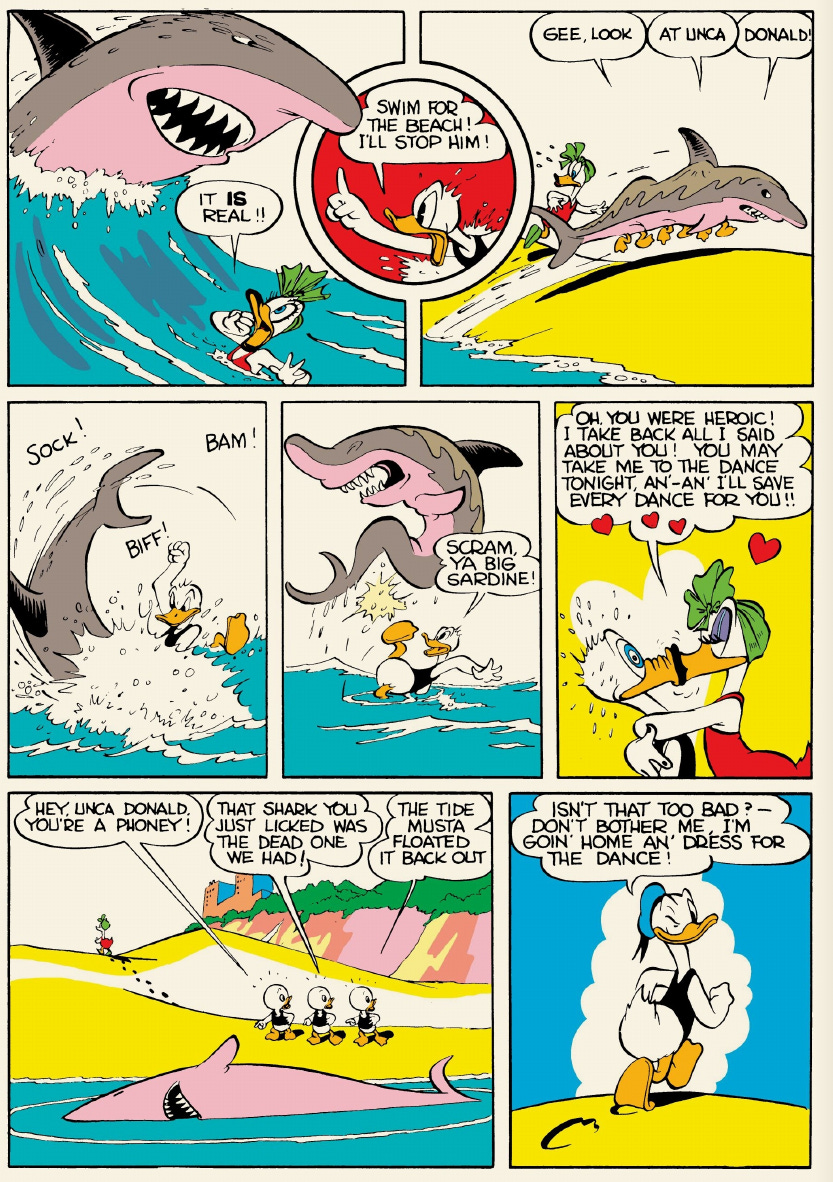
In summary: Donald unglamorously beat a real shark (sort of) and got no credit for it, then glamorously “fought” a dead shark and got the attention and affection he couldn’t get from the real fight.
Strangest of all, the final panel seems to indicate Donald knew all along that the shark was dead this time. Did Donald get to falsely replay the initial scenario as he had wanted it to go? Did he really deceive the girl into thinking she was in mortal danger just to impress her?
I don’t think so. Donald’s initial expression and “NO! NO! THAT’S A REAL SHARK!” seem entirely authentic. Donald is never such a convincing liar. My read is that Donald only realized the shark was fake by the time of the circular red panel at the top of the final page. Just as the circular black panel earlier signaled his intent to “Watch me make a bit hit with this babe!”, this circular red panel signals the same thing.
Both circles are performative. Donald takes the time to raise his finger and announce he will stop the shark. There’s far less urgency than in the beginning of the story, when he flew into the water to save the nephews. By the time he’s fighting the shark, Donald certainly knows and delivers his “Scram, ya big sardine!” quip right on cue.
That’s my read, anyway. The lack of sharpness on this point is a weakness in the story, particularly since the moral texture is already muddy. Why did fate favor Donald at the end? Did his initial heroism still merit good fortune—just good fortune that had to be cosmically engineered rather than staged by the nephews? Was his heroism enough to balance out his smug deception and impure motives at the end of the story? It isn’t clear whether Donald has triumphed rightly or wrongly.
These sorts of ambiguities pop up across Barks’s stories, but he hasn’t quite figured out how to deploy them here, in contrast the tightness of The Rabbit’s Foot. Barks himself seems ambivalent as to how hard the world should be on Donald, though he would quickly lean toward the more draconian end—if only because it was usually funnier.
That leaves the matter of the girl. There are actually two girls in the story, the unnamed beach girl and the plain jane Minnie Mudhen, a burger stand owner whom the nephews enlist in one of their schemes.
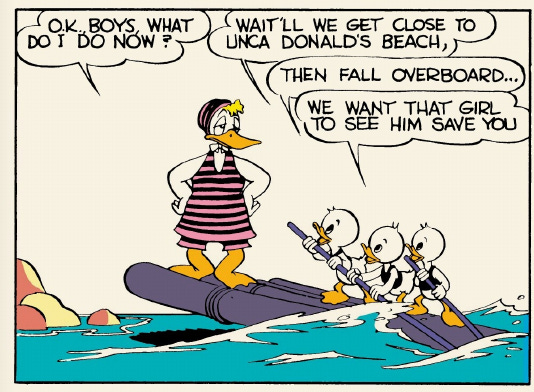
Minnie only appears in two panels, and the beach girl ends up “rescuing” her offscreen after the nephews’ setup fails. Minnie is a prop.
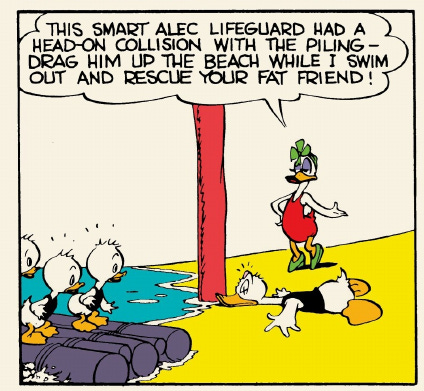
The beach girl, though, merits more attention. She’s the one who calls Donald a phony, but she also seems to think that Mudhen Minnie was really drowning and needed rescuing, not realizing that the whole thing was staged. She doubts Donald’s claims but fails to figure out the ad hoc ruse at the end. She doesn’t ever see fully true, even when she is skeptical.
There’s plenty to say about Barks’s portrayals of women, which tend to be inflected with a mixture of confusion and fear—but not just yet.
For more on Donald Duck and fate, see this post:
This 10-pagers looks like one of those Disney shorts Barks used to script. He was still finding his voice at this point.