

Donald Duck and Nature: The Limber W Guest Ranch
Carl Barks, comeuppance, and the natural world

The Limber W Guest Ranch (WDC&S #35, August 1943) doesn’t really gel either, but it has a few new motifs that Barks would come to develop. The story is Barks’s first attempt in a Western style. Barks was a child of the West and loved Westerns, and he likely had a keener and more personal sense of the disparity between the fantasy and the reality than most.
Donald comes in as a supposed expert, fake accent and all:
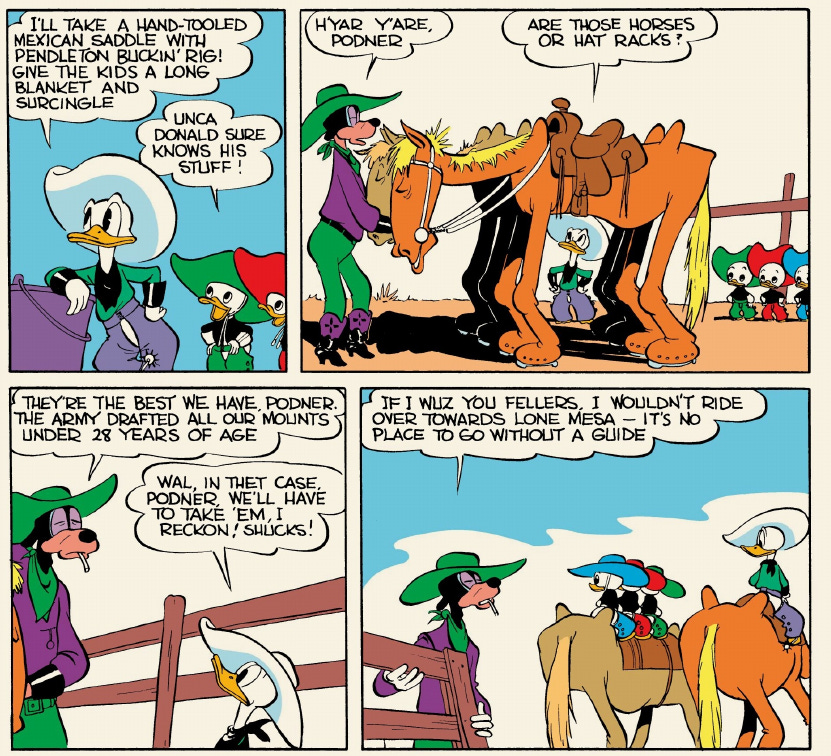
The ranch owner spots a faker immediately, and it doesn’t take the nephews that much longer to figure out that Donald’s knowledge is second-hand and shallow. What’s odd about the story is Barks’s difficulty finding the right comeuppance for Donald, and my goal here is to try to explain why.
When Donald and the nephews get lost, Donald gets even more prideful and insecure, and things get worse from there, to the point that the nephews have to actively hide their efforts to save their lives so that Donald won’t think that he didn’t save them all.
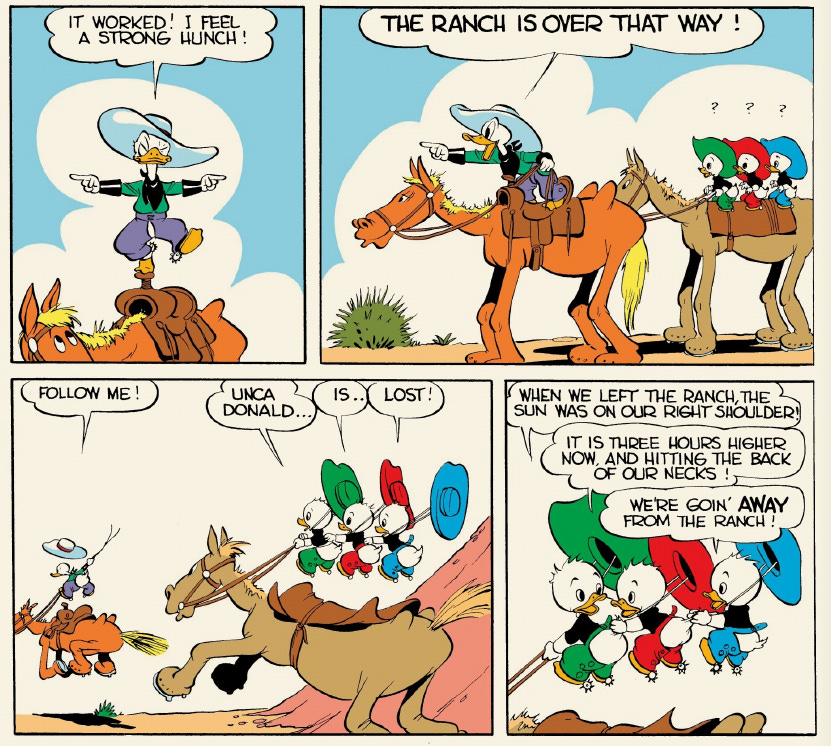
This is Barks’s first presentation of the nephews as prodigies. Barks gave vague indications that their ages were somewhere between 6 and 10 but never locked it down. Here they inexplicably have expert knowledge and powers of reasoning that would become their standard once the Junior Woodchucks came into the picture. In retrospect, it’s very familiar, but it’s quite a jump from their first few Barks incarnations. Only their purported youth stops them from being Donald’s superiors in every way.
The nephews were blank slates enough that Barks seemed comfortable turning them into wise children. Not so with Donald, who was far more established. On a metatextual level, the story’s setup is an implicit comment on what Barks was already himself doing with Donald, repurposing him and altering his personality and circumstances depending on what the story demanded. A few months into what would become 25 years of tireless labor (200-300 pages a year, not on a par with Jack Kirby but pretty damn respectable for a one-man show), Barks clearly understood that he’d need to adapt his characters to wildly different situations in order not to devolve into pure formula.
Sometimes these changes would be “sincere” and unremarked-upon, sometimes they would be pure arrogant pretense on his part, and sometimes somewhere in between. If Barks can draw Donald pretending to be a cowboy, it’s not that much of a step to turn him into a “real” cowboy and put him into a cowboy story. What remains? That issue of the essential “Donald-ness,” which Disney really didn’t care about at all—they were all icons to him—is a significant through-line in Barks’s work.
That may be why the story seems at odds with itself. Barks got so fluent with adapting to new settings that it’s hard to imagine it putting him ill at ease here, but I think it did. The funniest gag, involving Donald drinking from a gas-filled (?) desert spring that turns him into a helium balloon, is also the one that’s most out of place with the comparatively realistic desert setting.
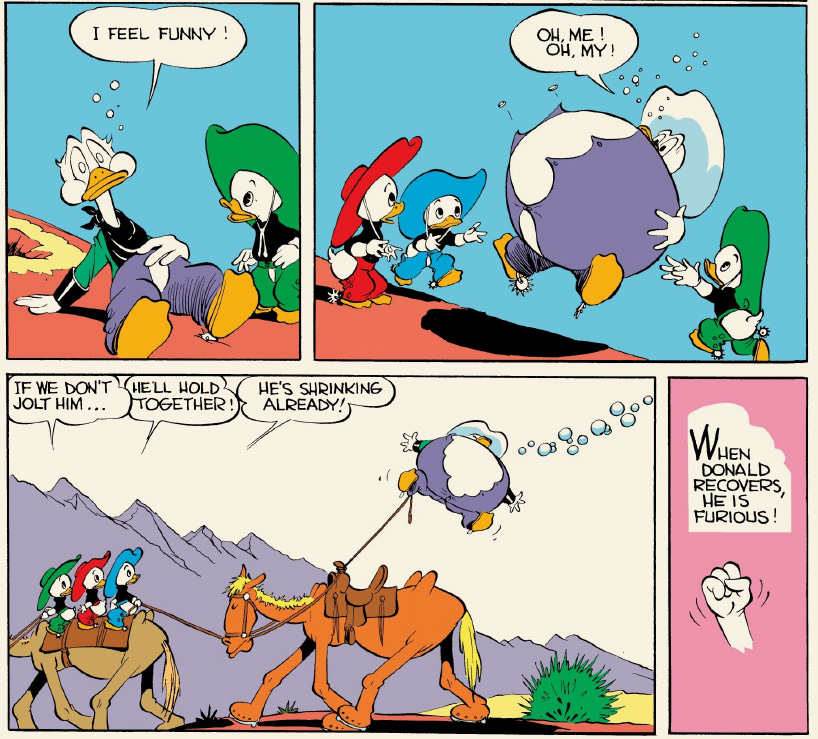
Yet it’s all anticlimactic. Donald never really gets his comeuppance for his incompetence and arrogance, despite it threatening their lives, and the nephews don’t really panic as they try to gently guide him the right way without piercing his ego—only to pierce it and have him double down on his idiocy. He screws up one last time at the end of the story as soon as he regains control, but it’s no ironic turnaround, only a “Well, duh” moment.
Thematically, capital-N nature makes a return from the first time since the beginning of Pirate Gold, when Donald and the nephews faced a deadly sea storm. Otherwise, the stories have been firmly oriented around human (i.e., funny animal) society and foibles.
For someone as fatalistic as Barks, nature force. The nephews navigate it with skill, and it’s only Donald’s folly that gets them into trouble—which never manifests as especially dangerous. Donald is more worried about being exposed as a phony than he is about dying in the desert.
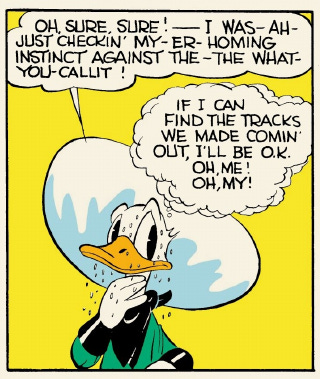
Nature is somewhere between an abyss and a toybox. Fate, as in the travails of fortune, is fairly merciless in Barks’s stories, but “Nature” plays fair in a way that fate does not, blessedly indifferent, honest, and consistent. When Donald sees a mirage of a resort, it’s not the desert taunting him—he’s doing it to himself.
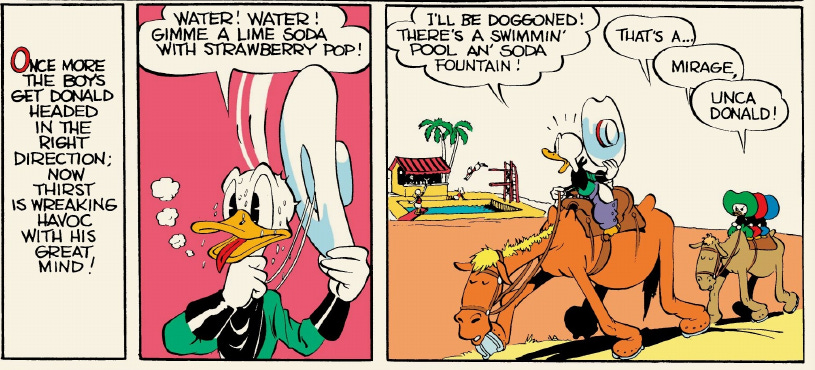
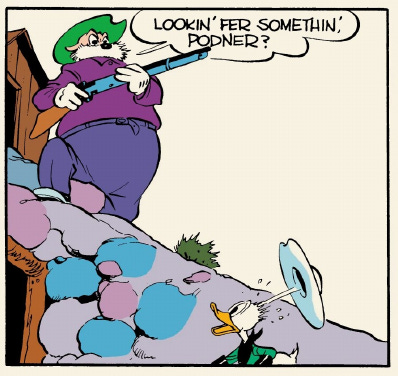
The most menacing real thing in the desert, naturally, is a person, a gold mine prospector carrying a rifle, in a perplexing single-panel appearance:
It would be easy to draw a parallel to Barks’s own rural upbringing and his uneasy attempts to integrate himself into the world of city slickers. I won’t go that far, but I do think the story shows a level of ease with nature that really never does manifest among interpersonal relationships in Barks’s work. And that’s why it never delivers quite the comeuppance to Donald that society would dispatch easily.
Comeuppance!