

Donald Duck and Parenting: Three Dirty Little Ducks
Carl Barks portrays Donald's first descent into anguish

Structurally this story is a milestone: it’s Barks’s first story with eight panels per page instead of six. The change seems to have been spurred by wartime supply shortages causing publishers to cut down their issues from 64 pages to 48 or 32 pages, though since the story page count stayed the same, I don’t understand the exact logic.
At any rate, the change benefits Barks. It carves the page into two equal four panel units, much more easily allowing for two story beats per page, while the six-panel page was mostly confined to one. The halfway point makes for an ideal transition point on the four-row layout, which the three-row layout couldn’t. While it’s technically 33% more panels, Barks’s narrative can accommodate up to twice as many beats, allowing for much denser plotting.
The story isn’t particularly complicated—Donald wants to give the kids a bath, the kids don’t wanna let him—but more happens in it. It feels notably longer than the previous ten-pagers. The art is simpler too, most of it taking place inside Donald’s strangely empty house. But it too is a milestone, because it’s the first time we’ve seen this side of Donald:
The story is the first portrayal of the very domestic situation of Donald actually trying to parent the nephews in the most basic of ways. He’s been their playmate and competitor, occasionally their mentor, but this story finally puts him into the role of actual guardian.
Barks adjusts Donald’s personality accordingly. There’s still some of his mischief and sadism, as when he finds them hiding in a phonograph cabinet and forces them out with “The Battle of the Thunderclaps.”
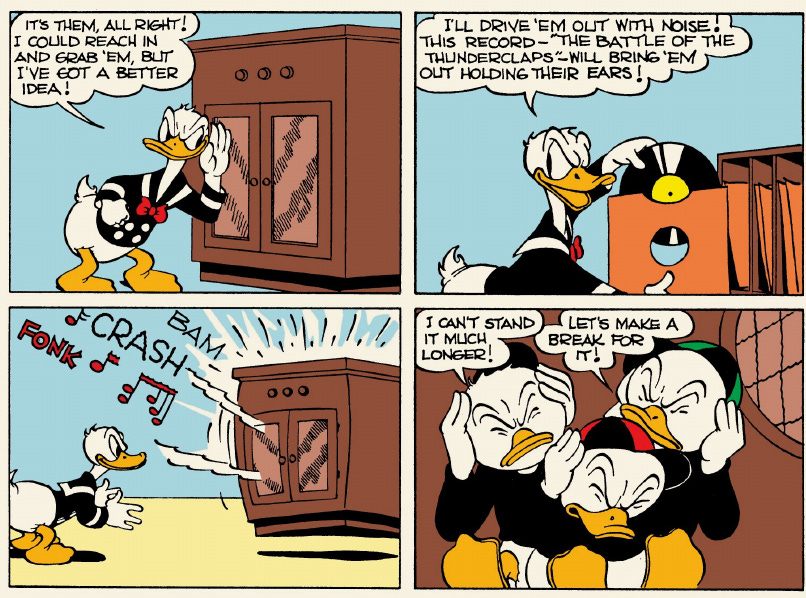
This is an isolated moment, though. He spends much more of the story beleaguered, vexed, and even well-intentioned. He sees giving the kids a bath as his parental duty, and he even takes steps to make it appealing to them.
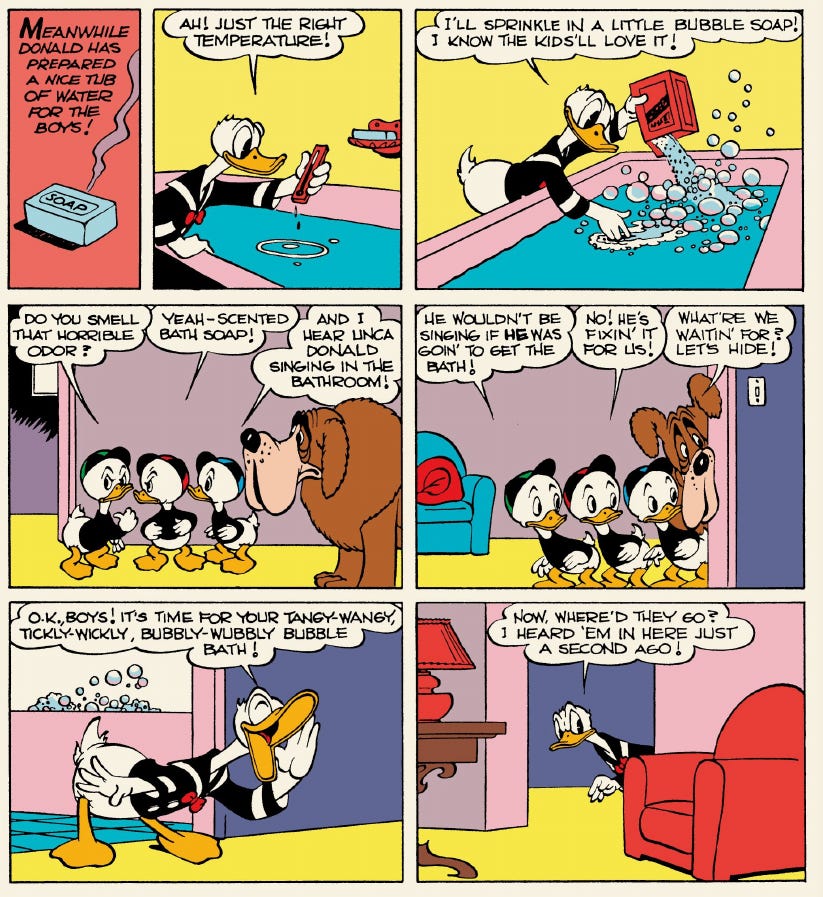
“Tangy-wangy, tickly-wickly, bubbly-wubbly bubble bath”? Is he serious? Donald’s sudden embrace of good parenting is peculiar enough that you want to ask whether he’s sincere or not.
He’s not consciously insincere, for certain. He even offers them candy:
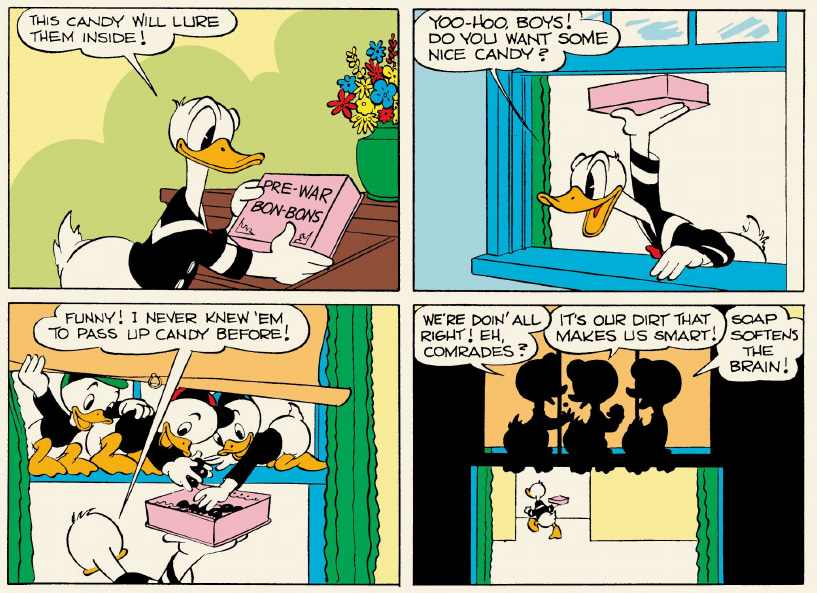
Donald snaps into a more outrage mode after he finds the candy missing, but he never sheds the parental obligation. The best answer to the question seems to be that he wants to be sincere, but in doing so is affecting the cutesy-poo mannerisms of a “good parent.” Since it’s clearly funny in general to see Donald aspiring and failing, this story is best viewed as another aspirational moment—though with more pathos than usual, since his intentions are driven by duty rather than ego.
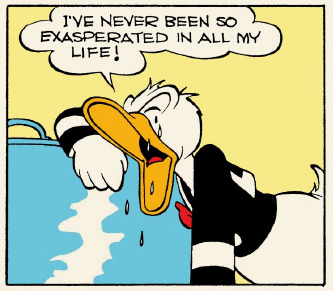
Unlike his past duels with the nephews, he doesn’t see bathing the kids as a battle of wits. In his most emotional moment in the story, he reaches his wit’s end:
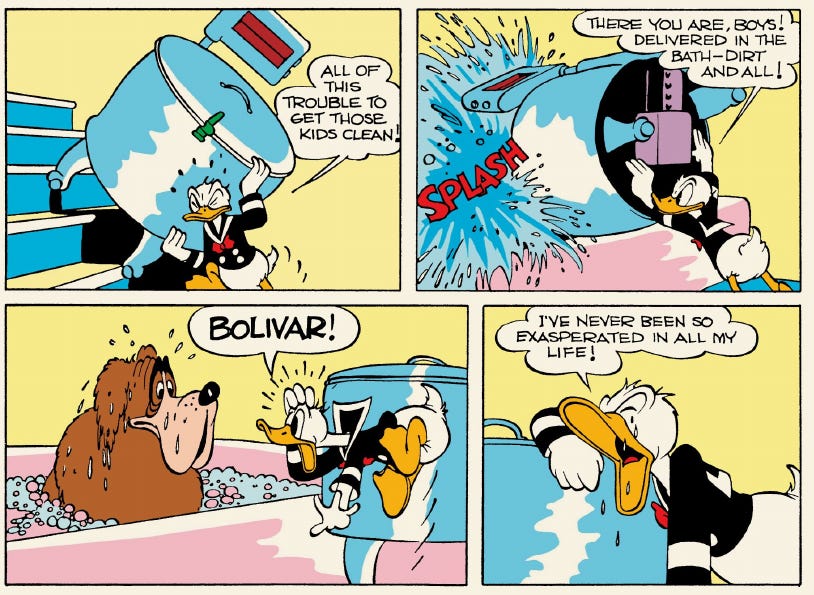
(I really love the use of the very big and very dumb Bolivar as a prop. He never seems to have any idea what’s going on.)
This is a parent who has been ground down by his circumstances, at a moment when the world just seems too damn much that everyday tasks become overwhelming. I think it’s a feeling most people can identify with, but it’s not one you’d expect to see in Donald Duck of all people. Donald’s exasperation ought to be funny and explosive, not exhausted and defeated.
It passes, and Donald recovers his wits only to fall into a trap the nephews set—before having a last-minute stroke of genius.
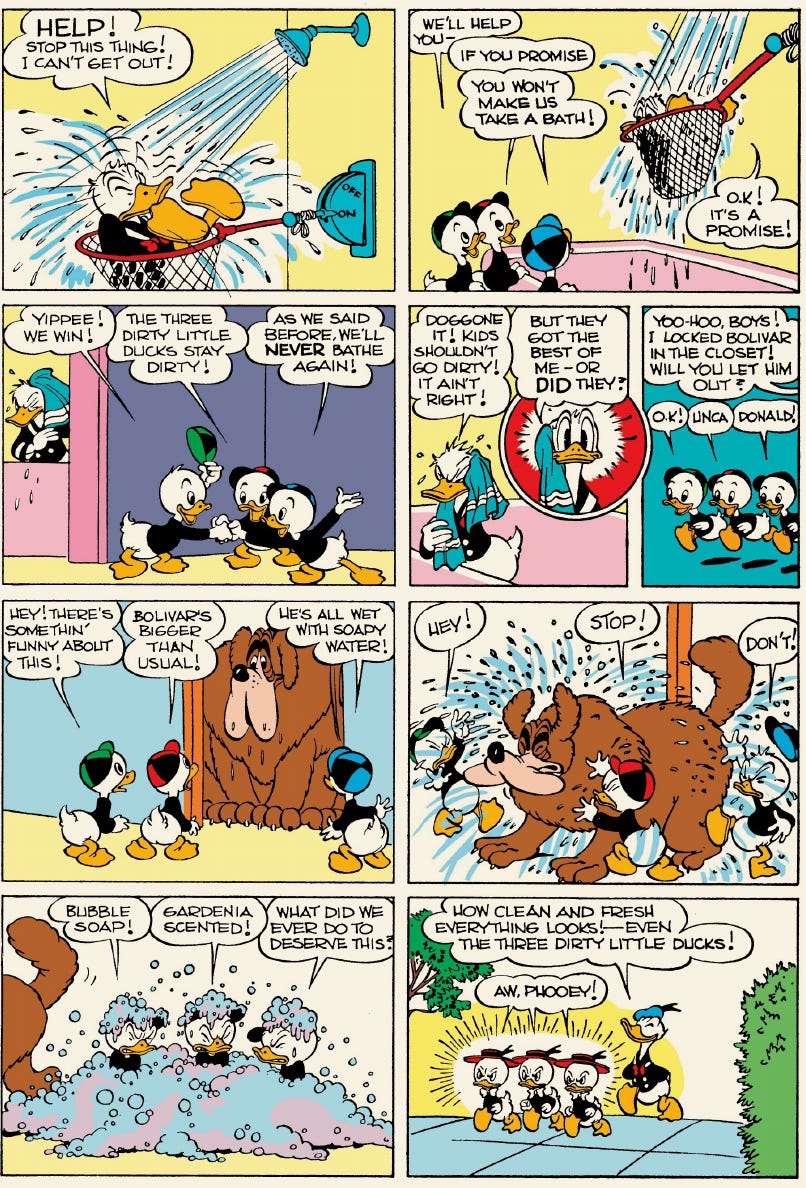
Donald keeps up his good-parent mannerisms—“Yoo-hoo boys!"—while luring them into his trap, and his final observation is less triumphant than it is satisfied, that everything has been put in its proper place, finally. It’s not a battle he sought or wanted.
What of the nephews? They’re mostly a plot device in this story, set up less as antagonists than just another force of the world that Donald has to contend with. Just as Kite Weather required that they be six years old, this story requires that they be ordinary naughty kids for once. To underscore their role here, Barks introduces a friend of theirs, the monosyllabic, near-catatonic Herbert:
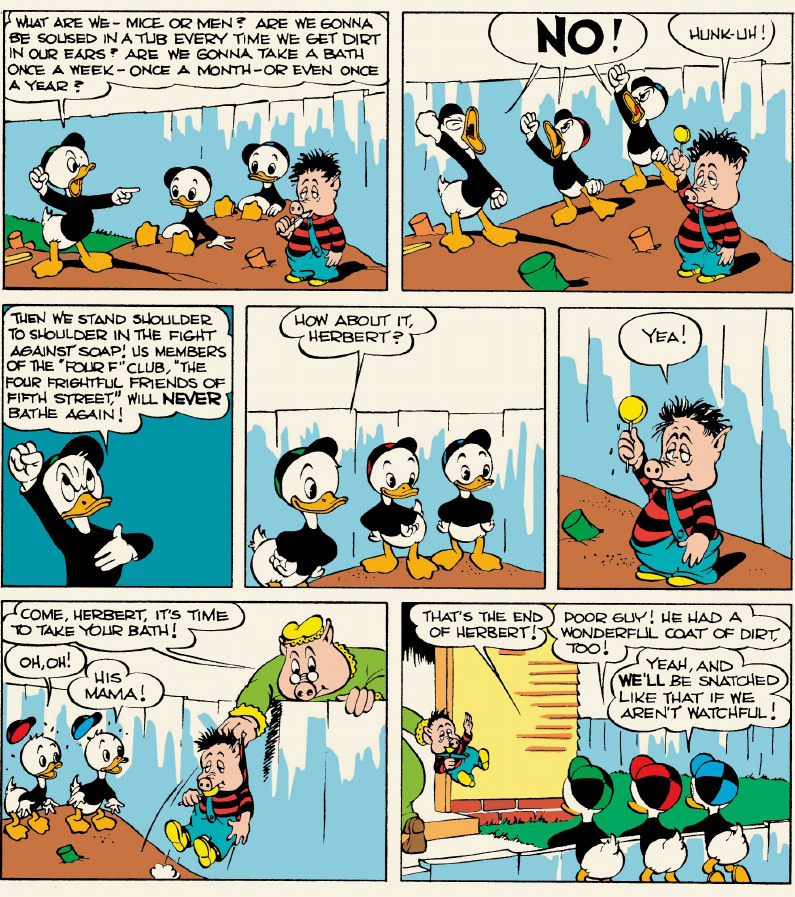
Barks only used Herbert twice, but I find him hilarious. He makes a good contrast to the strong wills of Donald and the nephews, and he’s so insensate that it’s not clear he has any more idea of what’s going on than Bolivar does. His relationship with his mother—the mom says what’s going to happen, and it happens with no resistance from Herbert—is the sort of situation Donald is trying to bring about in his own house. But Donald doesn’t have that kind of maternal power.
What stops this from being a Donald-vs-the-nephews story is that they aren’t playing the same game. The nephews are “just kids” for once (Herbert’s presence underlines that), and Donald isn’t setting himself up in competition with them. The nephews don’t know what they’re putting him through. His anguish is private.
Barks didn’t revisit this theme too often, probably because the pathos and the comedic elements don’t mesh well. The slapstick holds it together here, but the question of Donald’s sincerity ultimately muddles your sense of him and dampens your sense of just how invested Donald is. What Barks did take from this story, however, was that moment of sheer exasperation, and he put it to great use after this: Donald as a single man under siege by the world.