

Donald Duck and Surveillance: Eyes in the Dark
Carl Barks takes on spy technology

Eyes in the Dark (WDC&S #60, August 1945) is a blessed return to ten-page comic stories after two uncomfortably cramped eight-pagers, but Barks choose to stick with the denser, three-panels-per-row format, so the cramped feeling remains, just at greater length. Moreover, the basic idea here is simple enough that it causes the story to feel stretched. Unlike the remarkable Days at the Lazy K the previous month, the material here does not need this much sequencing. The most intringuing parts of the story are not its core theme and plot but the decorations, particularly the looming presence of radar as surveillance technology.
The story begins with a bit too much of the nephews being unable to figure out how Donald is tracking them when they sneak off to play. It turns out that Donald has built his own little panopticon in the form of a radar set:
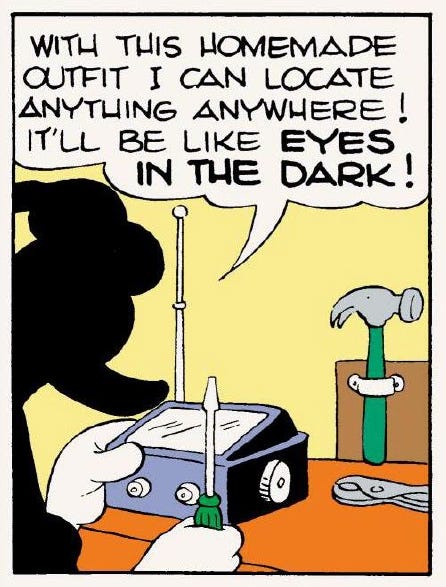
This story sees Donald back as a fairly responsible parent in a definitively adult and domestic role, trying to get the nephews to do chores when they’d rather play. The nephews, in turn, are a bit “naughty” but also annoyed with him fooling around with gadgets while they’re stuck with the chores. It’s a halfway point between Donald-as-troublemaker and Donald-as-conscientious-parent. He’s not a particularly great parent, but he is nonetheless a parent.
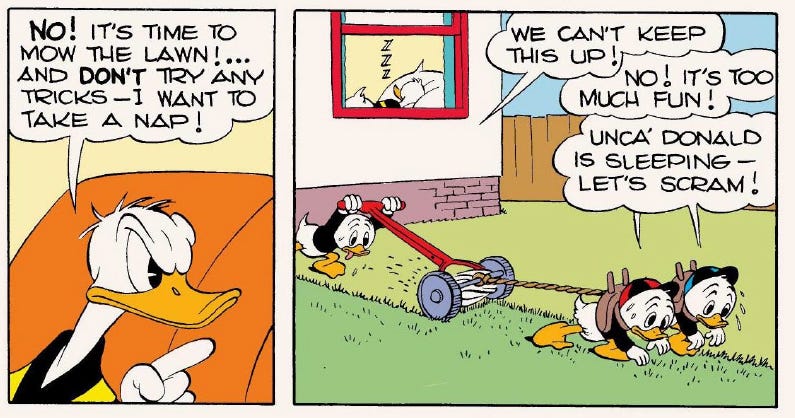
In fact, he’s a pretty bad one. He gives them increasingly back-breaking labor while he naps, like this over-the-top lawnmower gag:
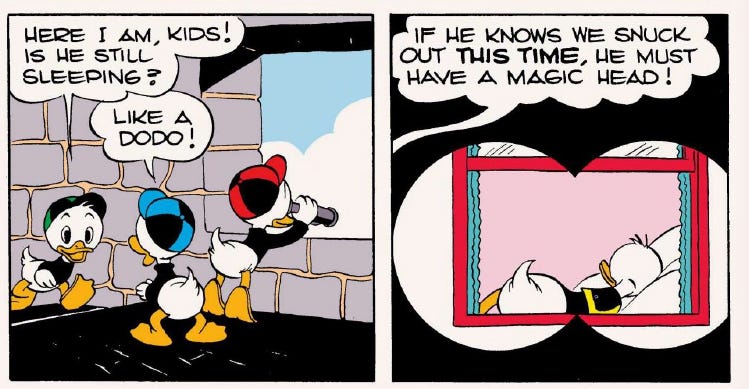
The nephews have technology too. They use binoculars to confirm Donald is asleep (though he is actually awake, watching the radar).
So he catches them time and time again, until the nephews peek into the basement and figure out what he’s doing:
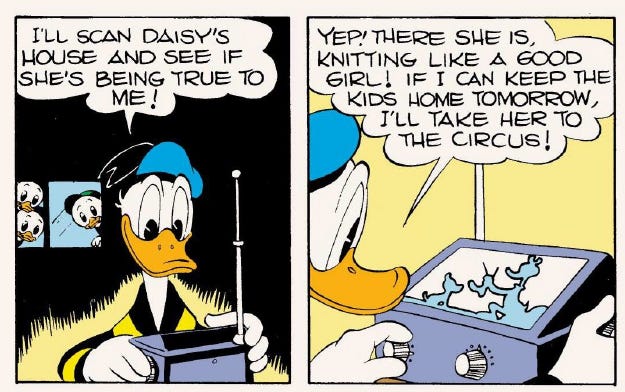
Donald’s surveillance operation is getting a bit out of control here, and it would have been interesting to see his spying on Daisy come to a head, since Daisy will always win once she starts appearing in Barks’s comics. Here, though, it’s just another device to show how Donald is offloading work onto the kids so he can do whatever he wants.
The nephews set up a trick display, constructing figures that look like them in silhouette. When he makes the discovery, he’s infuriated:
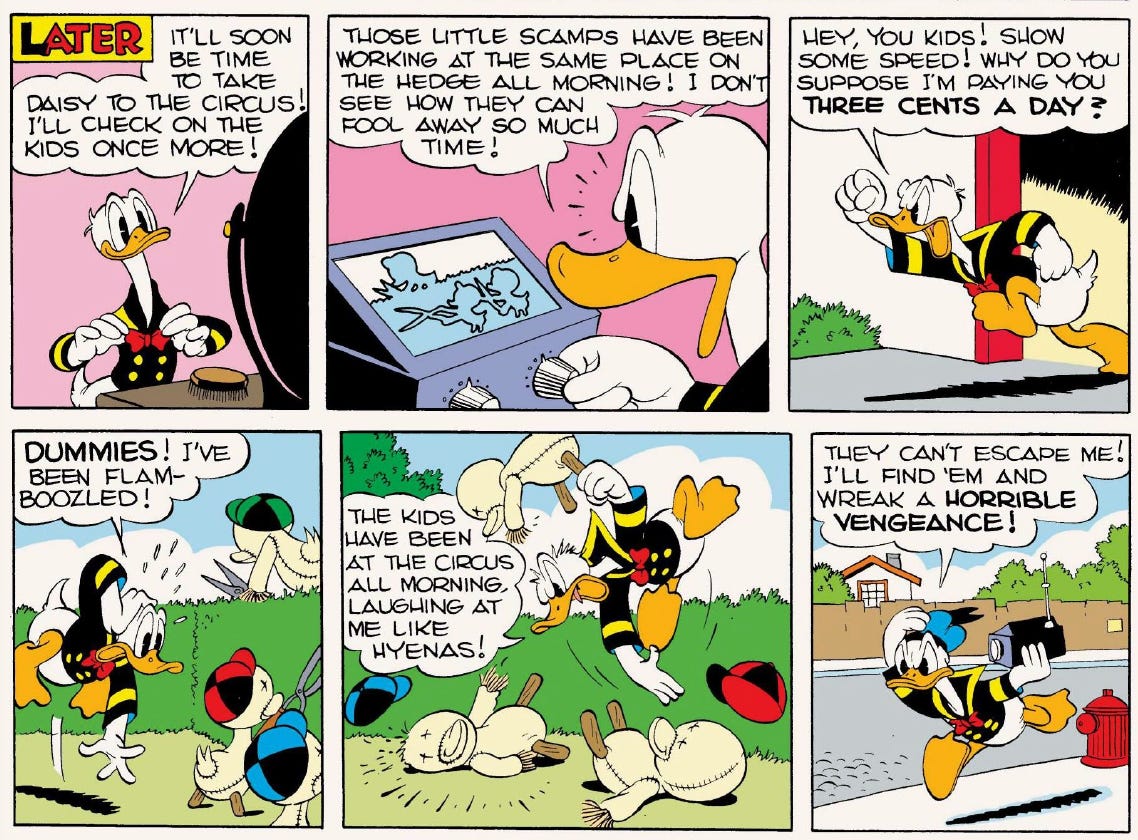
A few things bear ention. First, shadows and silhouettes have been prominent throughout the story, broadly suggesting unreliability and sneakiness, as with this panel earlier:
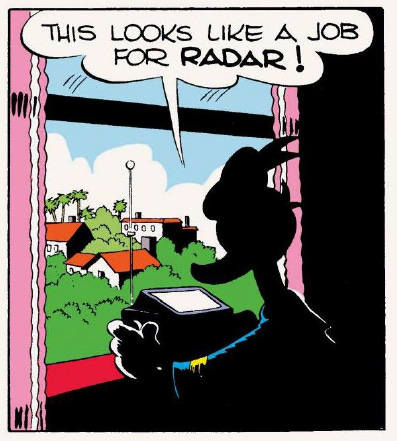
Second, that radar box shows up everywhere—powerful but unreliable. Donald’s hubris is usually focused on his own skills, but here it’s located in his arrogant faith in the technology he’s chosen to use.
Third, the smaller panels do mute Donald’s own emotional reactions. He’s not quite as broad here as he has been in past battles with the nephews, where his going ballistic loomed large on the page. The dense panels contribute a certain dehumanizing effect that fits with the technological theme.
Donald finds the nephews at the circus, where they manage to turn the tables on him with the radar several more times.
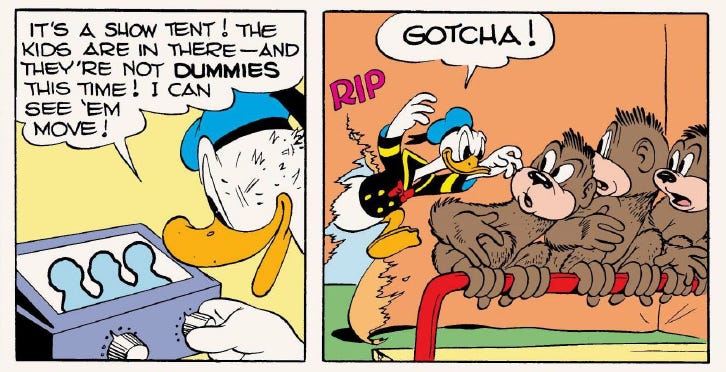
The gag is a bit tired because by this point Donald has learned the radar is unreliable, and we don’t need to see him learn his lesson so directly this many times. That said, the whole circus sequence feels a bit tacked on, as though this actually had started as an eight-page story before Barks was told the format was going back to ten.
While it’s funny to see the monkeys torture Donald, it does come out of nowhere.
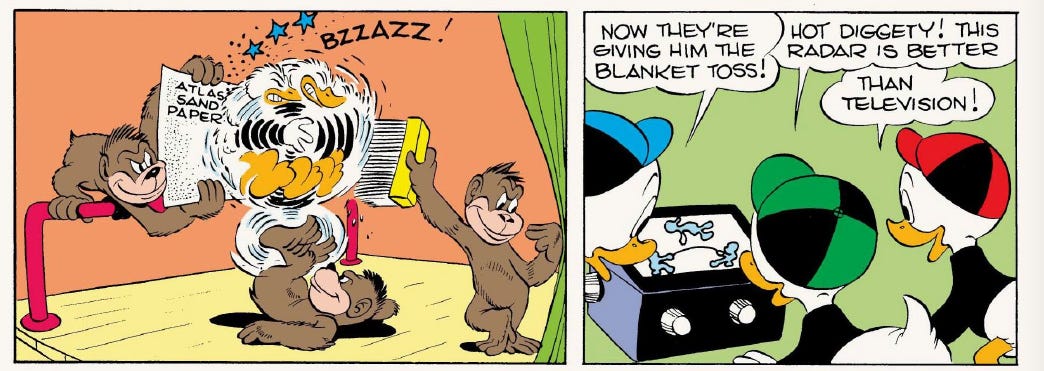
The comparison to television more or less speaks for itself with regard to spectacle and voyeurism, echoing Barks’s more focused comment on the subject in Camera Crazy, where the technology was specifically used to make money:

Here, it’s just a side note, and an indication of the general disorganization of the story. Donald flees the circus, leaving the monkeys, bizarrely, to mete out final punishment to the nephews:
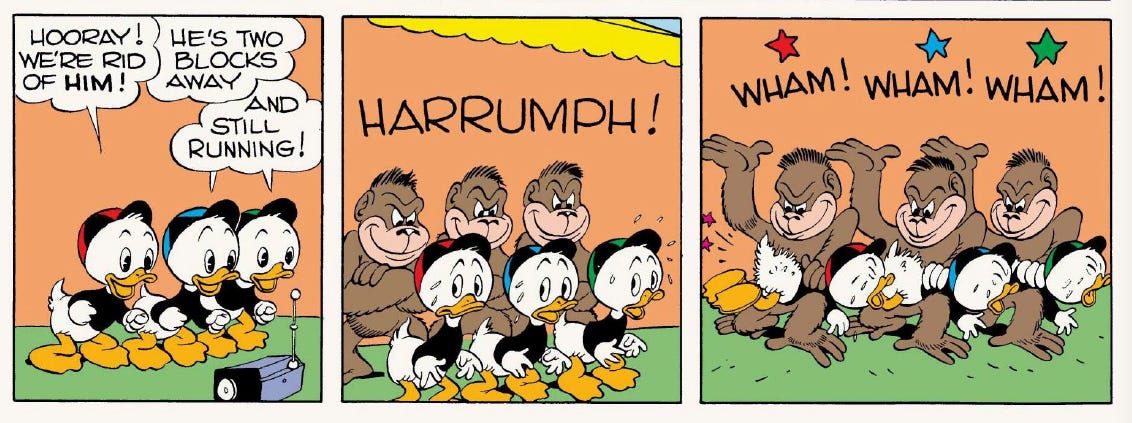
Perhaps this is some comeuppance to the nephews for their misbehavior, or perhaps it’s a final shift in protagonist-role to them, but it doesn’t make any thematic sense. The monkeys have no clue what’s going on, so what even are they doing other than attacking everyone indiscriminately? Perhaps the presence—still!—of that radar box in the left frame indicates that technology indicts all of humanity, but that’s a reach.
We haven’t seen Donald be such a bad parent as a parent before. When he was at his worst with the nephews before, he was portrayed as their equal, not their superior.
Barks’s take on technology is what you would expect from him: it’s unreliable, people put too much faith in it, it brings out bad things in people. Yet unlike most Luddite-styled technology parables, Barks keeps the technology roughly neutral and putting the fault with Donald’s overconfidence in it. For all the trouble it facilitates, Barks doesn’t leave you with the impression that radar is bad—at worst, it’s troublesome.
That in turn gets back to Barks’s genuine invariants: the dismal nature of humanity and the overpowering vagaries of fate. Those two themes are so powerful that they tend to downplay any specific aspects of life as being particularly noxious. Unlike Schopenhauer, who found reason to be petulant in all sorts of little irritants which he inflated to leviathan-size, Barks kept his pessimism quite pure and focused, rarely succumbing to paint any particular aspect of life as intrinsically bad rather than as just another vehicle for those two themes. At times it’s almost stoic.