

Carl Barks's First Donald Duck Story
Carl Barks and the dawn of a cipher

The 64-page Donald Duck Finds Pirate Gold, published in 1942, was Carl Barks’s first full-length Donald Duck story. Barks would go on to become the definitive Donald Duck artist/writer despite readers not even knowing who he was. For years, he would just be identified as the “Good Duck Artist” by a collective of fans who recognized that certain Duck stories were creatively and artistically far above the rest. After being “discovered,” he would go on to incredible fame and repute, though far more in Europe than America—and I hope to get to why that is in later installments of this little series.
Fantagraphics has been republishing Barks’s complete works in what is currently a 28-volume set, but they started with volume 5 and the first volume, containing Pirate Gold, is one of the very last to be published.
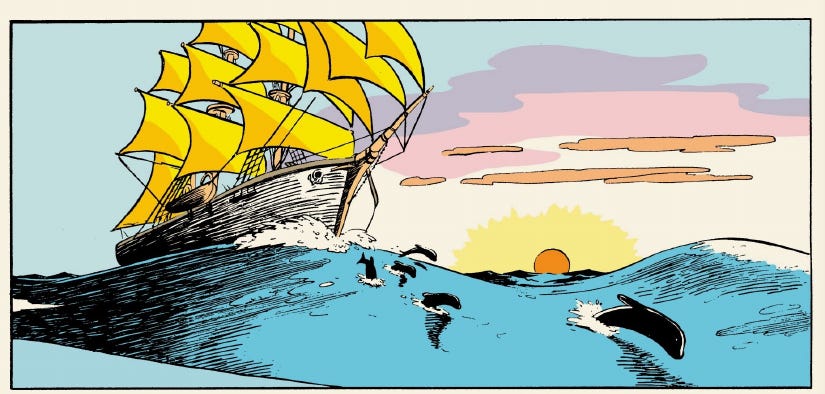
It deserves more notice than that. If it had been the only thing Barks done, Pirate Gold would only be a footnote, since it is an anomalous curio and only shows hints of Barks’s talents. Barks and Jack Hannah split the art duties somewhat awkwardly, it’s somewhat scantily scripted by newspaper strip writer Bob Karp, and long stretches are given over to cute but inessential gags. But in retrospect, certain subtleties emerge that would eventually become perennial obsessions in Barks’s classic work.
The plot is a fairly generic gag-and-adventure plot—its major novelty is that Donald Duck is the star. If not unprecedented (I’m not sure), it was certainly unusual for the irascible, incomprehensible figure of frustration and rage to be put in as the protagonist of an adventure. Unlike Mickey Mouse’s serialized newspaper strip, the daily Donald Duck newspaper strip had remained gag-a-day, so when its writer Bob Karp rescripted a Mickey/Donald/Goofy adventure to be the Duck-only Pirate Gold, Barks and Hannah had to figure out how to repurpose Donald.
The result is tentative. Donald and the nephews run a quiet domestic seafood joint and get pulled into the action by the bossy pirate parrot Yellow Beak and antagonist Black Pete, both of whom are in a chase for the same buried treasure.
Donald himself is most present in the initial setup. On the first page, he and his nephews lose their fishing nets in a violent sea storm, threatening their business and well-being. It has nothing to do with pirate gold beyond providing motivation, but the threats first to his family’s lives and then to their financial solvency look to take more out of Donald than the subsequent adventure proper does.
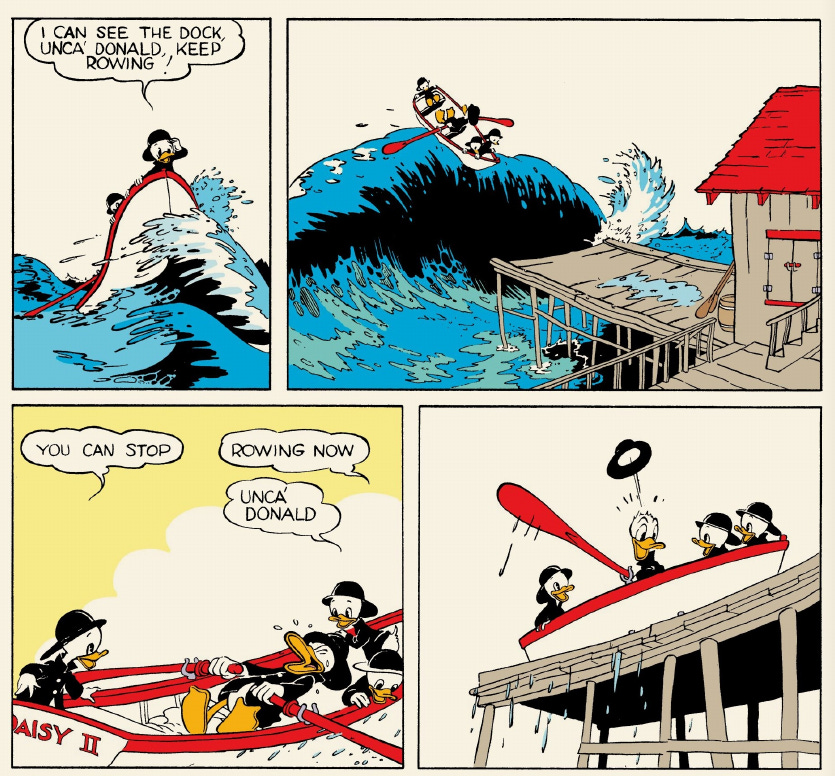
The ducks’ motivation, one of the most representative aspects of Barks’s future work, is that they’re broke and need money. Donald’s (and later Uncle Scrooge’s) relationship to money is a central fulcrum of Barks’s work and a big part of why it has the resonance that it does then and now.
Barks drew a few pages of the opening section and the entire middle of the story; Disney artist Jack Hannah did the rest of the opening and the entire last third, containing the story’s climax on the treasure island. Hannah’s work is broader and rougher, closer to the irascible and excitable Donald of cartoons, yet he has one remarkable (if anomalous) longshot where the hand of fate weighs on the ducks as they face financial ruin:
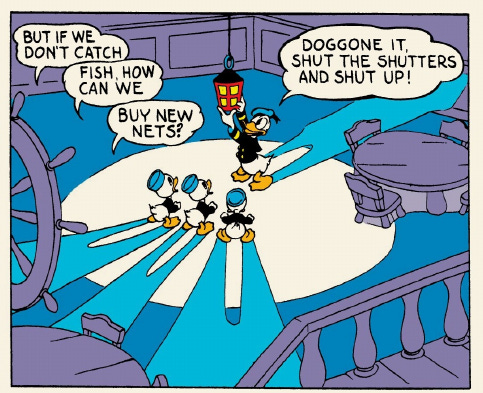
Dramatically and compositionally, this gothic panel stands out, but the faces are too vague, the shadows are poor, and the gothic atmosphere too forced and jarring. The longshot, striking as it is, also masks an apparent inability to draw the ducks’ faces in a manner appropriate to the mood.
Barks’s experiments are more successful and skillful. In the opening sequence, he brings new emotion to Donald’s face as anxious, competent, and burdened, good in a crisis but flawed in most other regards and hounded by mundane failures. Much of the next decade would be spent integrating this new Donald with other versions—or at least deploying him more savvily.
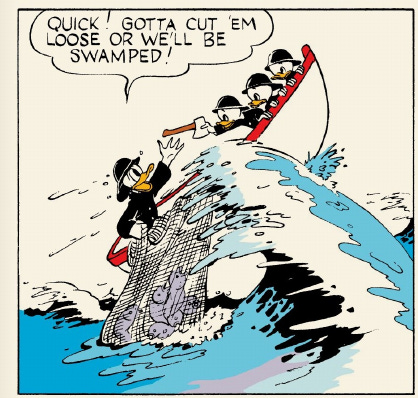
Barks also has fun with Black Pete’s antics on the boat, already comfortable with not-especially-smart and not-especially-scary villains. He hasn’t figured out what to do with Huey, Dewey, and Louie yet, one mind in three bodies, sticking with their portrayal in Karp and Al Taliaferro’s Donald Duck comic strip.
Conceptually, the milestone of Pirate Gold was showing the extensibility of Donald Duck. Mickey Mouse had already been turned into a serious adventurer and detective in Floyd Gottfredson’s 1930s newspaper comics, and Gottfredson’s portrayal of Mickey’s multiple failed suicide attempts in 1930 is arguably a limit case that has never been surpassed, possibly because no one would ever consider the idea—except Disney himself:
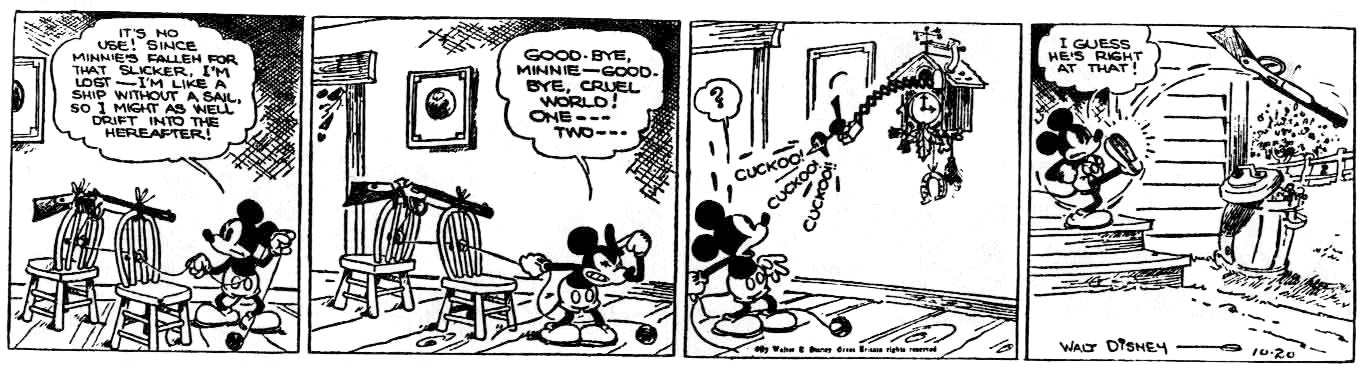
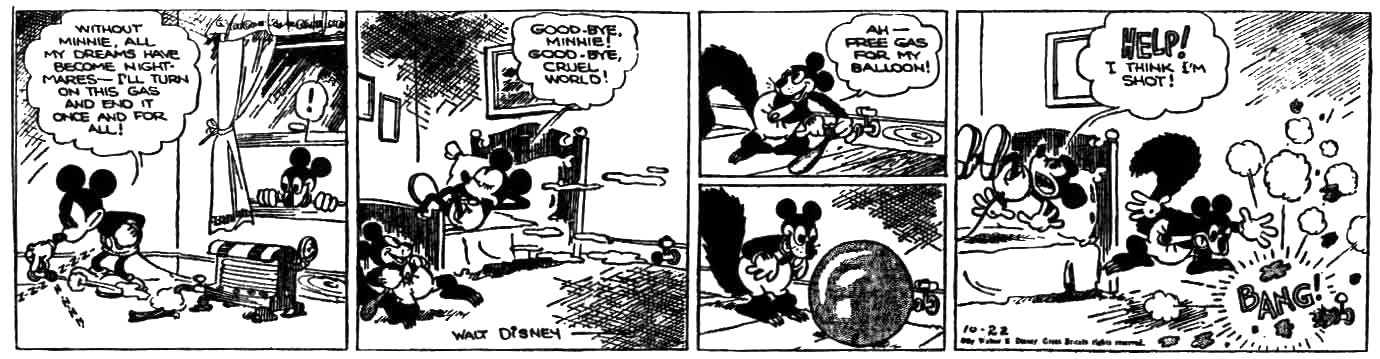
[Disney] would make suggestions every once in a while. One that I’ll never forget, and which I still don’t understand was when he said, ‘Why don’t you do a continuity of Mickey trying to commit suicide?’ So I said, ‘Walt! You’re kidding!’ He replied, ‘No, I’m not kidding. I think you could get a lot of funny stuff out of that.’ I said, ‘Gee whiz, Walt. I don’t know. What do you think the Syndicate will think of it? What do you think the editors will think? And the readers?’ He said, ‘I think it will be funny. Go ahead and do it.’ So I did, oh, maybe ten days of Mickey trying to commit suicide—jumping off bridges, trying to hang himself… I don’t remember all the details. But strangely enough, the Syndicate didn’t object. We didn’t hear anything from the editors, and Walt said, ‘See? It was funny. I told you it would be.’
—Floyd Gottfredson
Nothing matters except the end result, the joke in this case. Reducing characters to extensible and repurposeable icons (or brands), throwing out archaic concepts like psychology and consistency—that idea originated with Disney himself. (Disney even did this to his own name and persona.)
Compared to Disney characters, Bugs Bunny or Daffy Duck or Betty Boop are far more constant in their applications. That flexibility is what allows for the insanity of something like Kingdom Hearts. For all the different versions of Donald across America and Europe, I have never seen anything anywhere near as jarring as this version of Donald from Kingdom Hearts:
![I'm crying at Donald's lecture on why the world order must be maintained [Media] : r/KingdomHearts](https://substackcdn.com/image/fetch/$s_!6TYQ!,f_auto,q_auto:good,fl_progressive:steep/https%3A%2F%2Fsubstack-post-media.s3.amazonaws.com%2Fpublic%2Fimages%2F0faaa771-07b6-4e7a-b8bf-1db54c601f34_500x389.jpeg "I'm crying at Donald's lecture on why the world order must be maintained [Media] : r/KingdomHearts")
It’s extreme even by Disney standards, but it does at least make a smidge more sense than if it were Chuck Jones characters being shunted into Japanese fantasy and JRPG settings. (Just a smidge, though.)
But the roots of this crazy divergence lie in Pirate Gold.