

Donald Duck the Faceless: The Duck in the Iron Pants
Carl Barks on hats and masks

I spent the last post talking about Donald’s face, and here we have a story that hides it—in the opening panel no less. The Duck in the Iron Pants (WDC&S #41, February 1944) is another snow story, another slapstick story, but also a strange variation on conflict between Donald and the nephews. Seemingly fluffy, it works a much deeper symbolism than Snow Fun: masks, costumes, and faces.
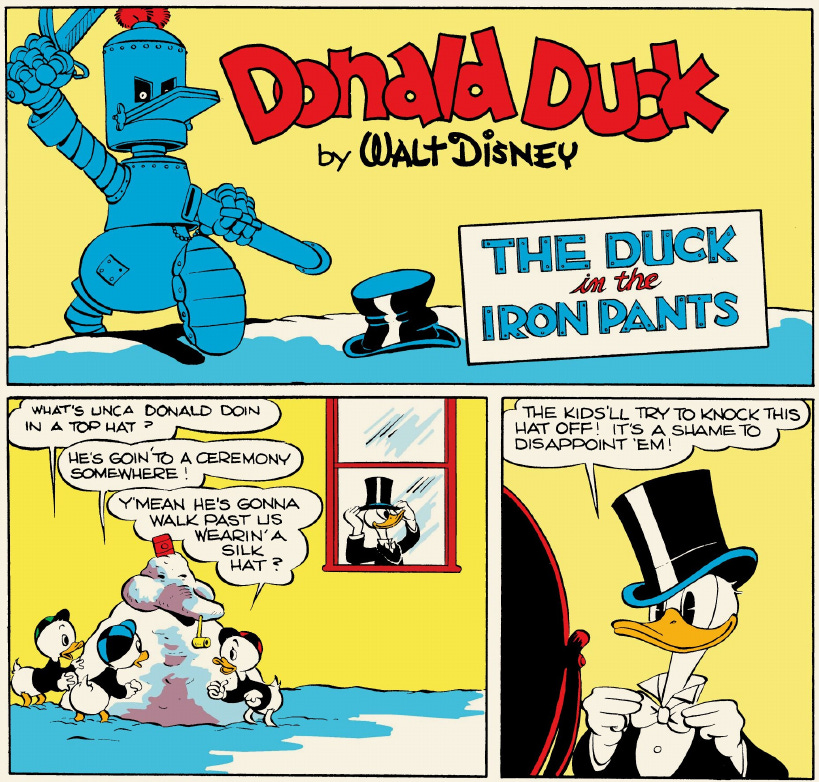
What is that thing? It looks a bit like a robot Donald. Moreover, the story starts off with Donald in a different guise, that of some kind of high-society man, so we’ve got two uncommon, opposed heads for Donald, one unfamiliar and one completely obscured, and no connecting link between them, other than the battered top hat in the title panel. Donald’s ever-present sailor hat does not appear anywhere in the story, and that fundamentally is what the story is about: Donald actually not being Donald.
Wherever Donald’s going, it’s never revealed, but both the nephews and Donald are fixated on the hat specifically. They’re fixated on it, and Donald knows they’re fixated on it. It also provides the threadbare excuse for why the nephews initiate the antagonism this time. They tend to be the reasonable ones, but that hat evidently was too much for them.
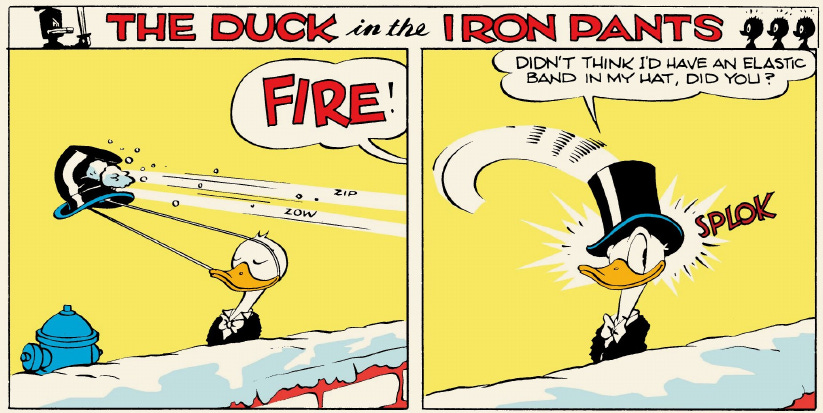
Donald’s defense is literally a mechanism to keep the hat on. As long as he has the symbol, he is polished, clever, and unflappable, very much the gentleman role he’s suddenly taken on. When he returns, the nephews try a second attack:
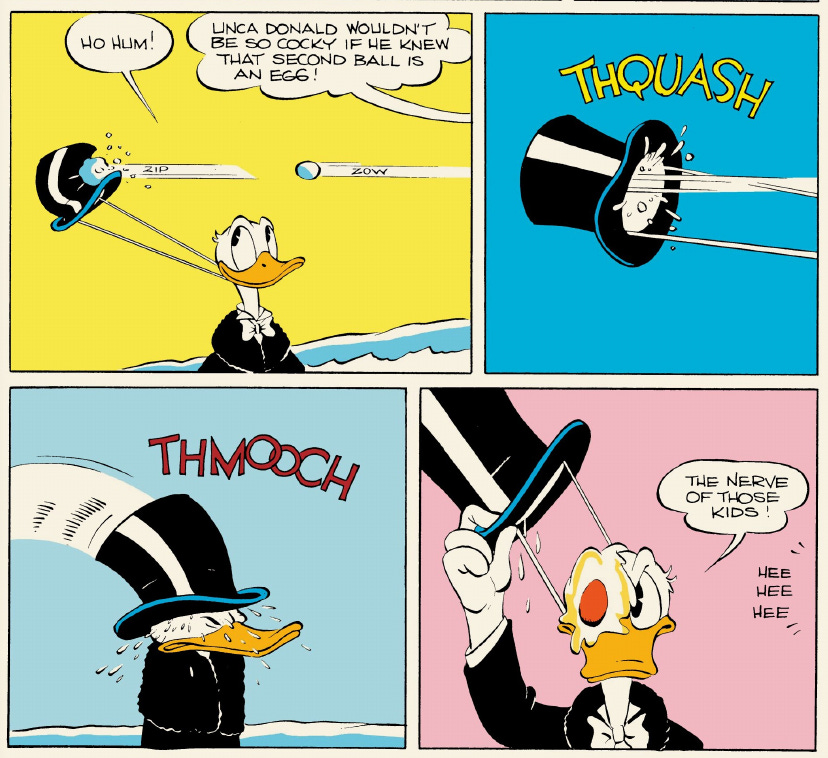
Note what happens here: Donald’s mechanism backfires. The egg cracks inside the hat and attacks him from within, forcing Donald himself to remove the hat.
That’s the last we see of the hat in the story. For the second third, Donald is hatless and furious. Any trace of composure has disappeared, and he’s hellbent on violence. His bare head makes him seem especially vulnerable, as he launches himself headlong at the nephews’ snow fort and gets battered repeatedly.
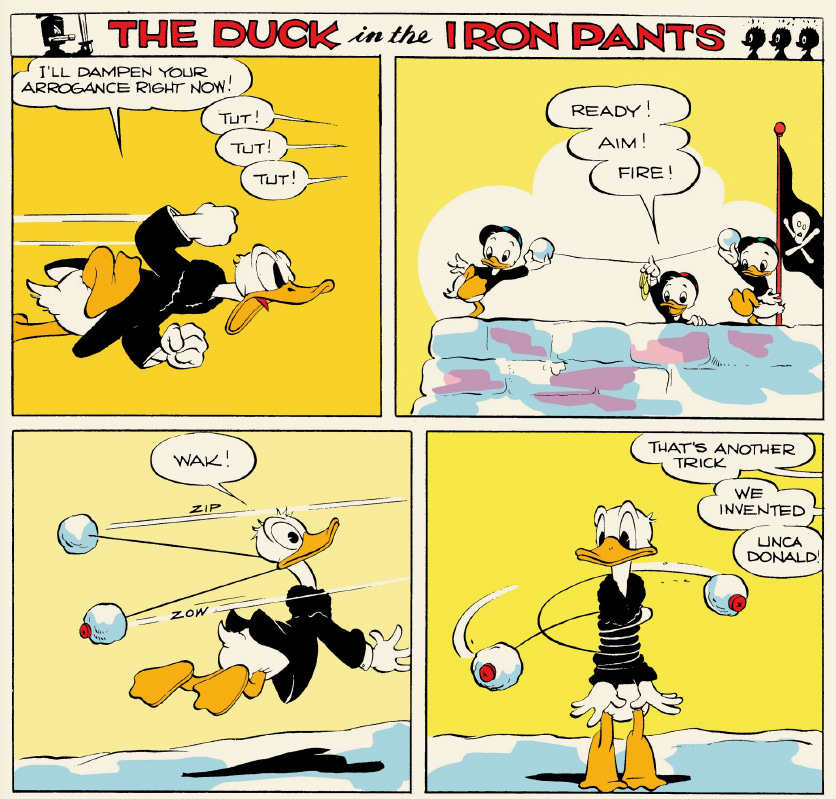
Donald’s white tie has vanished as well, and we see more of his rear end. He’s been emotionally exposed. He disappears inside the house for a while, and the nephews get very anxious, seemingly realizing that they’ve crossed a line somehow. That hat was charged with meaning.
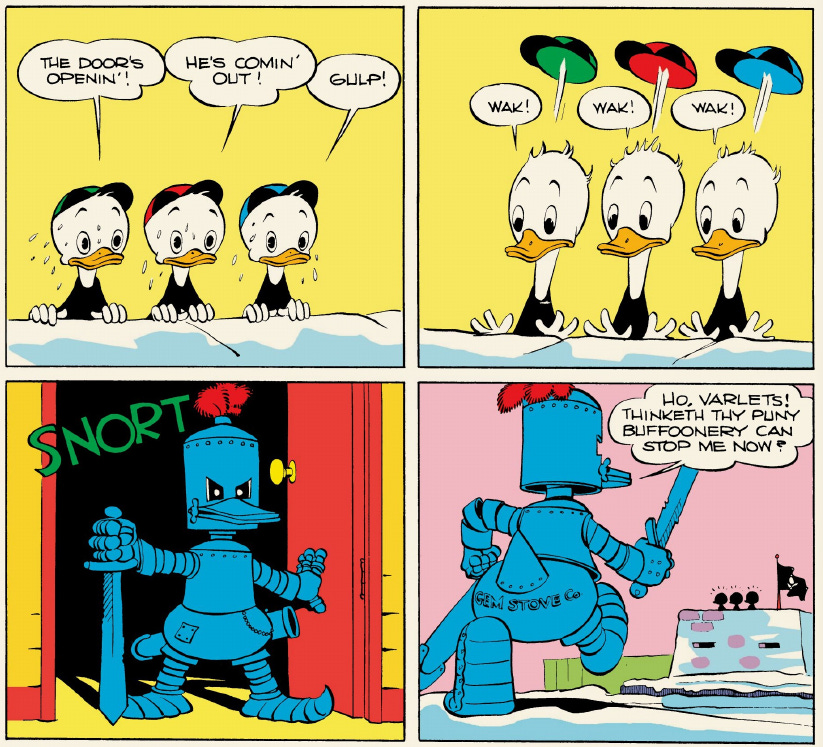
When Donald emerges, he’s improvised a sword and suit of armor, and he’s barely recognizable as Donald. The eyes and beak are fixed in a permanent triumphant smirk (Barks plays around with angles a little to get some variation out of it). There’s no wiping this smile off his “face.” Nothing stops him, not the nephews’ snowball “Gatling gun,” not their moat, not anything.
Donald himself embraces his new diabolical role as much as he did his high society persona earlier.
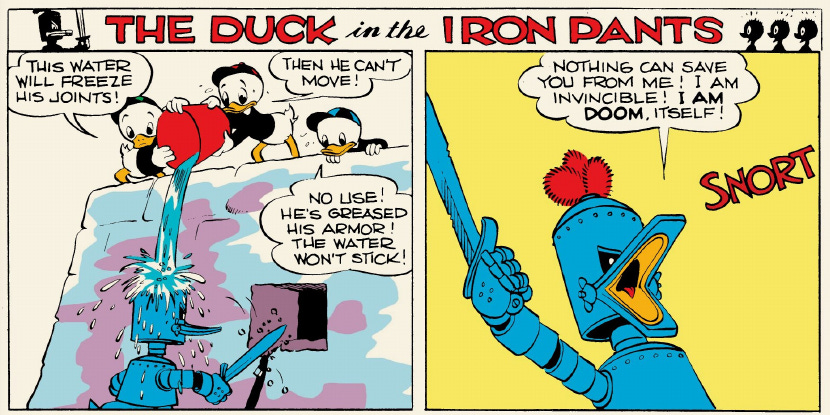
In a different context, this would read as puffed-up arrogance from Donald, but here Donald appears to have genuinely taken on the mask (and pants) he is wearing. What would reveal his pretense—his actual face—is hidden. He looks genuinely possessed. Thematically, Donald truly is invincible as long as he’s wearing this iron face, just as he was perfectly polished as long as he wore the top hat.
Only removing the mask will work, so once more, the nephews mount an interior attack. Dewey (or maybe Huey or Louie?) heats his rear end with a blowtorch, burning him inside the suit.
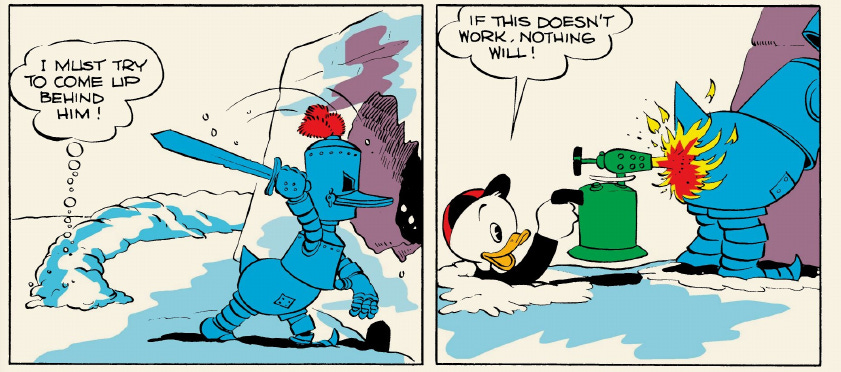
Not only does this get him out of the suit, but his suit literally self-destructs and blows up from within.
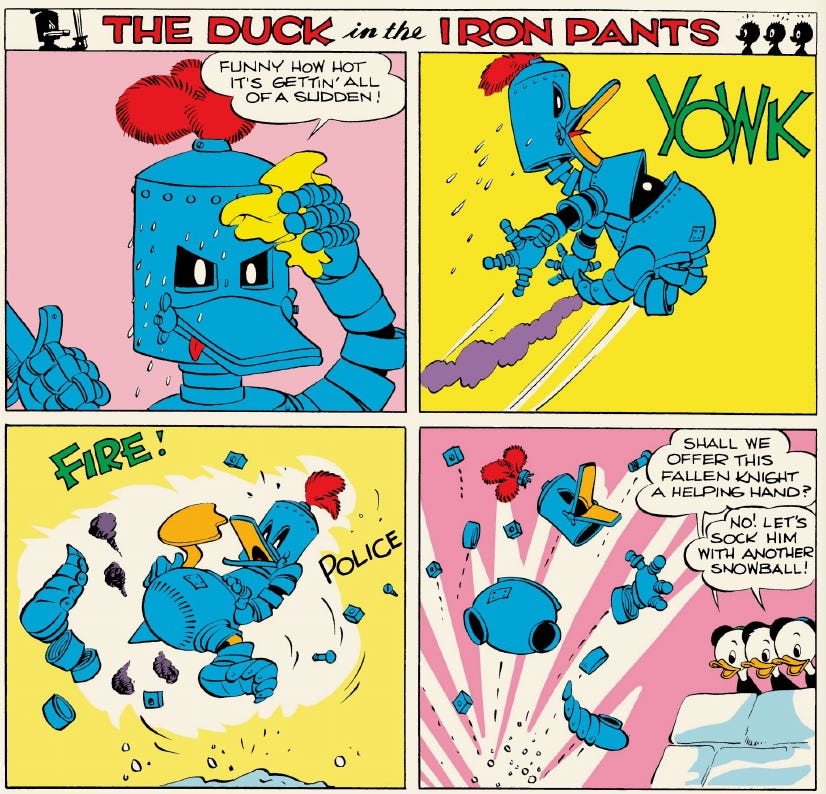
Donald’s face penetrates through the mask, changing its previously fixed expression to surprise and agony, as he’s once more exposed. Fantagraphics faithfully repeats the original colorist’s gruesome “mistake” of coloring the inner beak orange in the last panel, making it look like Donald has literally been decapitated and disemboweled. We don’t even see Donald himself, in the climax, only the destroyed facade.
The denouement is Donald, still hatless, returned to his bruised and petty self, waiting to discipline the nephews as a parental figure.
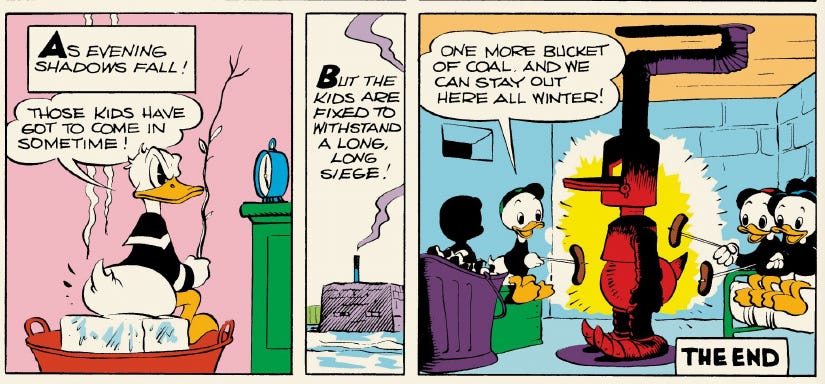
The nephews, in turn have turned his armor into a provider of heat and food, so even Donald’s parental control is undermined by the capabilities of his “mask.” It was what was inside the armor—Donald’s face, and Donald’s soul—that was weak, not the outside.
I’m struck by just how elegant and consistent the symbolism is. I never noticed it until writing this commentary, since at the surface level it’s a conventional and somewhat backward-looking story, but by intuition and craft, Barks brought it to a considerably higher level.
If Donald’s soul is located in his face, then hiding his face changes his soul. Charles Schulz discovered this in one of his greatest and darkest continuities ever, the “Mr. Sack” sequence from 1973, where Charlie Brown discovers that wearing a sack on his head frees him from all baggage and lets him become an inspiring leader:
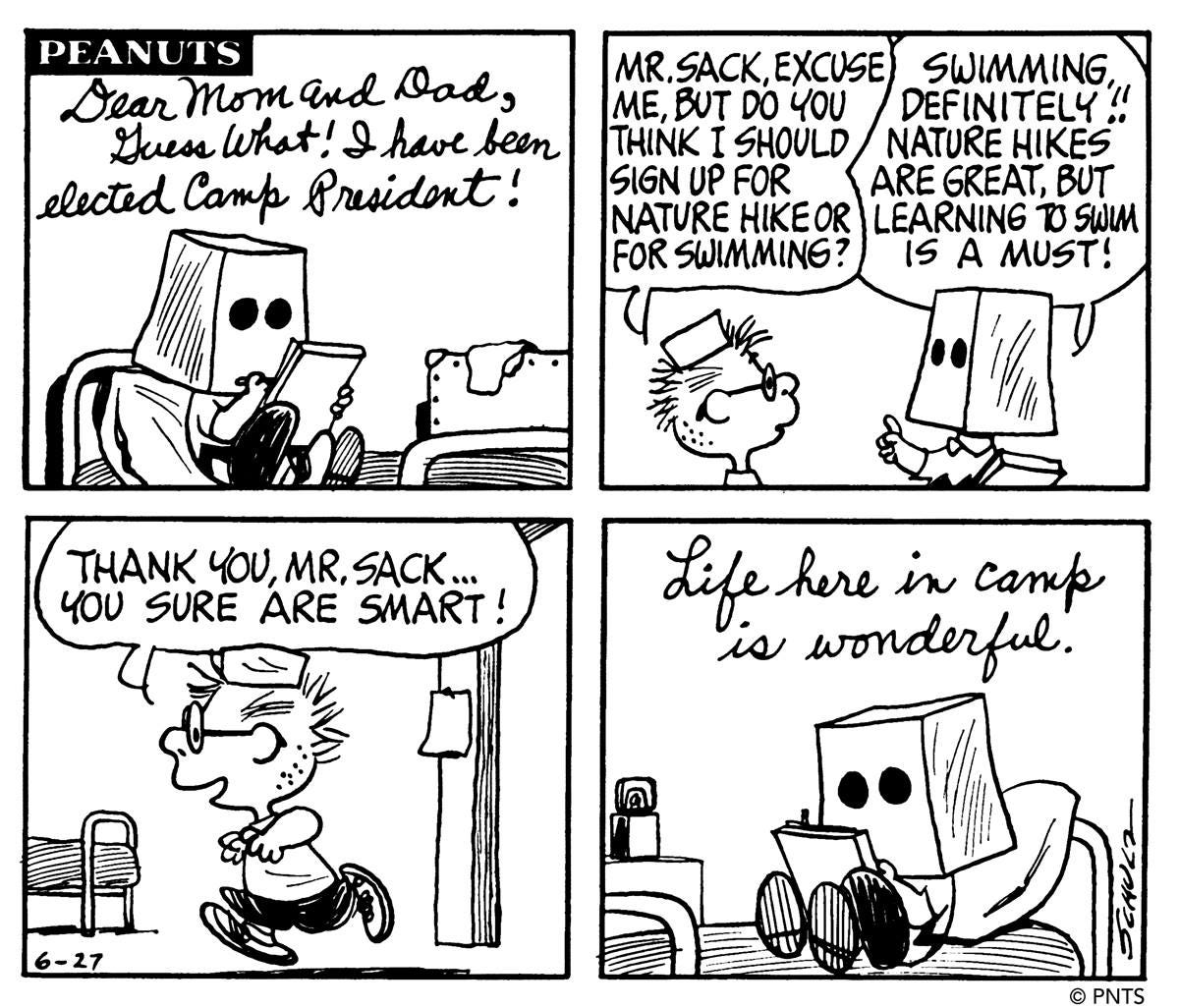
It did take Schulz 23 years of Peanuts to get to this conceit, while Barks came up with it within a year of beginning his comics tenure. That’s not a rip on Schulz, just an observation that Schulz was more unproblematically loyal to the faces of his characters (save for the special case of Snoopy). The paradox is that Donald was already so flexible a character, what did it mean for him to put on a mask? It meant, simply, to hide his face.