

Donald Duck the Master: Master Ice Fisher
Carl Barks on overengineering and the idea of mastery

Master Ice Fisher (WDC&S 66, March 1946) is another refinement story, following the trend of Barks taking elements he’d already been working with, recombining them, and deepening them. The results here aren’t exceptional. For one, ice fishing isn’t so momentous a task that Donald’s hubris comes to seem especially consequential. For another, Donald’s hubris isn’t so exaggerated that the story carries the needed punch that later stories would possess.
The story is an early prototype for a formula Barks returned to often, the “brittle mastery” tale, where Donald would start off with virtuosic skill in some domain, only to see his arrogance bring him down, Icarus-style. Master Ice Fisher doesn’t get the formula right, because Donald starts off with questionable confidence and then escalates to more extreme methods, but in the absence of a clear decline, the story has a shambolic and chaotic feeling. Donald’s strategies aren’t coming from a place of skill or logic, just desperation.
There’s a hint of Donald’s puffed-up arrogance early on when he stops the nephews on their way to ice fishing and uncharacteristically elevates his tone: “Whither away, infants, in such mad haste?”
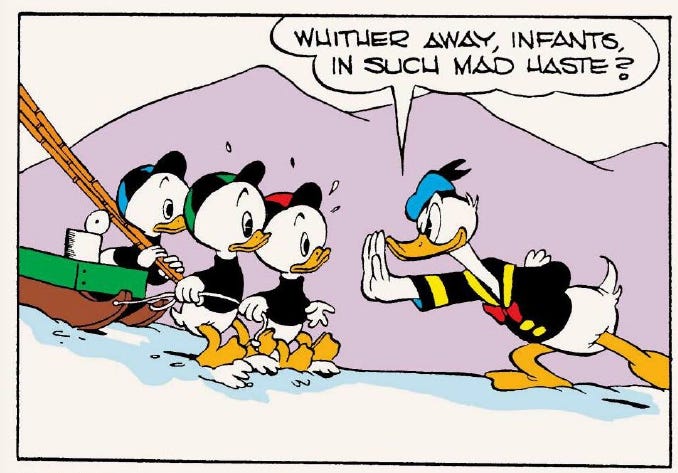
“Whither away” and “mad haste” were both somewhat archaic in Barks’s time, but as far as I can tell, this is not an allusion to anything. Its purpose instead is to set up Donald’s overcomplicated machinations in attempting to catch fish.
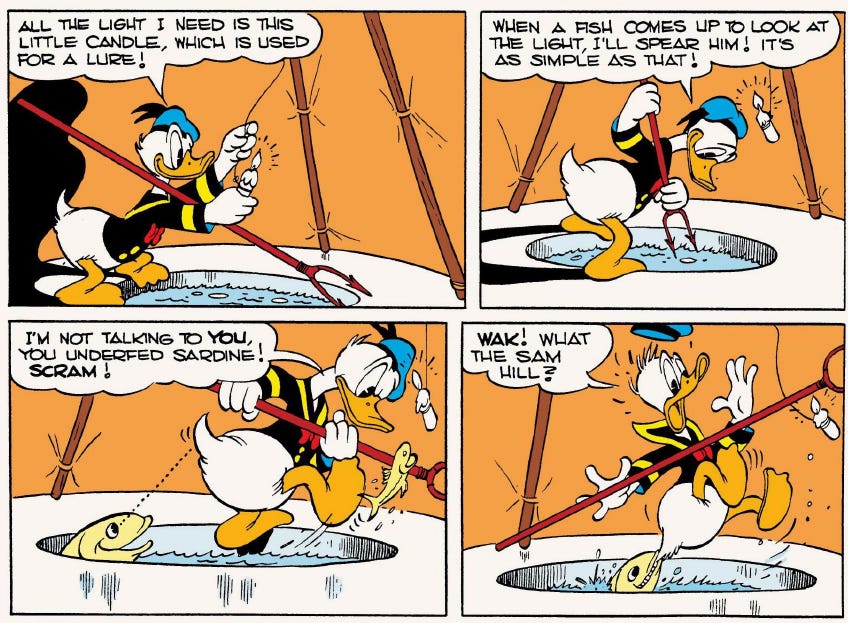
This fish is not some hellion like Singapore Joe the parrot or Farragut the falcon. It’s mischievous, but not sentient or capable of complicted motivations.

The action instead is closer to Donald against nature, with fish responding to stimuli in predictable but unfortunate ways.
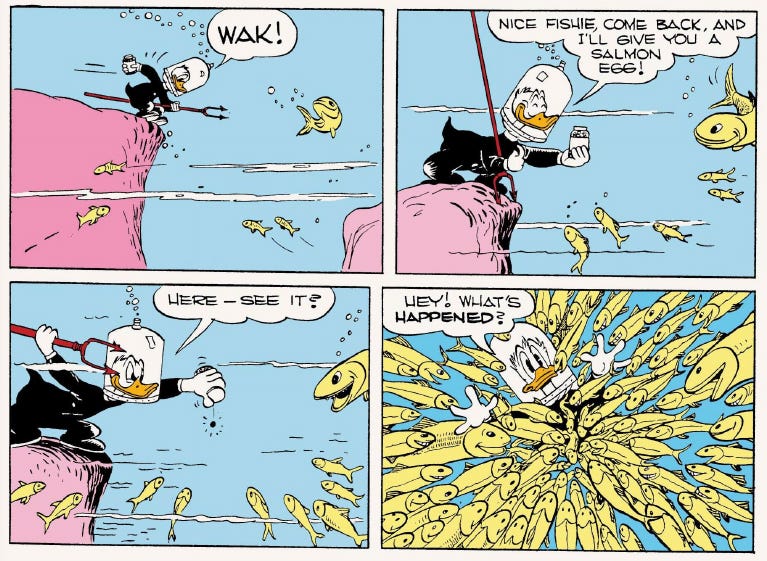
Here’s where the story’s difficulty comes in. In the absence of a clear antagonist, there’s not quite enough to push back on Donald’s ambitions, but his own folly is comparatively mild. The fish attack nearly drowns him, but it’s not the appropriate sort of comeuppance for arrogance.
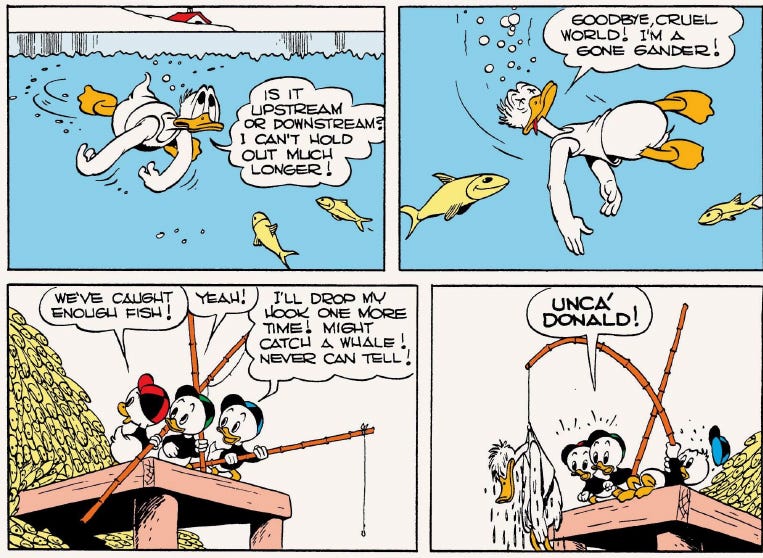
Adding hubristic, genuine skill to the later stories would even the score, since Donald is no longer everyman, but a talented artisan (of something or other) who is begging for his expertise to be challenged.
Without the mastery, Barks instead ups the stakes by having Donald bomb the fish. Armed with a canister of dynamite, he dumps it into his ice hole:
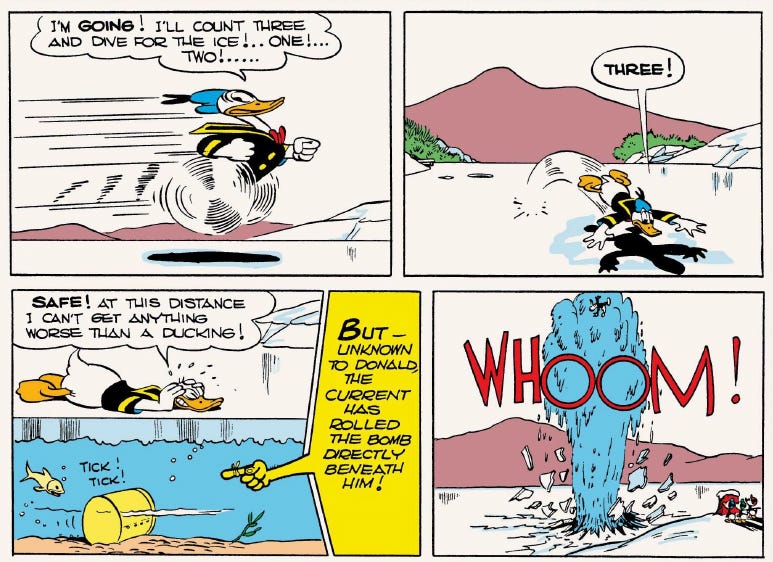
This deus ex machina ups the stakes quite a bit, but it feels too much like artifice. Donald isn’t quite furious enough to have the bomb make sense. The whole thing shatters the lake and necessitates a heroic rescue from the nephews, but by this point the whole “master ice fisher” conceit has gone out the window.
Barks pulls the whole thing in for an effective landing by having the nephews one-up Donald to end the story:
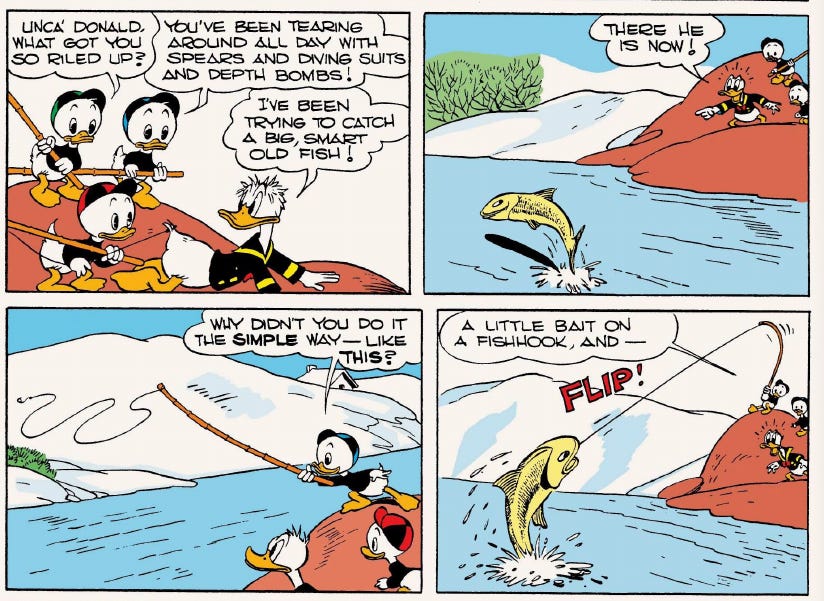
This does work: Donald started by overengineering things, so the “Keep it simple, stupid” message refutes Donald’s initial overcomplication. It’s the stuff in the middle that feels out of place: the bomb hardly failed because it was too complicated; it failed because the idea was dumb and crazy.
The whole story is a test run for the later mastery stories, a structure which Barks grew very comfortable with—even too comfortable. Having Donald master some new domain (demolition, weather, you name it) opened up new possibilities for large-scale sight gags while presenting a very classic formula of pride brought to earth. I suspect that here, Barks wasn’t yet comfortable giving Donald genuine brilliant skill, even at the start, but without that move the structure doesn’t work. Donald’s folly is immediately evident and Barks has to drag out the inevitable consequences.
Instead, Barks switches to a trope that he had already worked with extensively—the antagonistic animal—but it doesn’t gel with the pride theme, which requires that Donald be defeated by his own ambition rather than any clear external force (beyond everpresent fate and fortune).
As one of the weaker stories of this period, its weakness still arises from Barks’s growing strength, which was his rapid refinement of plot and character devices while relentlessly generating monthly stories. The 1946-47 period is the journeyman stage.