

Donald Duck's Eyes: The Mad Chemist
Carl Barks portrays a fugal episode in the atomic age

Continuing on with the theme of Donald’s face being the seat of his soul, we’ve got the first of Barks’s fugal episode stories, where some freak accident turns Donald into a different person. The Mad Chemist (WDC&S #44, May 1944) is probably the weirdest story Barks had done to this point, if only because Donald, as flexible as he is, is replaced with someone identifiably not-Donald for much of the story.
Because it’s not “Donald” in play, Barks’s themes of fate and morality play out differently. If it’s not Donald, the chains of cause-and-effect break down, and the story verges on pure chaos. Donald’s initial cavalier carelessness results not in humiliation or misfortune, but in personality transformation:
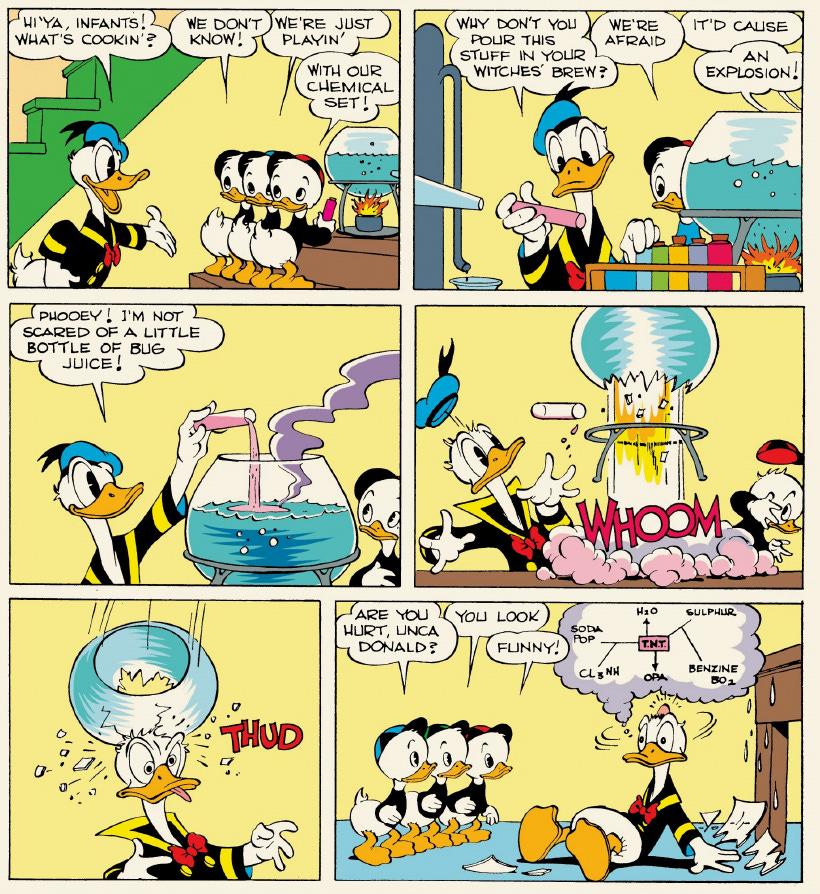
The transformation is immediately signaled with Donald’s eyes when he’s hit on the head. His black pie-cut eyes shrink and turn into little ringed blots. Pie-cut eyes were becoming anachronistic in the 1940s, but Barks cleverly used them not as eyes but as pupils, allowing for several degrees of expression. (Note how the pie-cuts emphasize his focus in the second panel above.)
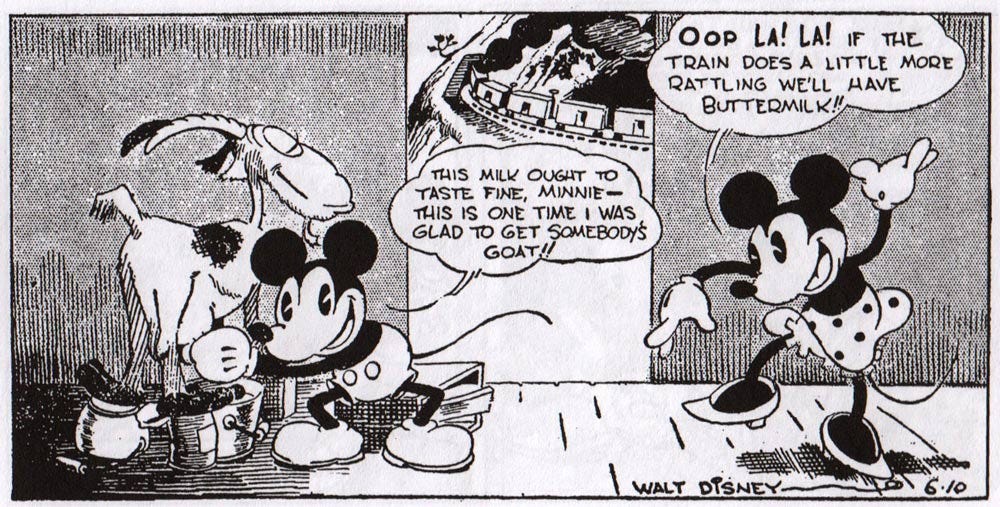
In this ink-blot style, the pie-cuts are nearly obligatory to make the characters look sentient. Donald doesn’t need them, but if you look at Barks’s contemporaries that didn’t use them when drawing Donald, Donald still seems less human without them.
And so here, Donald’s eyes shrink and go circular, he gets a shiny bump on his head, and he is suddenly a genius chemist.
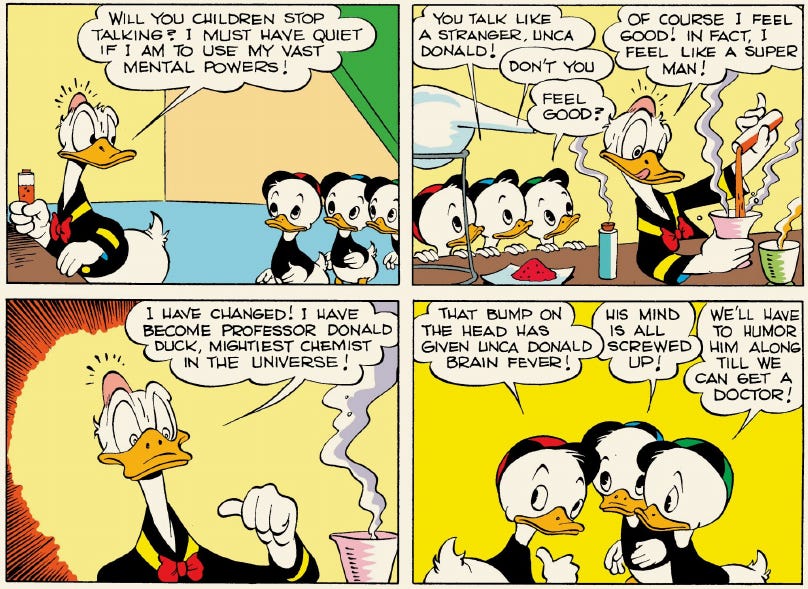
It’s a strange hybrid of a conceit: Donald recognizes the nephews but treats them differently, he takes on a “super man” identity that seems more drawn from comic books than actual science, yet he inexplicably possesses genuine PhD-level knowledge.
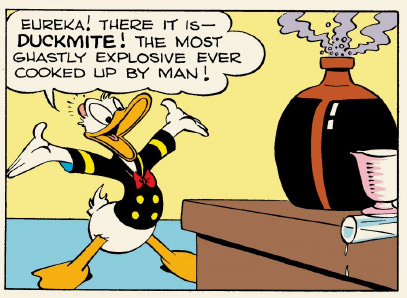
If this were Donald as we know him, there’s no way fate would permit him to succeed without a massive comeuppance. Here, we don’t know. Even stranger, the transformation is inconsistent. After brewing up “Duckmite, the most ghastly explosive ever cooked up by man!”, he reverts to more typical Donaldness when testing it out.
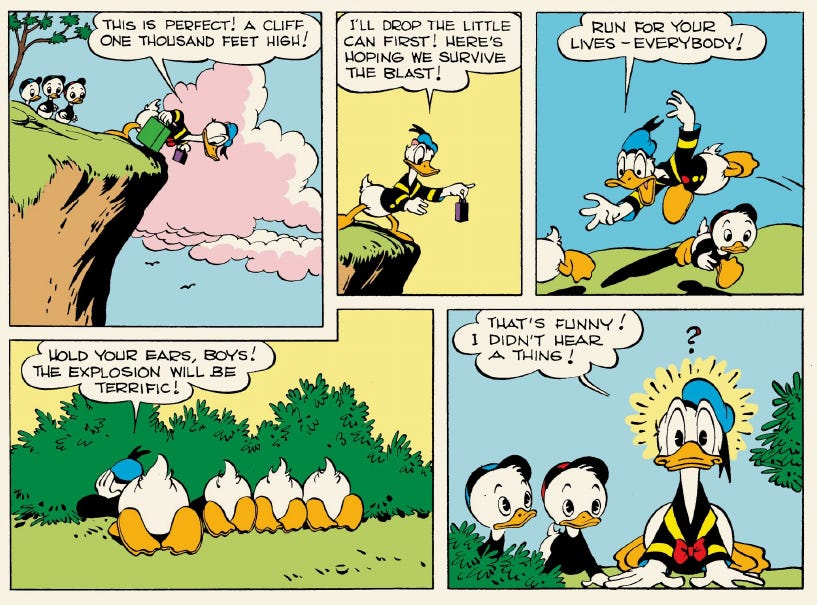
That last panel is Donald as we know him, as though his doubts and confusion have suddenly caused his old personality to reassert itself. When it does blow up, he immediately switches back into triumphant mad chemist mode:
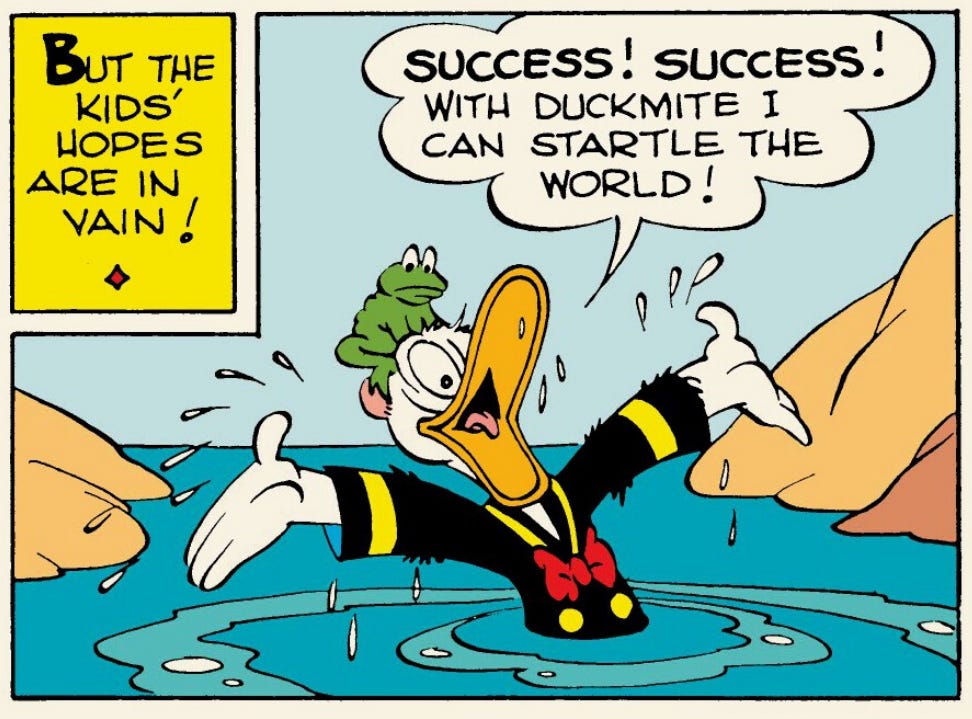
Only to flip again after trying to use it as gasoline:
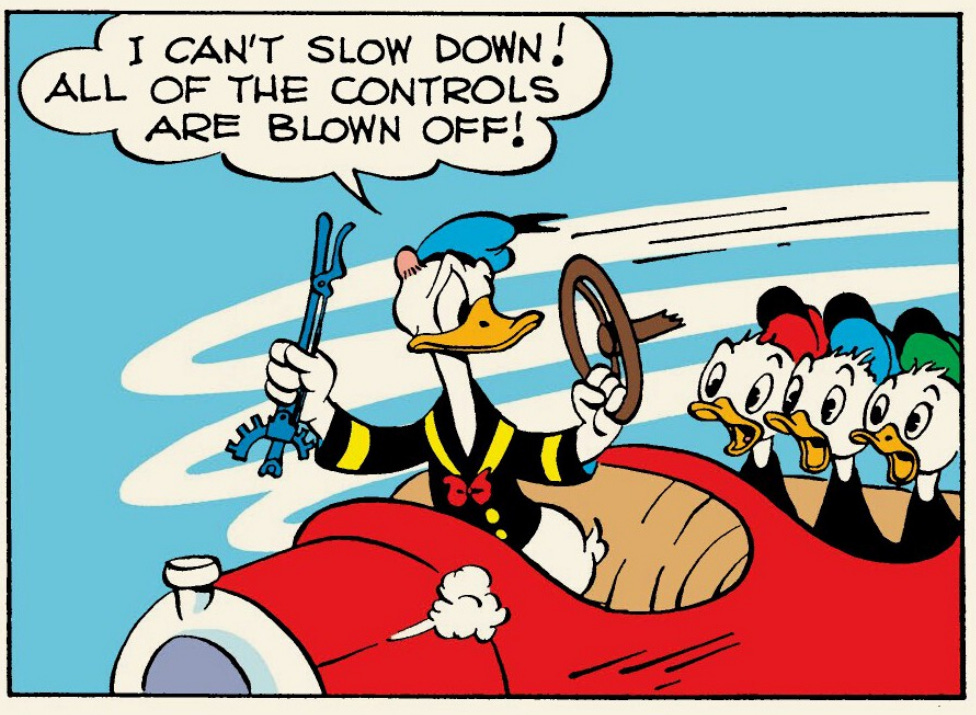
And back yet again after flying off a cliff and almost drowning:
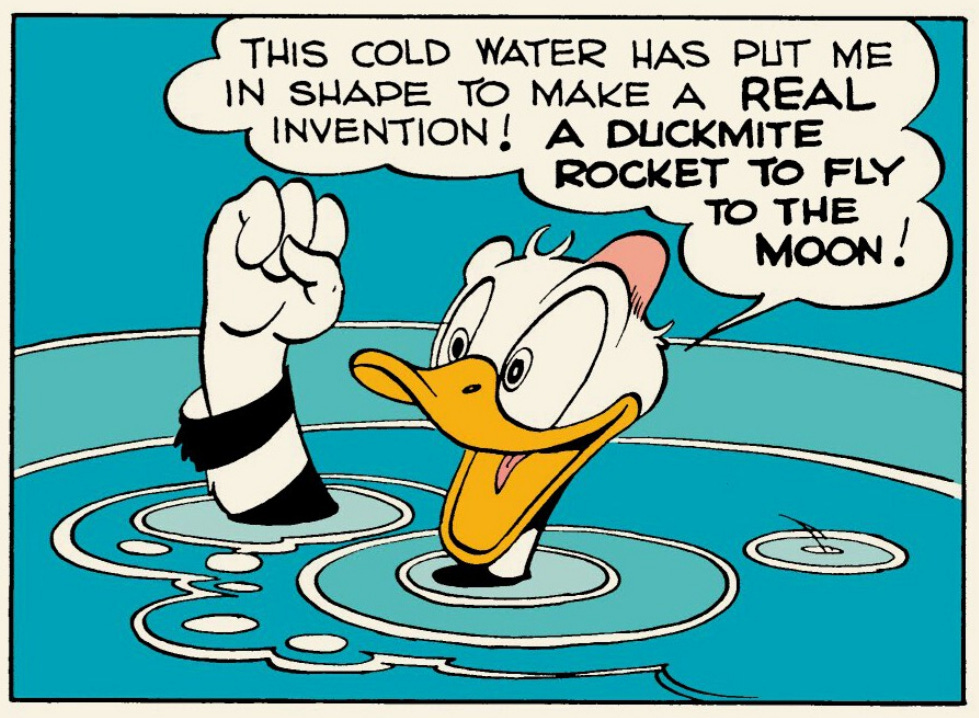
Who could say where the story is going? Donald seems mad, possibly supervillain-ish, yet not completely transformed. Barks smartly grounds the story a bit by having the nephews take him to a doctor.
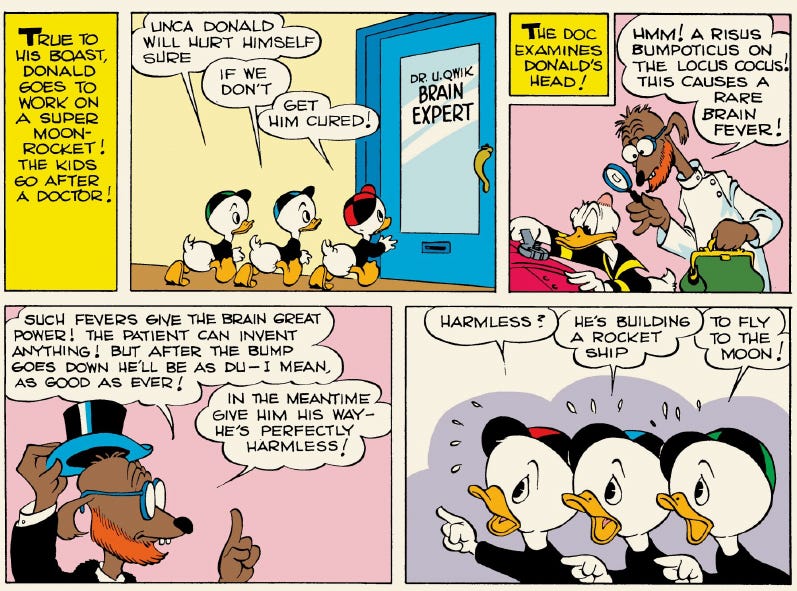
Barks never liked this sort of expert, and his condescending dismissal of Donald’s talents and the threat he poses to himself stands in contrast to Mad Donald’s genuine enthusiasm. The nephews are left, completely bewildered, to face the prospect of becoming orphans.
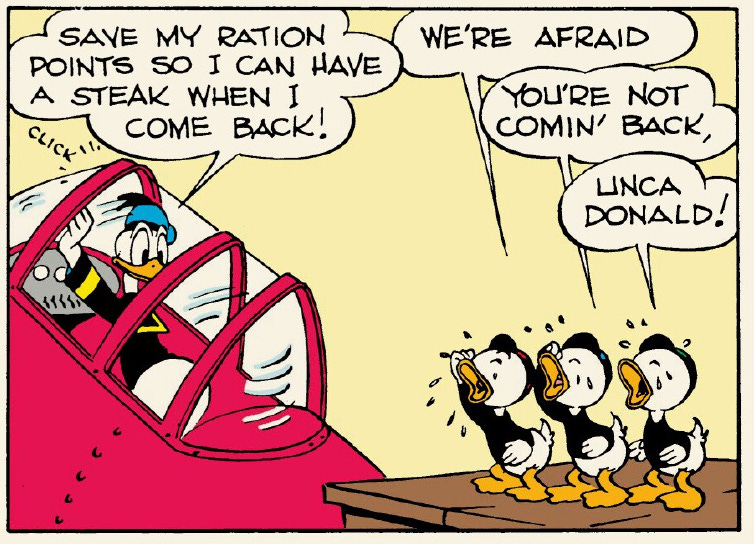
As expected, Donald’s bump goes down once he’s in space, and we abruptly return to the all-too-familiar Donald, vulnerable, out of his depth, and confused.
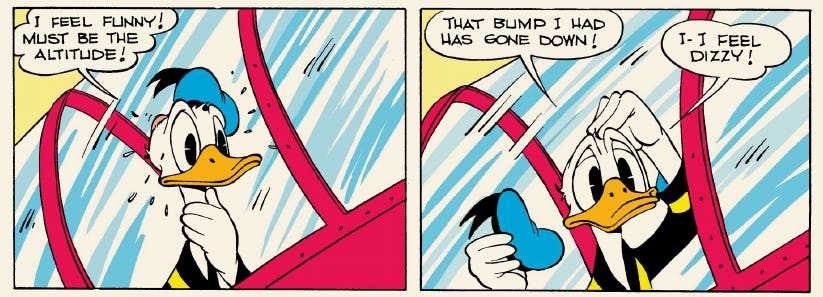
His eyes in the second panel are the eyes of a man fate has thrown for several loops. He remembers nothing, then he has to confront the fact that he’s flying around the moon and likely to die.
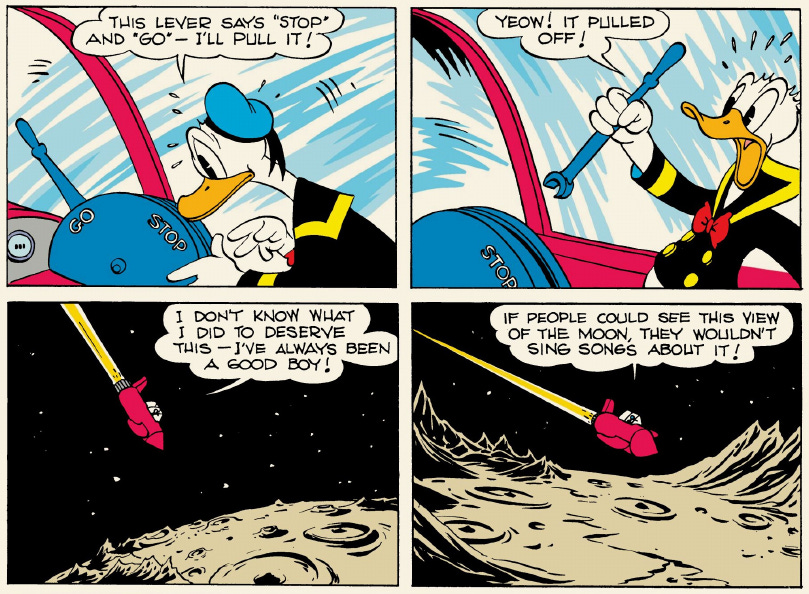
I like that Mad Chemist Donald can build a functioning rocket with complicated navigational controls, but forgets to attach the “STOP/GO” lever properly—like regular Donald still asserted himself somewhere in there.
I also like Donald’s woeful “I’ve always been a good boy.” His futile appeal to fate emphasizes that this really isn’t a jam he got himself into. Even if you could argue that he was careless with the chemistry set at the start of the story, this really isn’t about Donald learning a lesson. The world is messing with him, and no psychiatrist cares enough to help him out of his jam.
And yet, he survives:
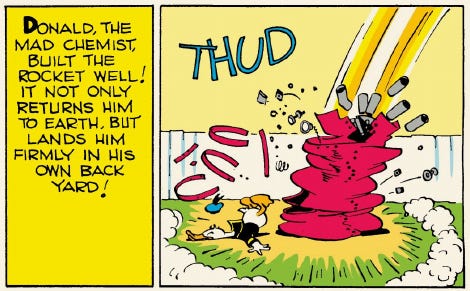
His appeal to fate might not have been futile after all. He survives a crash landing, attracts the attention of the town, and of course, remembers nothing.
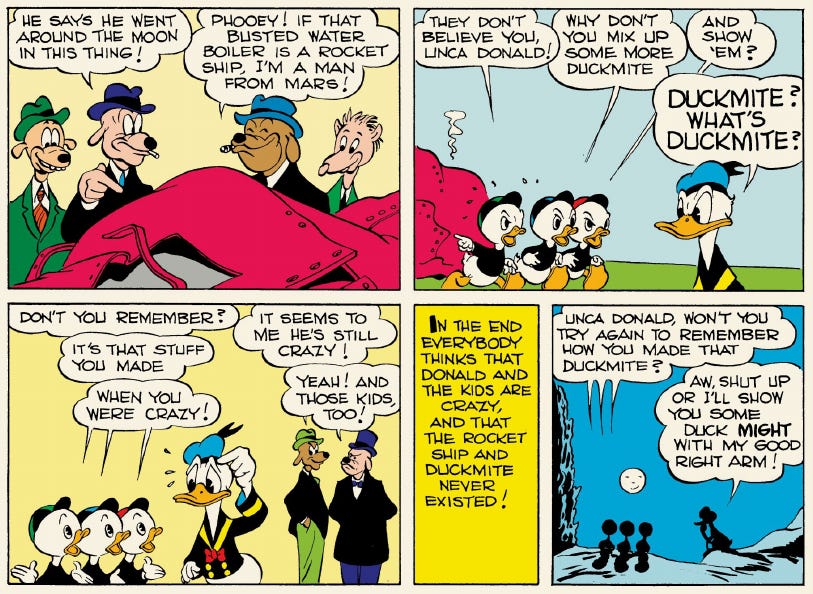
The nephews feel some defensive pride for their uncle, more than they’ve shown for any of his uncle’s achievements when he wasn’t out of his mind, and Donald himself looks sheepish to disappoint them. After an abrupt narrative panel (this does not seem like the tightest story Barks wrote), they’re left in shadow, the moon indifferently above them, looking like pawns of fate. Which is what they are.
The humor here, as much as there’s humor, feels very absurd to me. At every step, it’s the unpredictability of what will happen next is there, but the scope of the subject matter has blown up into something that doesn’t make sense (in several ways) for Donald or the nephews.
It’s hard not to see the shadow of World War II in play. Barks was a vaguely apolitical isolationist who’d opposed entry into the war, having seen World War I be a disaster and being of the “leave well enough alone” school of thought. By 1944, talk of atomic weapons and crazy rockets was all over the place, and to a rural misanthrope, it probably felt very similar to how we feel reading this story: a bunch of science-fictional nonsense suddenly posing a mortal threat—human folly and crazy fate combined. Donald’s chemistry accident has some Faustian undertones, and the psychiatrist represents the experts of the time, bizarrely untroubled by the danger. Traditional comedy doesn’t really work under these circumstances, so it turns to the absurd.
Part of that turn is finally shattering Donald’s unity. By changing his face, Barks opens up a world where we can’t rely on being ourselves or knowing ourselves, where our own actions cease to be ours, where we aren’t necessarily responsible for our own actions. Yes, it’s just a silly story, but there’s also some cosmic horror and a note of tragedy at the end—by showing what happens after the crazy stuff has happened and we’re left to pick up the pieces with no comprehension of what took place.
"the most ghastly explosive ever cooked up by man [or duck]!"