

Donald Duck's Good Deeds
The vanished Duck story

Good Deeds (WDC&S #34, July 1943) is one of two Barks stories that have been officially vanished from the historical record, not appearing in Fantagraphics’ Complete [Sic] Carl Barks Disney Library, their omission not even being mentioned. I assume this is Disney’s doing rather than Fantagraphics, but it’s annoying.
As a story, it’s far from Barks’s best, weaker than the three ten-pagers that went before it, but it has some good gags, the writing is decently sharp, and I’m not in favor of ignoring the past, warts-and-all. The problem is the appearance of some dark-skinned “tribal” ducks in the final sequence of the story. I won’t show any of the art from it here but GeoX has some in his analysis of the story. I’ve seen far worse from the period (this is nowhere near Coal Black and de Sebben Dwarfs, also from 1943), but it probably is the most egregious racial caricature in Barks’s work. Barks said that at the time, the editors told him not to do it again, though exactly what he was told not to do is unclear.
The story once again deals with Barks’s perverse moral arc of the universe, except this time it’s a sequence of disconnected vignettes hung together very loosely by the idea of Donald doing “good deeds” at the nephews’ urging. Some of the vignettes are very funny, but the story doesn’t add up to much.
Still, the beginning is Barks’s first portrayal of Donald as joyfully malicious. Barks would soon turn Jones into an equally obnoxious nemesis for Donald, but here he’s little more than a target for Donald’s harassment.
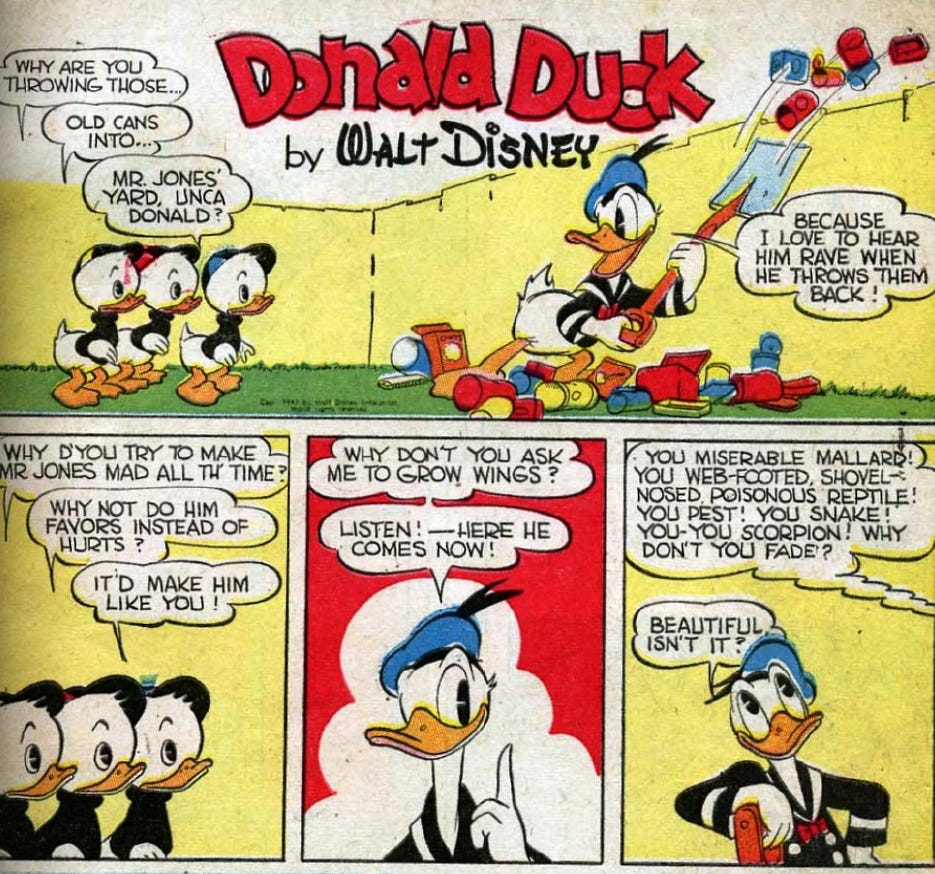
It may be the best bit in the whole story, nicely building to a conflict that it quickly abandons. The “bad neighbors” theme is such classic comedic gold that the only question is why Barks waited four more months before pursuing it fully (in Good Neighbors).
After Jones smacks Donald with one of the cans, the nephews too easily convince him to resolve to do only good deeds. They immediately start backfiring. Donald accidentally hits Jones with the newspaper Donald was trying to throw onto Jones’s doorstep, which Jones naturally takes as a hostile act, and Donald gets clobbered with a vase quite violently.
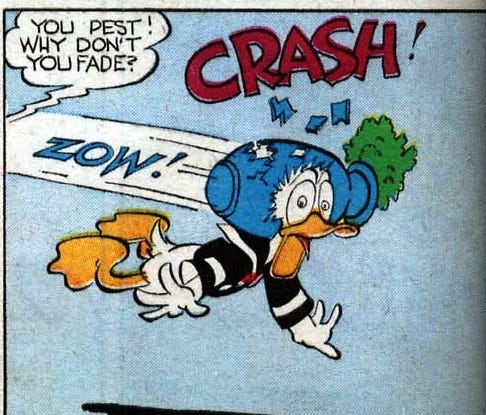
Sadly, that’s it for Jones. Donald’s resolve is unshaken, but subsequent encounters are with strangers, so the theme of Donald’s good deeds being disbelieved because of his innate character and his track record (remember, he’d been trying to make Jones mad “all the time”) disappears, leaving the story weightless.
Donald unwisely imposes himself on a pieman, and when his good deed backfires, the pieman is less than sympathetic to Donald’s good intentions:
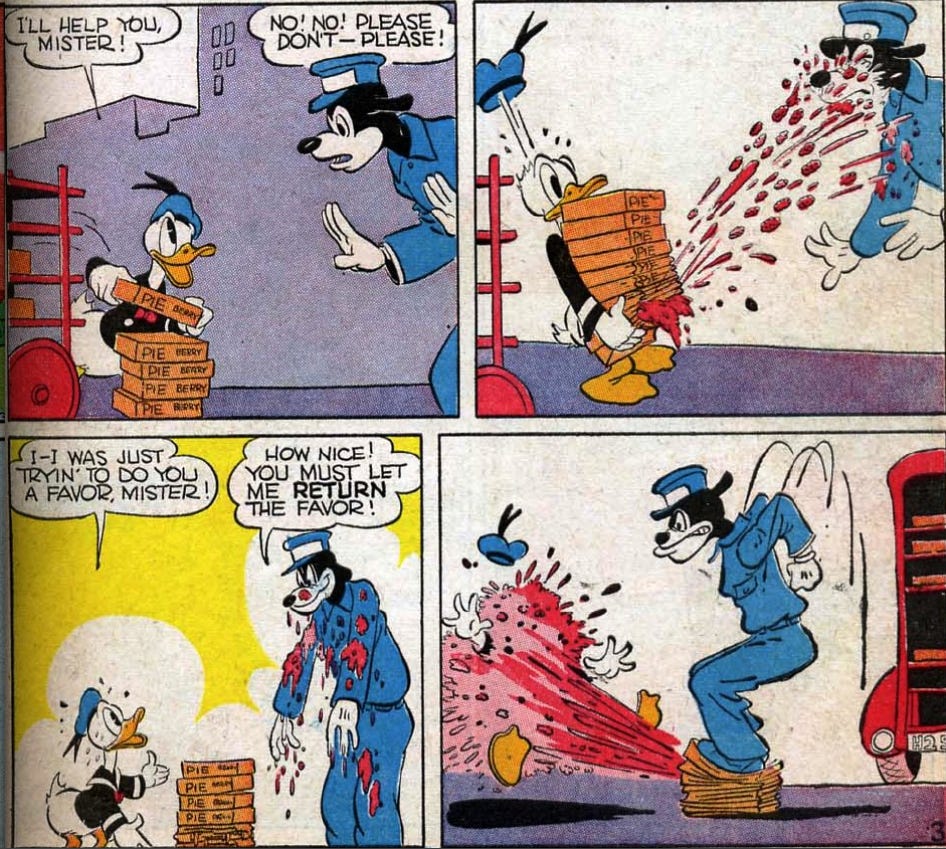
On to the next vignette. Then Donald and the nephews run into a sleeping pilot who left the engine of his plane running, and while trying to turn it off, the plane takes off and they end up on some island with those “problematic” natives, where at the nephew’s urging Donald keeps trying to do good deeds, which do perversely get them out of trouble.
They return home, and the pilot is less than thrilled:
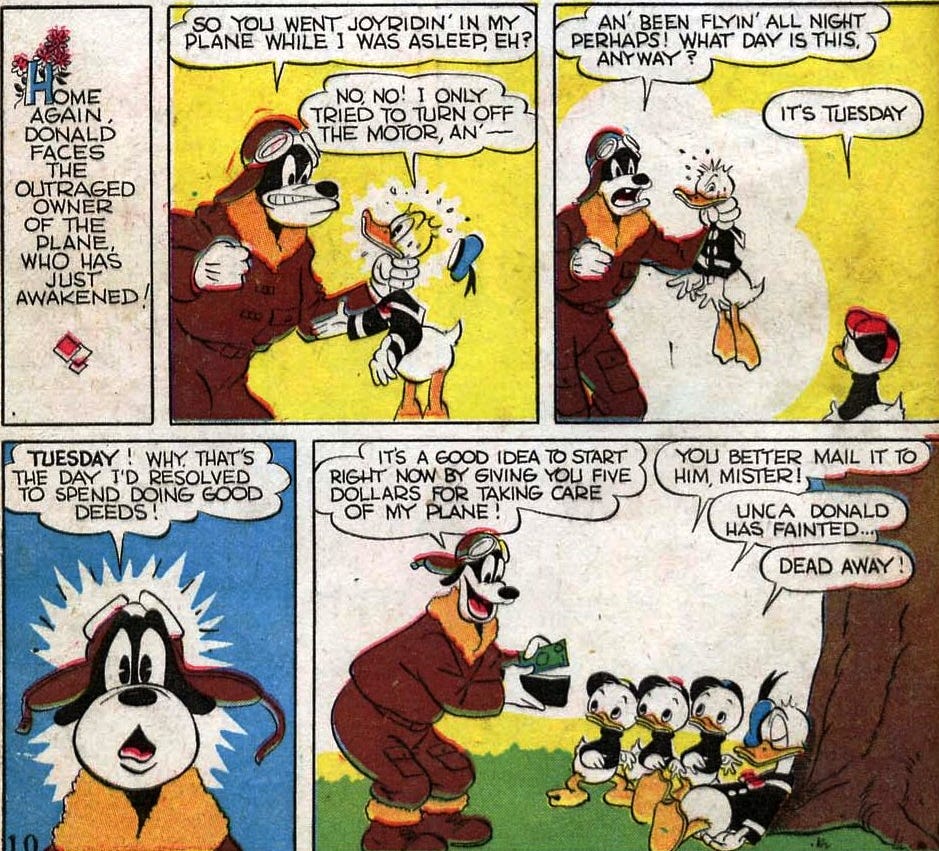
It’s a weak ending. The pilot’s sudden turnaround doesn’t make sense, since the ducks got in way over their heads and certainly didn’t take care of the plane. Good Deed Day apparently makes people suspend their critical faculties. And since it’s the first we’ve seen of the pilot, his abrupt turnaround carries no weight.
If there’s a consistent message to the story, it’s that virtuous acts can get you out of the worst trouble, but beyond that, all bets are off. But the five bucks hardly seems worth the danger and trouble. Donald would have been better off continuing to antagonize Jones.
The art is good, the gags are mostly sharp, and Barks gets an excuse to draw some sky/plane and island scenes, but this is the weakest of Barks’s early stories. Barks wasn’t really in a crafting mood that month. Maybe he was researching, thinking, or drawing his first solo adventure story, The Mummy’s Ring.
I love it that you are so against the grain. Everybody is talking about ... and you are talking about Donald Duck.