

Donald Duck's Victory Garden
Struggle and hive minds

Victory Garden (1942) was the first 10-page comedic story that Barks drew, but there are fewer clues to Barks’s own voice as there was in Pirate Gold. The script was by someone else (possibly Dorothy Strebe) and only tweaked by Barks, and the gags fall plainly in the tradition of the Donald Duck cartoons and the newspaper strip. Even the bizarre “invisible seeds” gag at the end (they’re great for fooling birds!) isn’t out of character with some of the more peculiar Duck cartoons of the late 1930s.
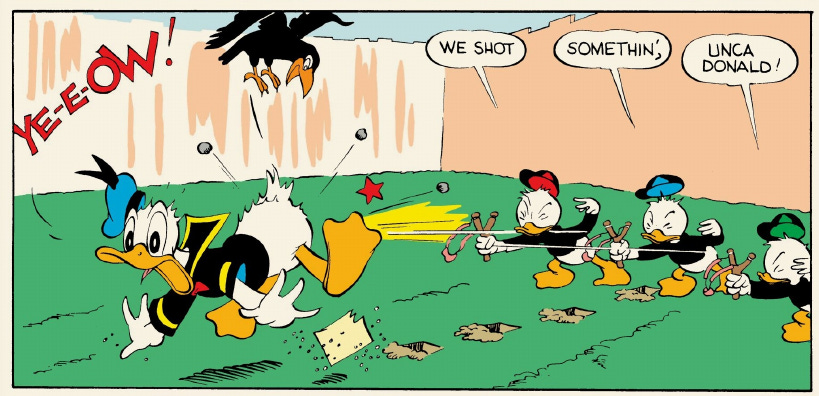
Barks illustrates the story well, but his voice isn’t particularly clear, as it would be in the next story. It’s most noticeable in a sequence that plays up the drama of the story, where Donald’s failed attempts at making a patriotic “Victory Garden,” only to have a trio of crows sabotage every effort, lead him to search for a vacant lot at night.
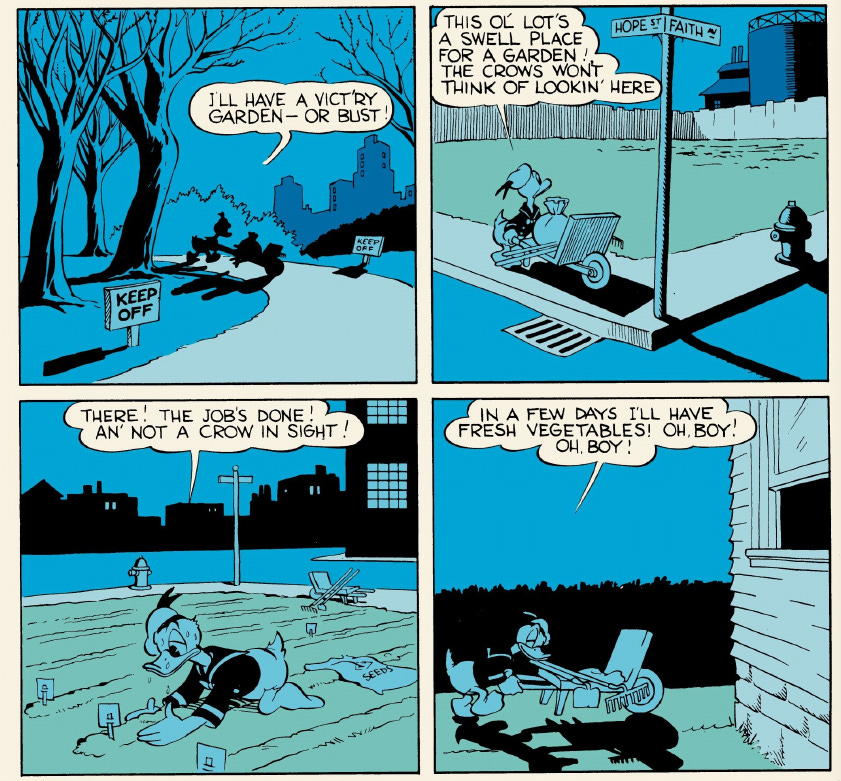
The script itself is full of determination and optimism, but Barks’s pictures tell another story. In the first panel, Donald is in long shadow, with the world telling him where he can’t plant with KEEP OFF signs. The vacant lot is at the corner of Faith St. and Hope St., underscoring that Donald’s modest ambition has somehow taken on existential stakes. The task is exhausting and leaves him drenched in sweat. And he is alone.
It’s odd to see the Protestant work ethic assert itself so suddenly and darkly, but it is unmistakably Barks’s attitude. I cannot find a clear source on Barks’s religious background, but based on his family and on his work itself, I would be very surprised if it were not Protestant. Barks himself was hardly religious, but a Calvinistic fatalism pervades his work:
I have no apprehension, no fear of death. I do not believe in an afterlife. I think of death as total peace. You're beyond the clutches of all those who would crush you.
Carl Barks, 1999
That amassing of “all those who would crush you” is what turns the antics of troublesome crows into a mortal struggle for Donald. Foiled ambition becomes cosmic fate.
Victory Garden is also a good spot to look at the other main characters of Donald Duck’s world, his nephews. First off, there is his fractured relationship with them. It’s rarely stated how he ended up as their guardian—their first cartoon has his sister dumping them on him, and they apparently just stuck around after that.
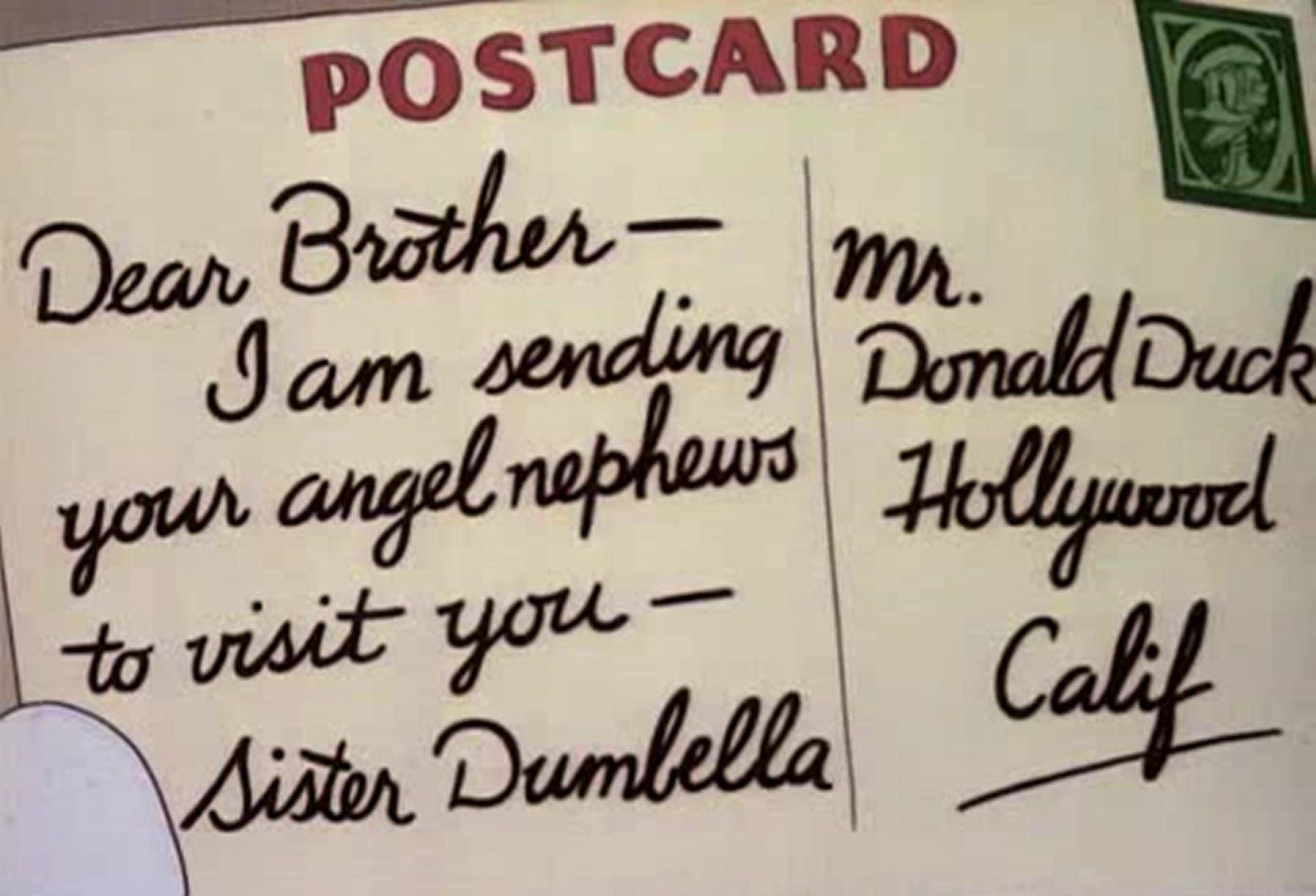
Their first appearance anywhere, in a 1938 strip by Ted Osborne and Al Taliaferro, provides a bit more context—they put their father in the hospital:
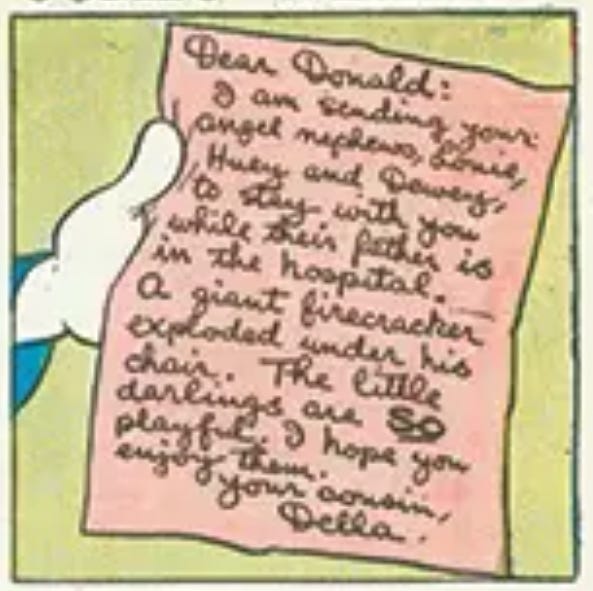
Either way, it was a simple gimmick to burden Donald with troublemakers that he couldn’t get rid of. The lack of paternity undermines his authority while saddling him with full responsibility, and as Barks’s angry-Donald gave way to beleaguered-Donald, the nephews mostly ceased to be troublemakers and became allies, competitors, a Greek chorus, or occasionally saviors, as the story demanded. Donald never faces any competition for the nephews’ guardianship—the only competition is their own precocious autonomy.
The uncle/nephews dynamic, ultimately, lends the same flexibility to the entire family dynamic that Pirate Gold did for Donald’s personality. Without the strong paternal bond, the nephews can be Donald’s juniors, his equals, or his superiors, and the amorphous nature of their familial relationship avoids father-son preconceptions from getting in the way. It also plays down the bizarre concept of Donald Duck as a single parent, even though he is. Daisy Duck very rarely takes on any kind of maternal role toward the nephews, the inverse of Barks’s own experience, where his two daughters had stayed with his mother’s family after he divorced in 1930. By 1942, both Barks’s daughters were practically adults, which makes it difficult to see an autobiographical projection onto the nephews. The nephews are vaguer figures than that, representing responsibility in a more abstract form.
In Victory Garden, the nephews are well-meaning and innocent of all but accidental mischief, not that it prevents Donald from being furious with them. This wasn’t a new maneuver; Barks himself had already storyboarded the nephews as ingenuously well-intentioned in their second cartoon appearance, Good Scouts, in 1938. He went on to make them agents of punishment for Donald’s obnoxious hubris in 1939 with Hockey Champ, but even there, the karmic weight falls mostly on Donald for his sheer pettiness in trying to show them up.
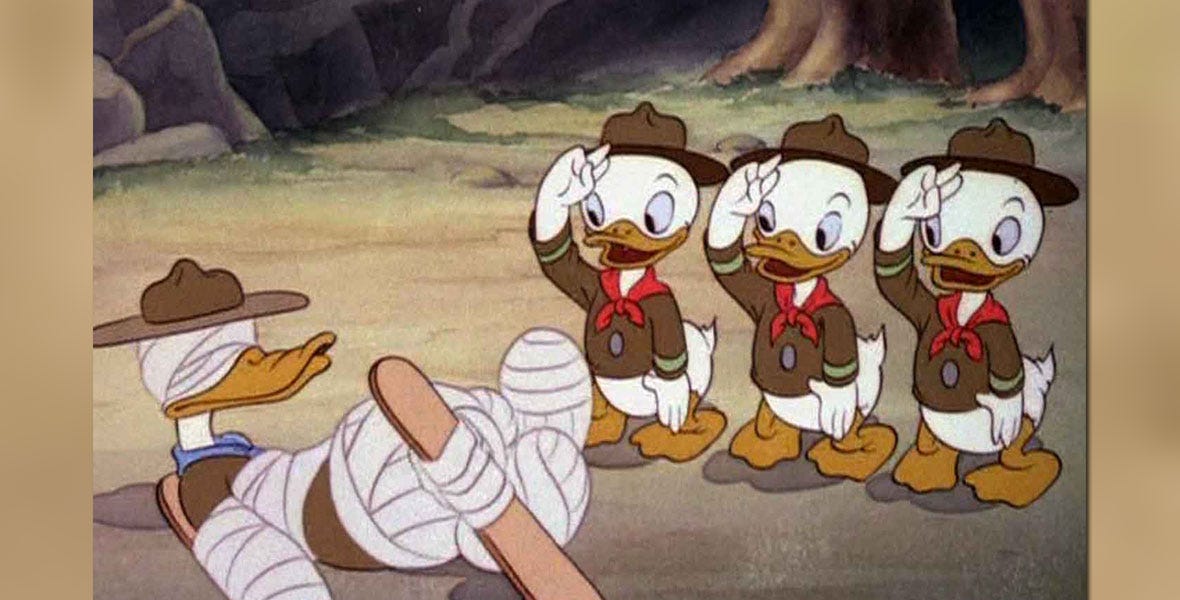
Huey, Dewey, and Louie’s signature trait, though, is that they’re a hive mind, one brain across three bodies. Identical character sets (or “twindividuals”) are a longstanding trope in comic fiction in particular, just as “the two young Cratchits” in A Christmas Carol also function as a single unit. They’re rarely main characters, though, for all the obvious reasons. They aren’t always hive minds either, but Huey, Dewey, and Louie very much are, speaking thoughts in three parts and very rarely displaying any individuation whatsoever. It’s enough that you think that if one of them were to be separated from the others, the other two would get dumber. (A Disney animator whose name I can’t recall was once asked his favorite Disney character, and he quipped, “Love Dewey, hate Huey.”)
When the nephews are used for comedic purposes, the hive mind doesn’t seem quite so strange, but Barks will end up repurposing it as the stories become darker and more dramatic. Aside from their ability to be a Greek chorus, the nephews also serve as an indirect expository device: they can effectively “monologue” by talking to each other.
As for Donald, the nephews ironically isolate him that much further. Since he (and everyone else) can only relate to them as a single unit, there’s no possibility of the intimacy of bonding one-to-one. Paradoxically, their trinity-state distances them from Donald. He can never be as close to them as they are to each other. Even as a single parent, he remains essentially alone.