

Donald Duck and Daisy: Donald Tames His Temper
Carl Barks and the non-negotiable authority of women

After several years, Donald Tames His Temper (WDC&S #64, January 1946) finally gives a significant role to Daisy Duck. Arguably, it’s the first time Barks so much as gave a significant role to any woman at all.
It’s not a flattering portrait. Within one page, Daisy has lectured Donald, preached at him, and beaten him up, with Donald conceding every point to her.
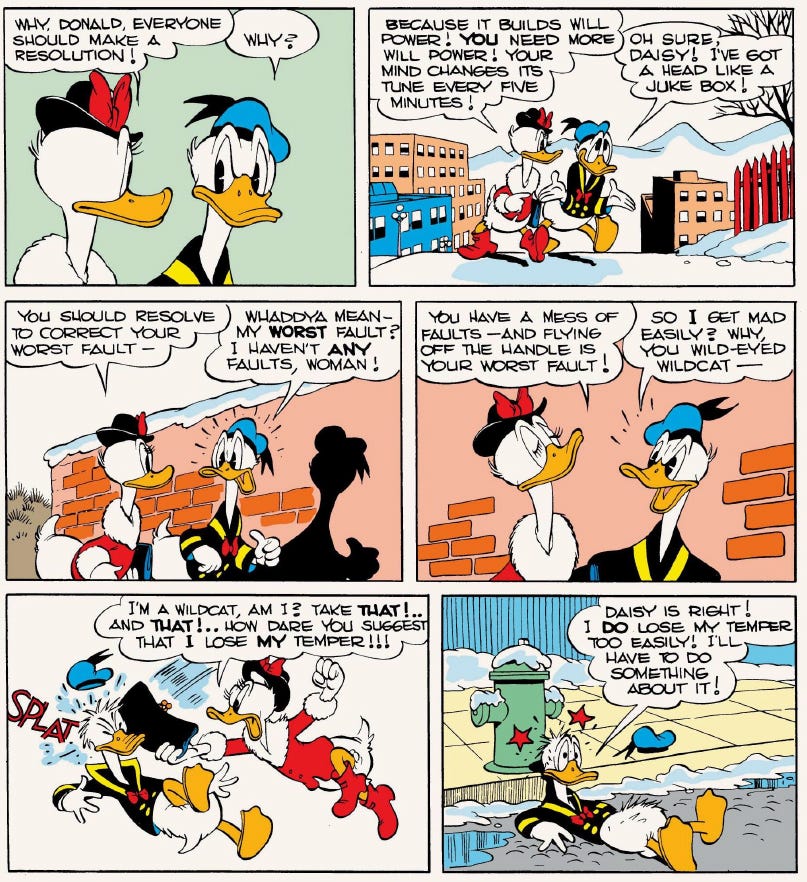
This may seem misogynistic, but Barks was a battered husband at the time with an alcoholic wife, and that fear makes itself felt whenever women enter his stories of the late 1940s. The elevation of women to an unquestionably superior level of authority and violence becomes a constant, and it’s particularly striking in a story like this, which is about corporal punishment.
Daisy is also able to evoke a mood in Donald we haven’t seen before, which is massive repression through sheer force of will. He resolves to never lose his temper again, Again, the implication is that only Daisy could bring Donald to such a feat of going against his own primal nature.
What follows is a sequence of gags where Donald’s hair-trigger temper is set off, but he catches himself in the nick of time before exploding.
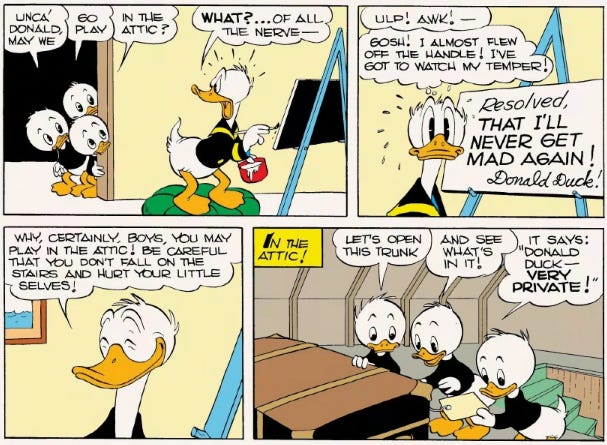
Donald’s denial is always accompanied with him closing his eyes. I’ve written earlier that the eyes are the seat of Donald’s soul, and so when they vanish, it’s Donald himself that’s vanishing, overwritten by this barely-sustainable persona of kindness.

Now, power abhors a vacuum, so Barks takes the opportunity to have the nephews behave quite badly—far worse than we’ve seen them to date. It’s as though the introduction of Daisy has upended all the usual power structures and removed Donald’s agency, leaving it free to float into the nephews.
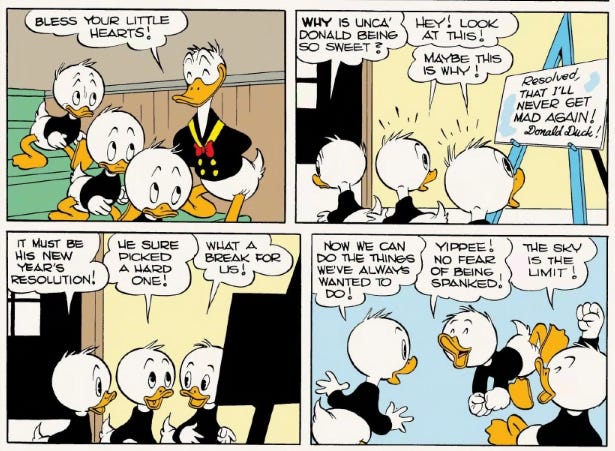
For all the nephews’ sanctimony and maturity in prior comics, here they instantly turn into hellions, wrecking Donald’s stamp collection and making a mess of the house.
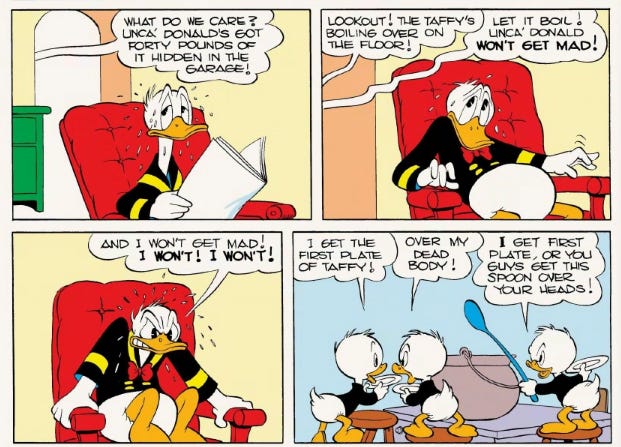
Donald’s facial expressions are amazing. Barks vividly depicts the stress of the repression, and Donald’s incipient mental collapse. The entire story has some of the best and most expressive faces Barks had done to date, as Donald’s self-control combusts with his powerlessness and rage.
Barks takes it further by bringing it to the level of a breakdown of parental authority:
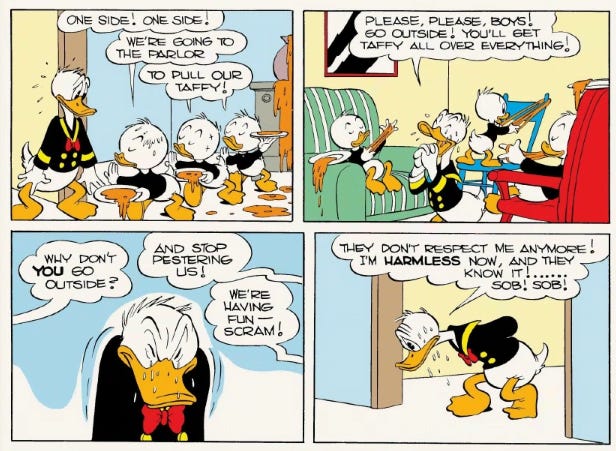
It’s a dark implication that it’s only Donald’s uncontrolled anger that regulates the nephews’ behavior. It takes Daisy to point out the flaw in the logic, which is that Donald drew such a huge perimeter around his “temper” that he left no room for discipline.
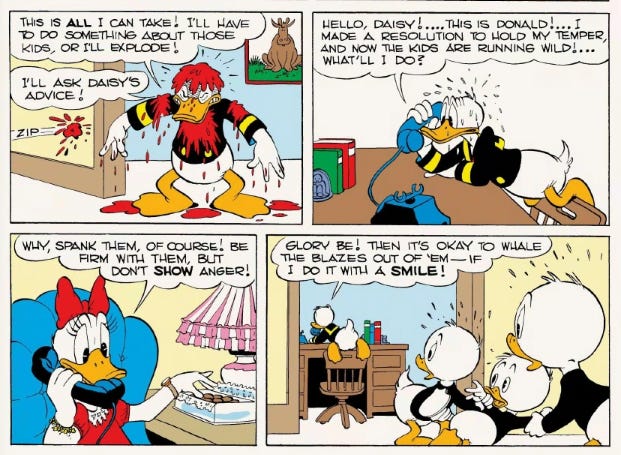
So the whole story has been based on a misunderstanding that Donald thought he needed to change his behavior when the problem was actually his affect—the upshot being that for Donald the two aren’t really separable. The idea of punishing the kids when not in the heat of anger didn’t even occur to him.
On the last page, we get a different form of repression: Donald’s rage masquerading as calm authority:
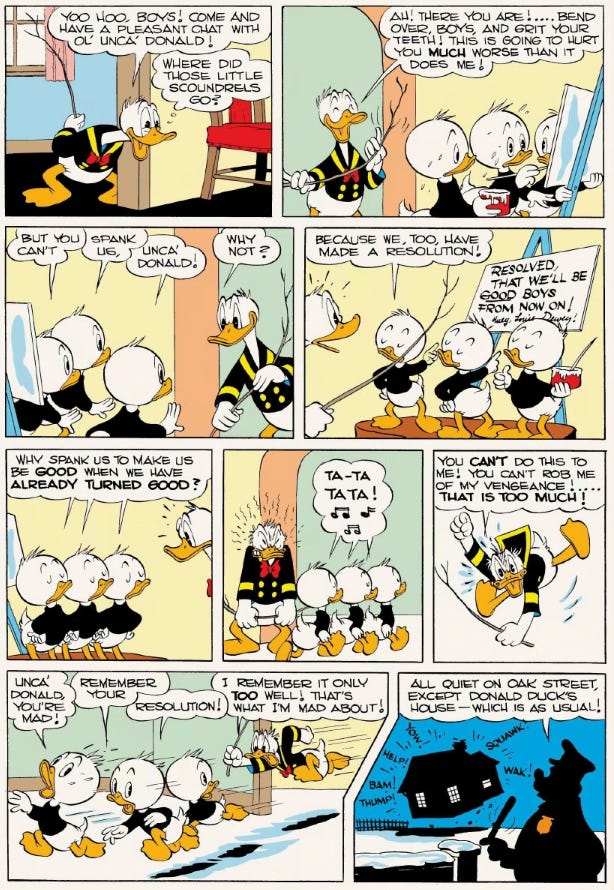
The nephews neatly undercut the pretense of rational discipline with their last-minute ploy, collapsing the affect-behavior distinction and sending Donald back to his true self. The “logic” used by Donald about his vengeance is not exactly coherent. What it really constitutes is the self-correction of the mechanism that Daisy completely threw off at the start.
The whole story comes down to indirect chaos caused by a very foreign force: Daisy. Donald and the nephews were in uneasy equilibrium, but her irresistible first-page assault on Donald’s being ends up causing way more stress and misery all around. She’s not really the villain of the piece—that role gets distributed around to Donald and the nephews in about equal proportion—but as the external catalyst she plays a very outsized role. The (male) policeman at the end blithely passes by as Donald beats the kids, acknowleding it as the basic state of things. It was only Daisy that found it unacceptable.
Calling it misogyny, again, doesn’t feel right. Daisy is hypocritical and instigates the mess, but Barks’s attitude is closer to one of fearful veneration and incomprehension than any sort of disapproval. She’s no more hypocritical than Donald can be, but she comes from a different world.
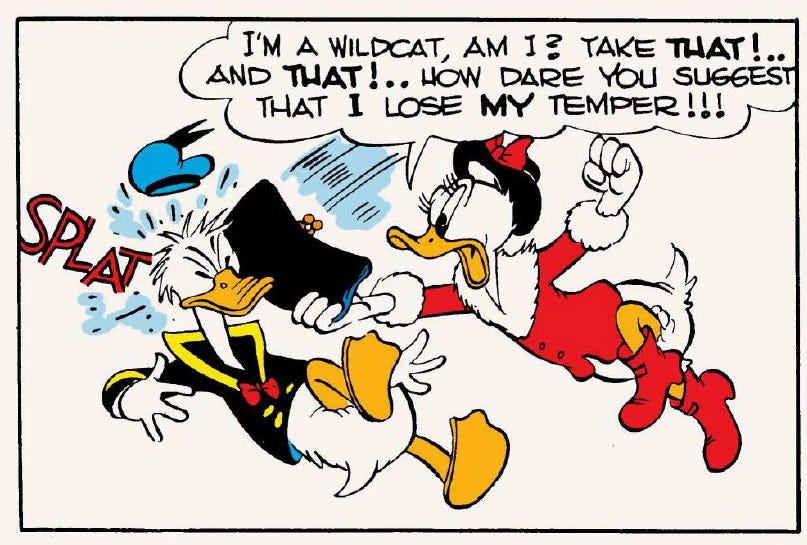
When she explodes, the background completely disappears. Donald reacts not with anger but numbness and shock, and Daisy’s own anger is different from Donald’s: she’s impulsive, yet retains full control of herself and doesn’t lose her glamour. If anything, she is the strongest character in the whole story.
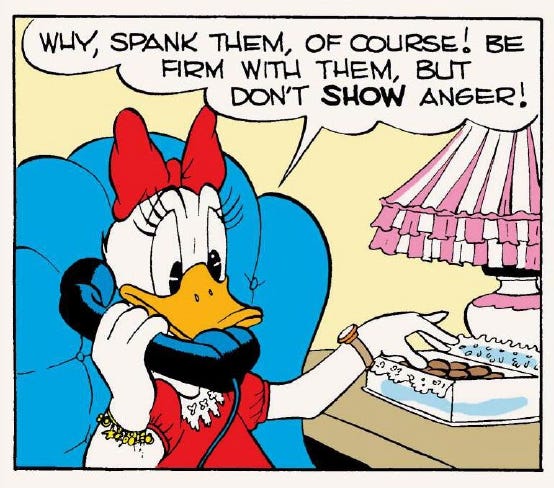
In her final appearance, she gently grabs a chocolate from a box while dressed classily, embodying the poise as she directs Donald to use corporal punishment freely. She exists in this bizarre state of grace where violence, disconnected from the ugly world of masculine affect, loses any negative connotations and becomes right and disciplined and orderly. She has access, as do other women, to a level of authority that is completely unavailable to Donald.
The story is fascinating and inconclusive, since the introduction of such a powerful new element raises more questions than Barks can answer. He wouldn’t answer them quickly or often, but they come to make up a central element of Barks’s cosmos.