

Donald Duck and Innate Character: Good Neighbors
Carl Barks's tale of fate and star-crossed neighbors

The “feuding neighbors” comic setup is such an old saw that it’s bizarre to think it never popped up in Donald Duck cartoons until after Barks had used it in Good Neighbors (WDC&S #38, November 1943). (Jones would later appear in a 1950s Donald short that copied this plot.)1 Barks certainly writes as though the theme is timeless—but his pacing and some twists of fate make the story great. Piling almost painful suspense and uneasy fatalism onto a seemingly trivial setup—Barks is finding his strengths.
Unlike most of the ten-pagers so far, the setup seems absolutely traditional—no rabbit’s feet or fox trapping here. Donald and Jones swear to be good buddies from now on, laying it on so thick that the outline of the story is blatantly, painfully obvious from the first panel. We know the reality: fundamentally, they want to fight, we the audience want them to fight, and the story requires that they fight. It’s fated. Just how fated is what we will find out.
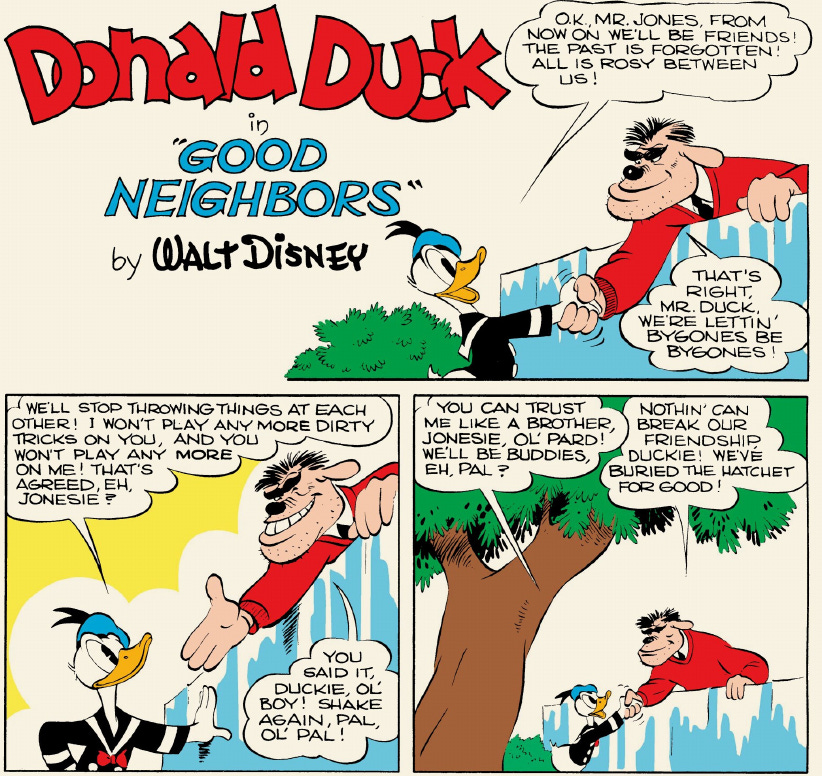
It’s like an action movie where the older partner of the hero has a week left until retirement. Barks milks the anticipation relentlessly, taking half the story for the truce to blow up. Twice, an accident happens—and the accidents are genuine—only for Barks to defuse it.
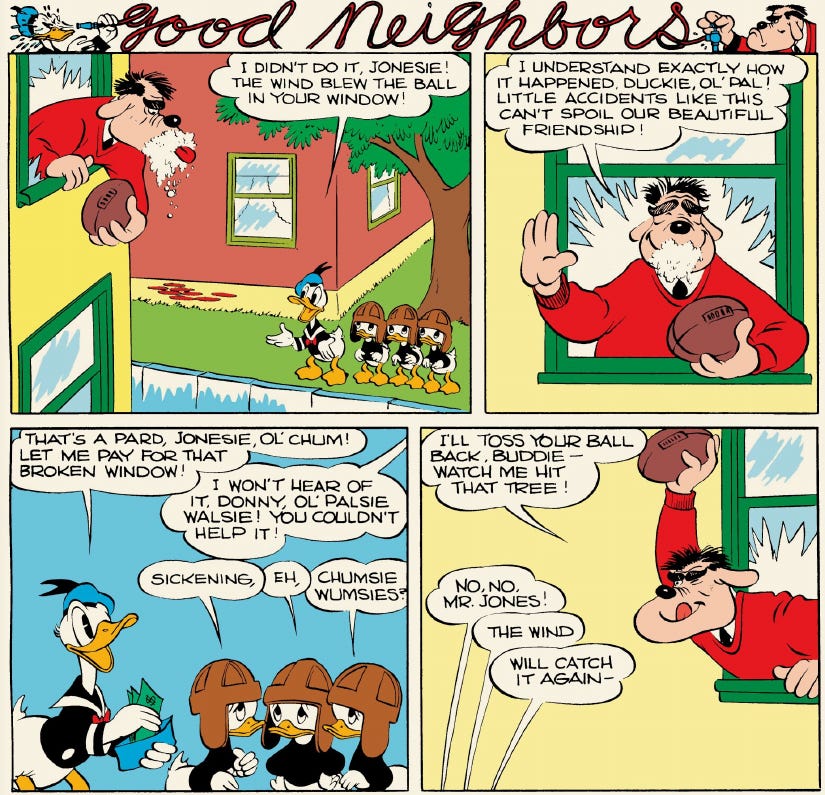
The suspense builds. Not that you needed it, but the header logo shows that the inevitable is indeed inevitable. Even the nephews, frequently the moral compass, are fed up with the bonhomie. They know what’s coming too.
Then the third accident happens, again with the football, and Jones’s benefit of the doubt is exhausted.
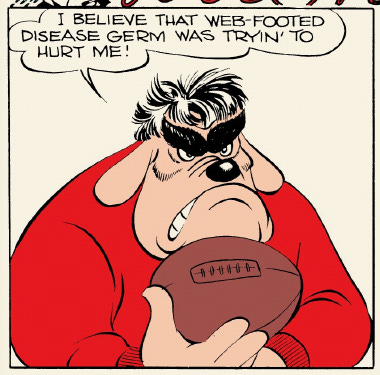
Finally! Jones tells Donald he’s got a present to return, Donald opens the door to say “Let me have it!”, and sure enough—
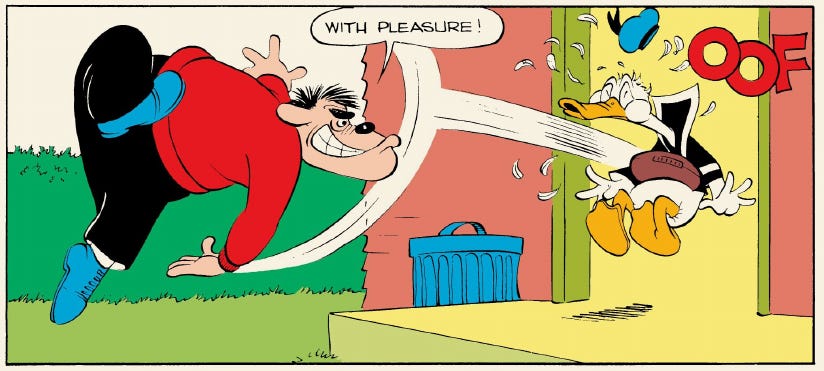
What was obviously going to happen has finally happened!
This panel is pure catharsis, and not just for Jones. It’s catharsis for Donald, who has his pretenses toward sickly-sweet neighborliness knocked out of him. It’s catharsis for the readers, who’ve been itching to see the truce collapse for five pages now. The suspense hasn’t just been in waiting for the truce to collapse, but also in seeing how long it will take for Donald and Jones’s true selves to emerge from the unbearable repression they’ve subjected them to.
The reader gets to feel some of this, since in waiting for the inevitable blowup, they get to feel something akin to Donald and Jones’s repression of their basic drives for conflict. It’s a very clever bit of reader identification by Barks. Jones and Donald were sincere about the truce, make no mistake. But for the first five pages, they are in bad faith with regard to their true characters.
There are then three pages of havoc, all based around that troublesome football. Donald fills it with ink, Jones fills it with nails, Donald fills it with firecrackers.
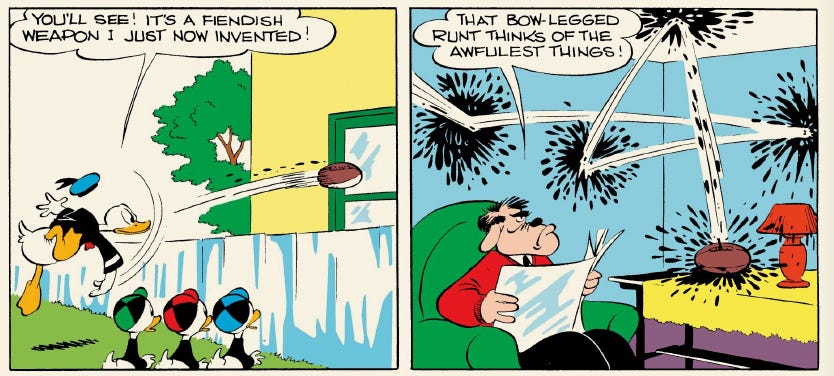
For all their irritation, Donald and Jones both seem to exhibit a kind of joy and satisfaction in the warfare that was completely absent during their truce. (Look at Jones when he throws the football!)
Donald’s football shrapnel bomb goes off a little earlier than he planned and pumps holes into both roofs:
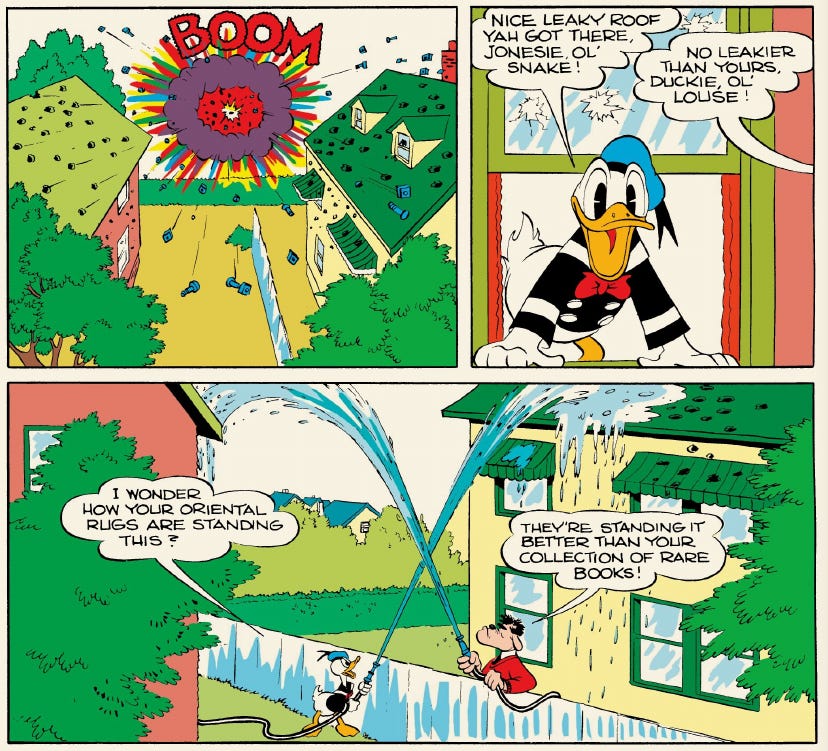
The bottom panel is wonderful, showing their joint satisfaction in their mutually assured destruction, gleefully embracing a negative sum game. It sums up the situation: this is who they are. Fighting is their nature, and they take pleasure in it.
Yet Barks pulls back to a bigger picture. He has the nephews, who recognize that this will go on forever, get Donald and Jones evicted from their houses:
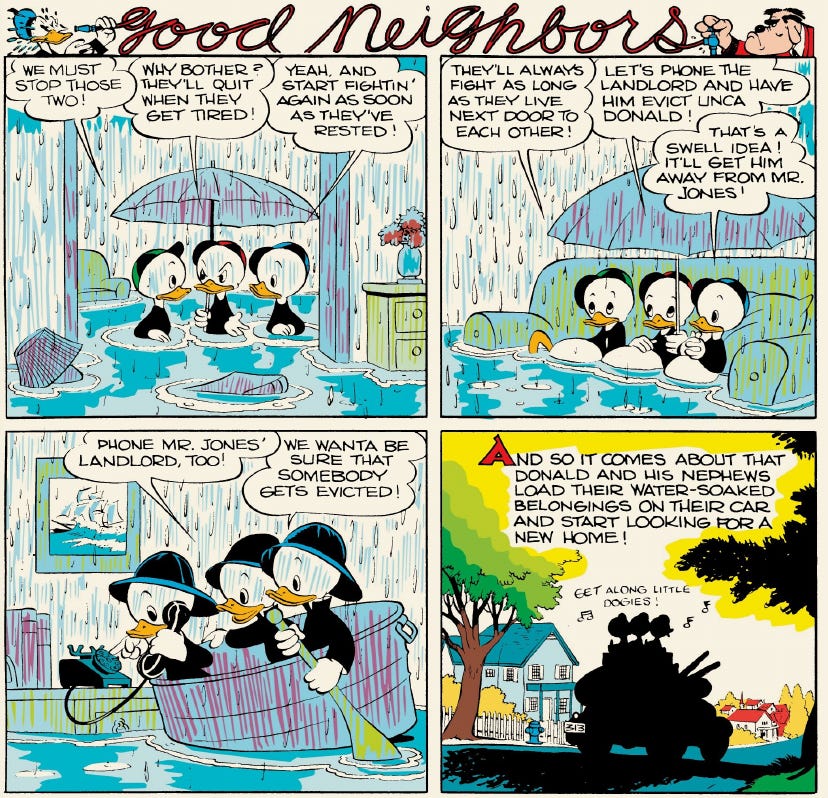
A subtle structural note: the nephews in the flooded house inverts the peaceful birdbath of the first page:
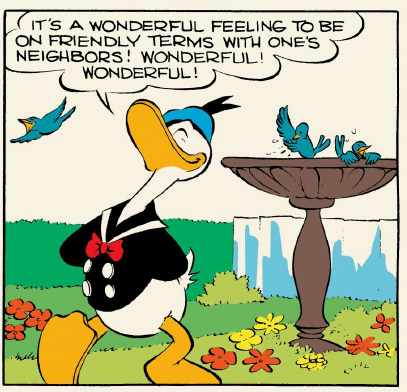
Donald’s real nature is feuding; water’s real nature is destruction.
(Barks also plays around with anthropomorphosis. While the nephews have to wear raincoats and paddle in a bucket despite being “ducks,” the bluebirds wash themselves like humans.)
Donald and the nephews move to the other side of town, and sure enough, their new neighbor is just who you’d expect:
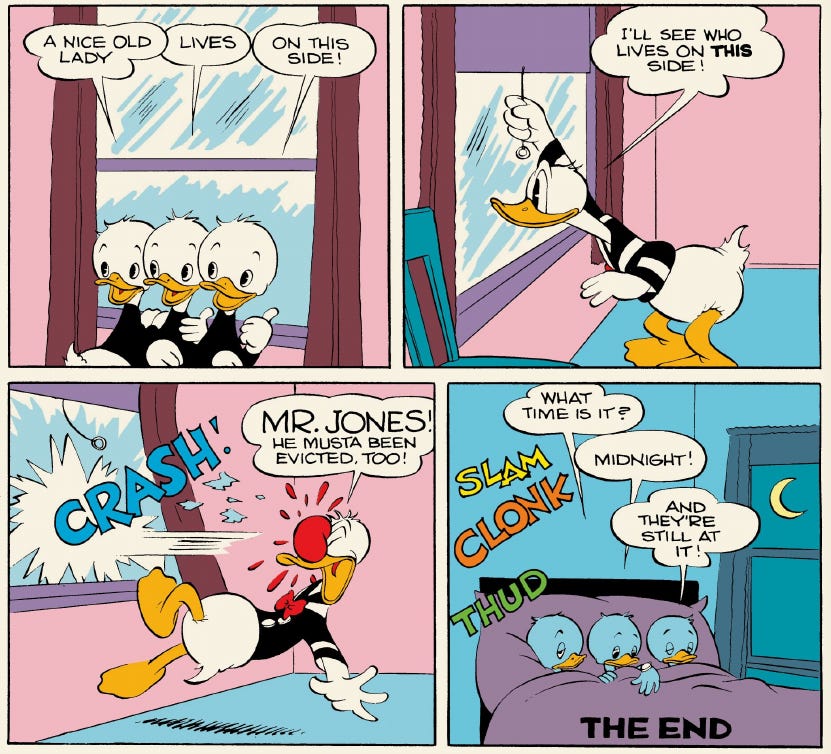
This confirms what that football of trouble only hinted at: there’s some kind of cosmic force in play that keeps them together, fighting. It’s not just their inner natures that demand that they fight, it’s fate itself.
The football looks more menacing in this light. All the accidents that led to the explosion of the truth involved the football, to the point that Donald even blamed the football for threatening his truce with Jones:
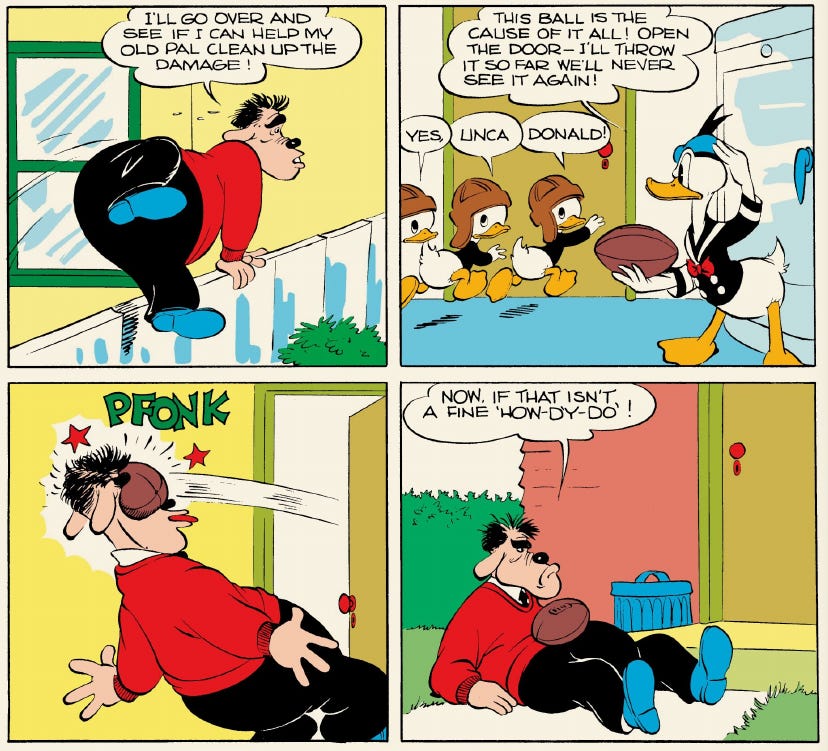
His attempt to get rid of it, in fact, is the final straw that turns Jones’s thoughts to violence. It would have been fitting if it had been the football instead of a tomato that Jones throws at the end, but the football exploded spectacularly several pages earlier.
It’s absurd that a banal football (of all things) could be acting as some kind of agent of fate, but the ending makes it look like there was indeed some kind of higher force in play, sent by the powers that be to blow up a truce that went against the mysterious laws of the world. If Donald and Jones try to go against their natures, fate itself will turn them back to antagonism. They’re star-crossed neighbors.
As I hinted, you can read this metatextually. The actual forces that are making sure they stay in conflict is Carl Barks and reader expectations. But Barks’s worldview was dim enough to go beyond that. Barks, as will become clear, believed that the real world was just as prone to make a fool of you as a gag writer is to make a fool of their characters.
This story is the first time Barks combined issues of fate (see The Rabbit’s Foot) with psychological issues of inner nature. The logic of The Rabbit’s Foot was overt and almost mechanical.

Here, ambiguity steps in. While Donald might be self-congratulatory about his truce with Jones, he doesn’t exploit it. His worst crime is self-deception and bad faith. There’s no clear karmic debt as there was in earlier stories, just an unease that the world has a peculiarly petty and malevolent agenda. What remains are the questions of:
Can one go against one’s innate character?
Can one go against fate?
How does one even know which of the two one is fighting?
That ambiguity would prove very, very fruitful for Barks’s work.
1944’s Trombone Trouble is sort of an enemy-neighbors plot, though far weirder than that.