

Donald Duck and Millionaires: Rival Boatmen
Carl Barks on wealth and class

After the craziness of The Mad Chemist, Rival Boatmen (WDC&S #45, June 1944) comes as comfortably familiar. Donald is very much himself, the plot is the sort of rivalry with the nephews we’ve seen before, and the gags are exactly what the setup predicts. Until a millionaire shows up and it all goes awry.
At the start, Donald and the nephews are competing in the same way as they normally do in offering rival fishing boat rides. As usual, Donald plays dirty and the nephews aren’t unwilling to go so low, but this time they’re competing for the favor of a millionaire, a Black Pete clone named J. P. Diamondtubs, who throws the story completely off kilter. Far from just being a supporting player, he takes over from Donald as the center of the story.
There is nothing remotely classy about J. P. Diamondtubs, even if you ignore that he is modeled on the déclassé schlub Black Pete.
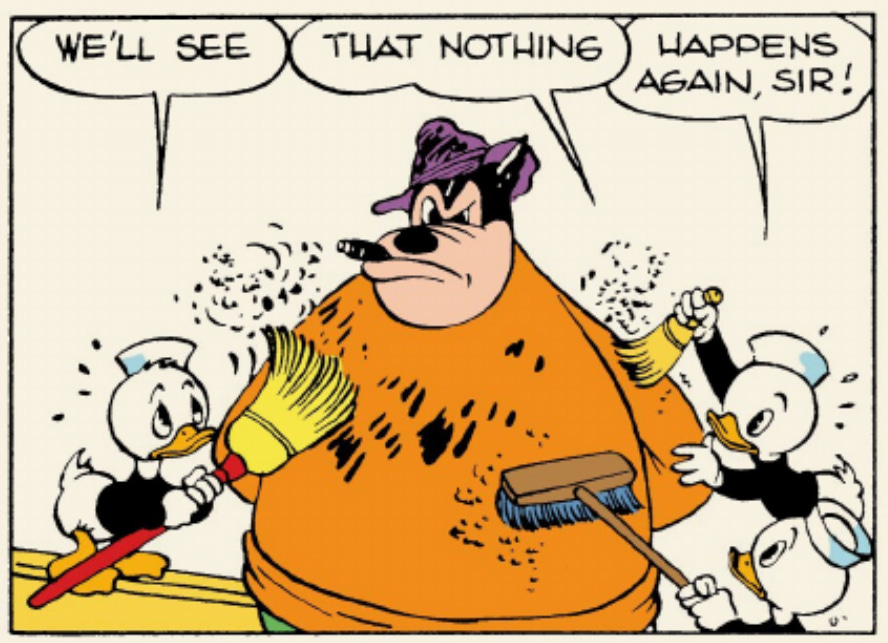
The cigar is the only thing that even remotely suggests an upper-class person, and even that’s a stretch. Barks had no trouble drawing refined, well-to-do characters when the occasion demanded, but here a rude and impatient millionaire is called for. The most millionaire-like quality that Diamondtubs isn’t in his appearance, but his entitlement.
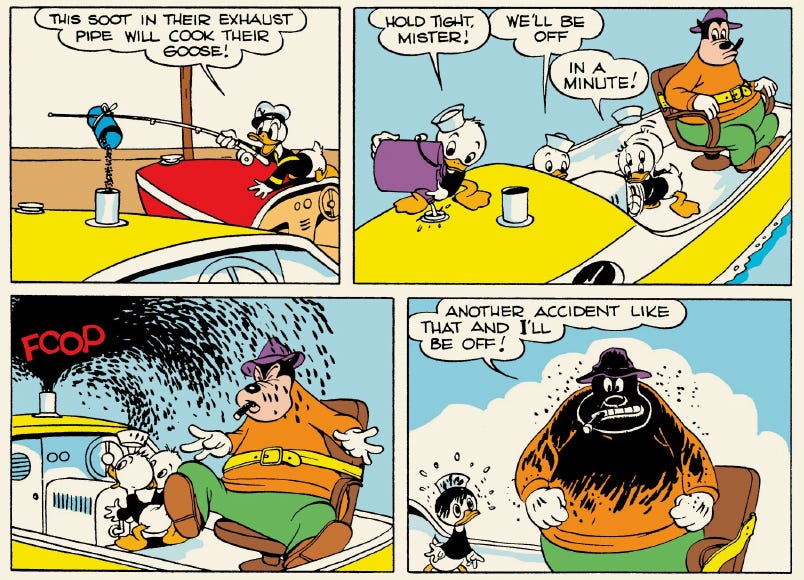
When things start going wrong, he sees no need to give anyone the benefit of the doubt. Usually the nephews get a bit more of a break from Barks, but Diamondtubs has no sympathy for kids.
Once Diamondtubs jumps to Donald’s boat and the nephews leave the story, it’s up to nature to even the score. In other stories like Snow Fun, nature is mostly passive, rarely posing the sort of threat that other human beings do.

Here, though, nature cooks up a sequence of tortures for Donald and Diamondtubs, and Diamondtubs immediately blames Donald for all of them, even though they are genuinely not Donald’s fault.
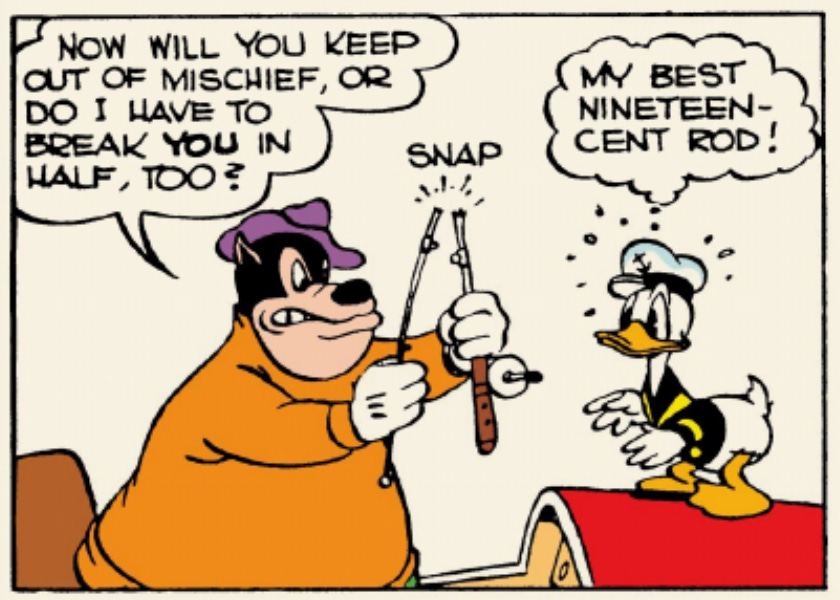
You can see this as cosmic justice for the way Donald sabotaged the nephews, but it plays differently because of Diamondtubs. When Donald pathetically bemoans his nineteen-cent rod—fishing rods cost about $7 in 1944, so Barks is ludicrously playing up Donald’s poverty—it feels like the wrong sort of comeuppance, deflating him not for his ethics but for being poor. Diamondtubs is a threatening thug, but because he has money, that plays differently too: he acts like this because he can.
When a bit of business with an eel goes very awry, Donald not only gets tortured, but is powerless to respond in the face of his millionaire client:
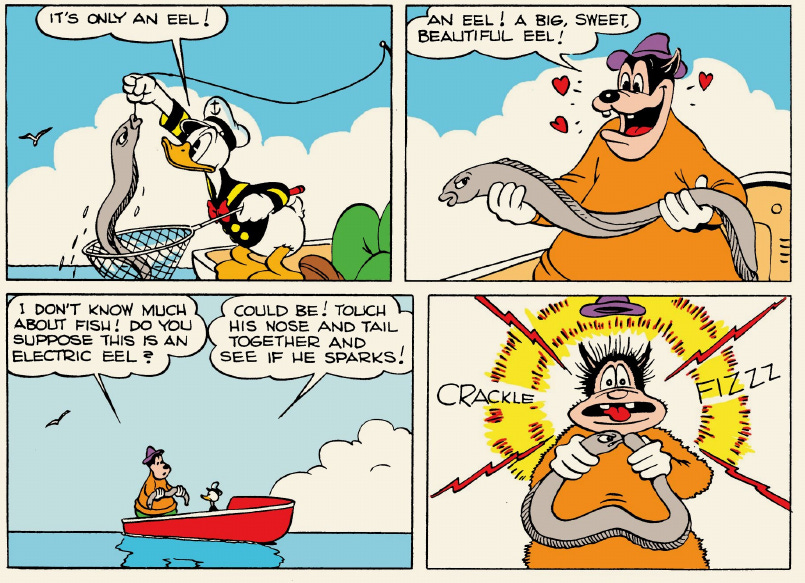
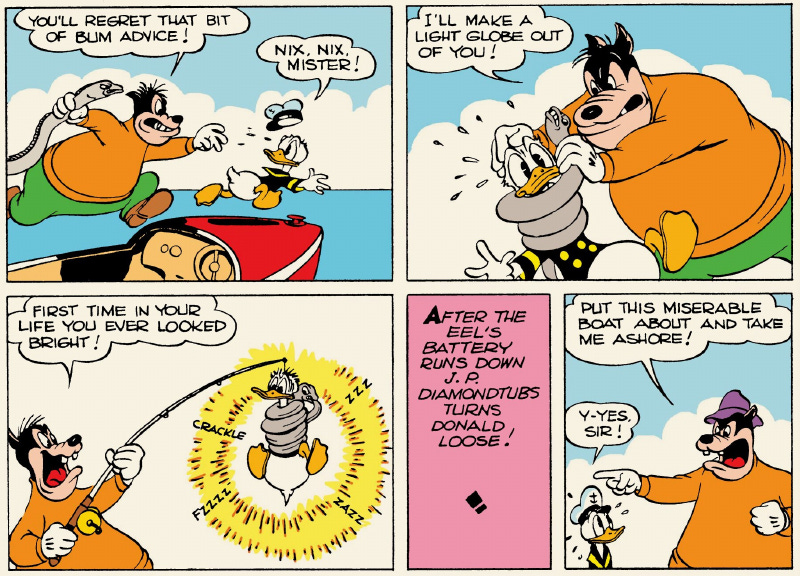
This wouldn’t be the last time Donald was electrocuted at the hands of another (see the amazing, censored 1945 story Silent Night, which I’ll get to soon). Diamondtubs’s sadism, again, plays differently because he’s a millionaire. Donald can’t object or reply. He just shrinks and sweats.
(I also like Diamondtubs’s bizarre “A big, sweet, beautiful eel!” complete with hearts around his face. I guess it’s a take on millionaires who treat animals better than they treat other human beings, but mostly it just cracks me up, particularly the side-eye from the eel.)
Then the real trial comes. Donald and Diamondtubs get lost at sea. It’s ambiguous, but I don’t think it’s Donald’s fault. In that pink text panel, Barks implies is that Diamondtubs zapped Donald with the eel for a long time, long enough for them to drift out to who-knows where. Elsewhere in the story, Donald is reasonably competent, just remarkably unlucky. The object of fate’s lessons has shifted from Donald to Diamondtubs.
Out in the middle of nowhere, they get caught in a rainstorm, and then in a waterspout, leaving them drenched and waterlogged.
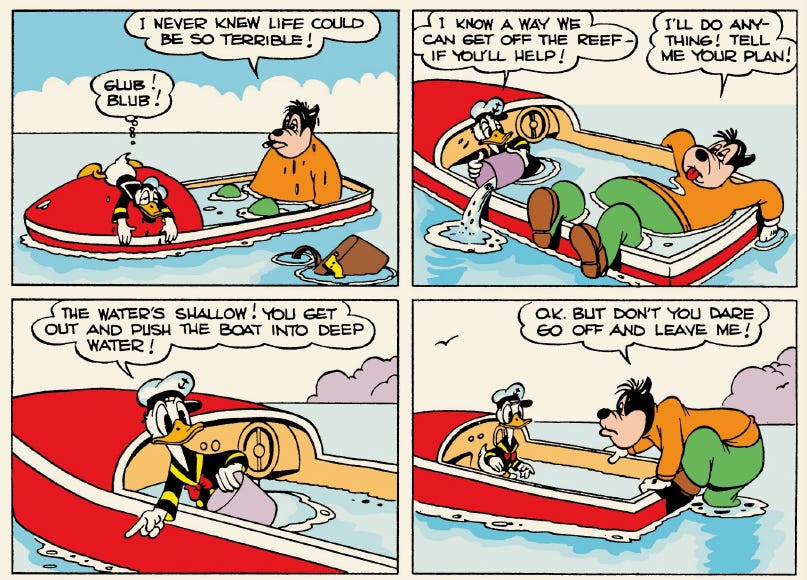
Nature hasn’t cut Donald down to size as much as it has Diamondtubs. Donald did sabotage his nephews, but he never professed to be some master boater or fisherman. The real change is in Diamondtubs: “I never knew life could be so terrible.” His anger and sadism from earlier in the story turn into exhausted desperation, to the point of going along with whatever Donald says.
Donald is stressed and weary as well, but Diamondtubs ends up having the worse time of it by far. Donald bails out the boat, but can’t start the engine and ends up stranding a very-panicked Diamondtubs:
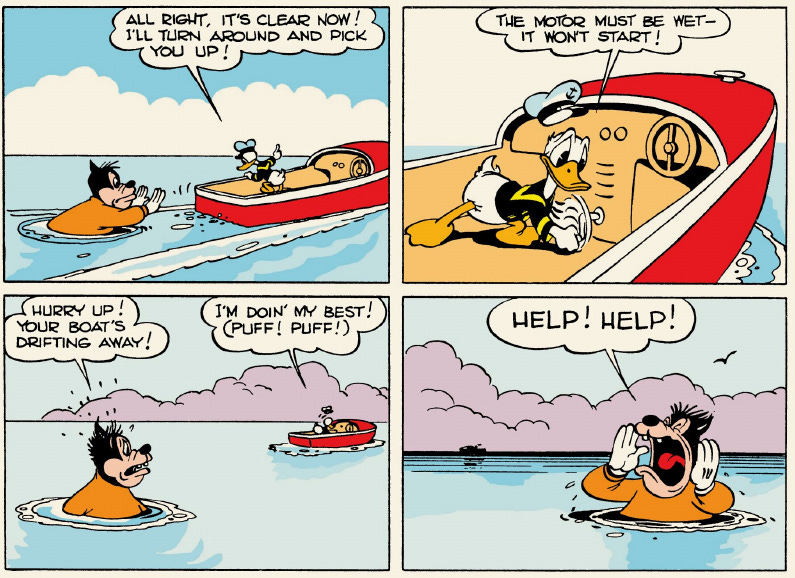
Again, Donald doesn’t fail from incompetence or false pride—it’s just one more stroke of bad luck directed at Diamondtubs. The nephews go sailing and find him, and all is forgiven with them, needless to say.
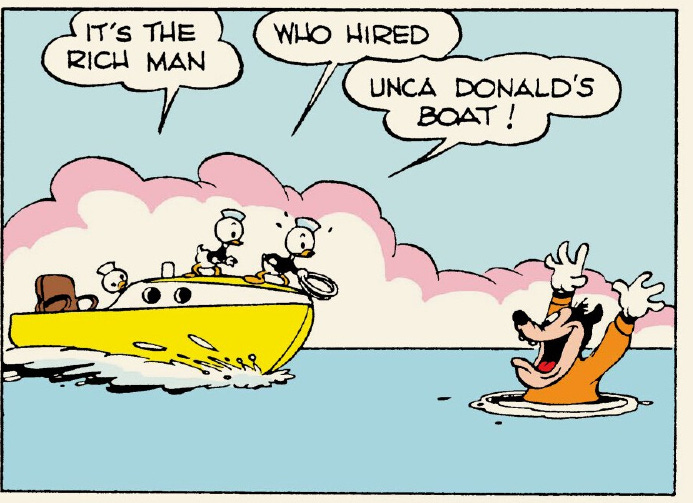
Finally, we get some real joy out of Diamondtubs. It’s not clear whether he’s learned anything from this experience, but he has become the focal point of the story. He hires the nephews for an even higher price, because money, after all, rules the world.
That leaves one loose end. After the nephews save Diamondtubs, we return to Donald for a strange denouement.
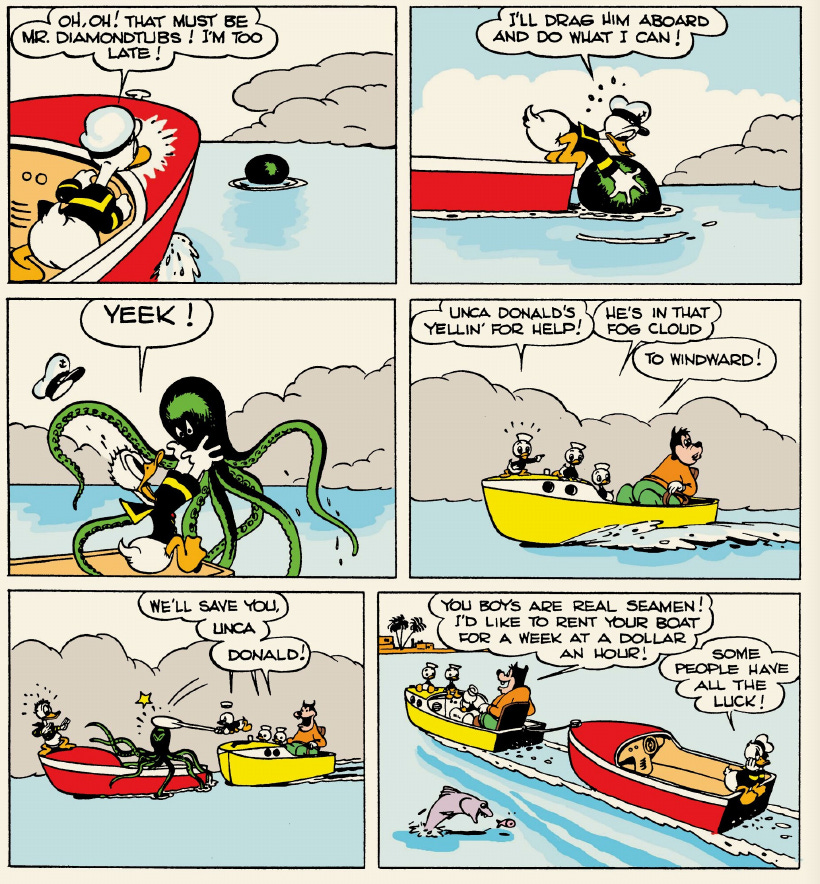
This octopus gag comes out of nowhere and just seems to fill space on the last page. It gives the nephews an opportunity to show off their competence, but once again, Donald isn’t quite getting his comeuppance. If anyone was the target, it was Diamondtubs. His money couldn’t help him much in the face of nature’s mysterious workings, but once back in civilization, he is still on top. Maybe he will be nicer, maybe not, but the arc of the story is his.
I do have a theory about the octopus. Barks didn’t go in for symbolism except of the most direct and explicit kind. Even the big fish eating the little fish in the last panel, which so obviously seems to invoke a great chain of being, may have just been Barks having fun—which doesn’t make it less interesting. When it comes to the octopus, I believe any link was subconscious, but the idea of the octopus as representing capitalist industry was well-established in the 1940s, and Barks’s background does share something with the western exploitation chronicled in Frank Norris’s 1901 novel The Octopus.
This doesn’t make Barks a socialist union man—quite the opposite—but rather seems to represent the conservative but cynical Barks rejecting any naive virtue-of-selfishness nonsense, when common sense dictates that money and privilege make people just as mean as poverty and immiseration do—just in different ways. In this story, Barks puts Black Pete on top, only to have him be as crass and nasty as ever, just more spoiled and entitled.
The difference is that you don’t identify with Pete in the way you do with Donald. Moving Donald to the sidelines causes him to become more sympathetic. He’s mean to the nephews at first, but as a hapless and fate-bound servant to a millionaire, his flaws seem more like the pettiness of a poor working man trying to get by and trying to get wins in the few areas available—against his kids. It’s not nice, but it’s human.