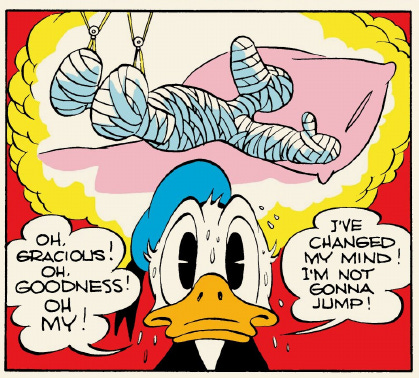
Donald Duck: Snow Fun
Carl Barks and Donald Duck's face as the soul of the human body

Snow Fun is a light and fluffy story next to its neighbors, consisting of two modest pieces yoked together rather crudely. Barks’s art continues to improve, with Barks skillfully recapturing some of the kineticism of the best Donald cartoon shorts—and developing Donald’s face as a major tool of emotion.
It takes some time to get there, though. The first, weaker bit consists of the nephews annoying and finally tricking Donald into getting them skis.
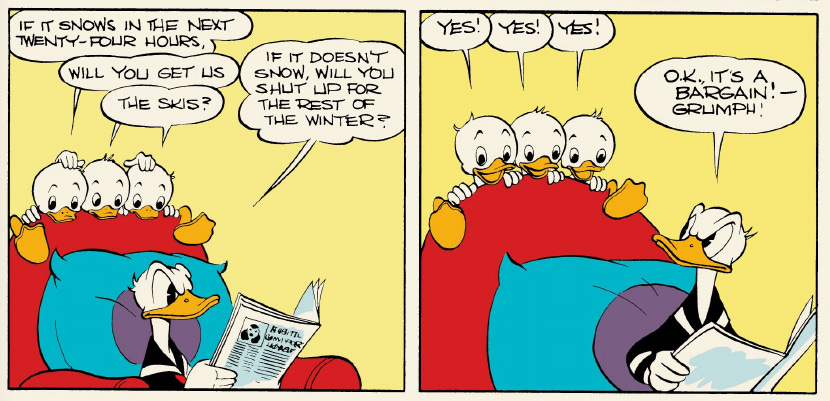
There is a nicely atmospheric nighttime scene of the nephews with some unusual shading, but again, Barks seems to be filling out the page count a bit.
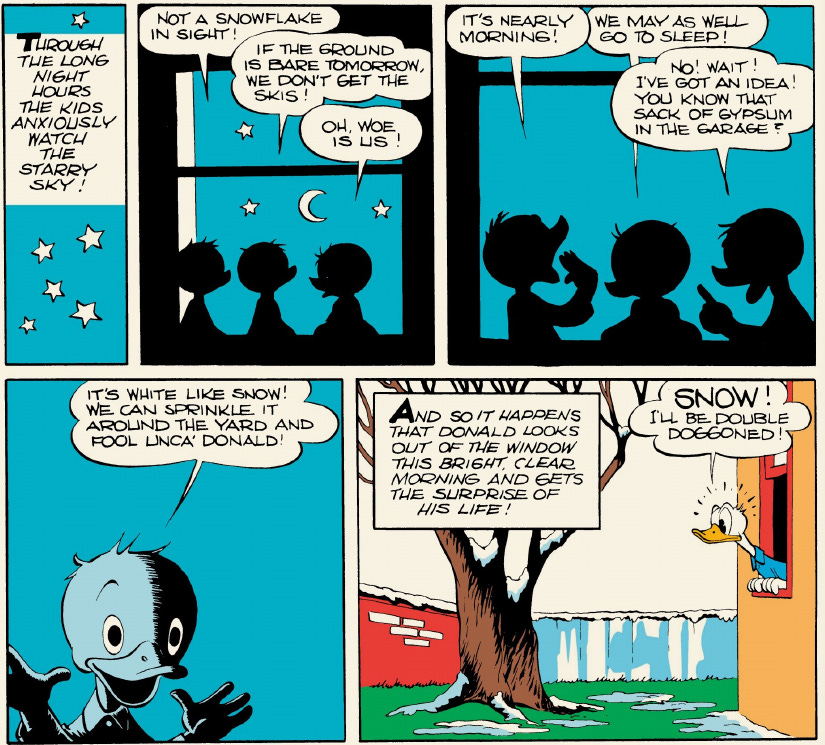
No snow is forecast, so the nephews put gypsum on the ground to fool Donald, who predictably blows up when he finds out he’s been swindled…only for a snowstorm will blow in as he’s chasing them.
The meat of the story is once they get on the slopes, when Donald shifts from grouchy parent into overstuffed blowhard.
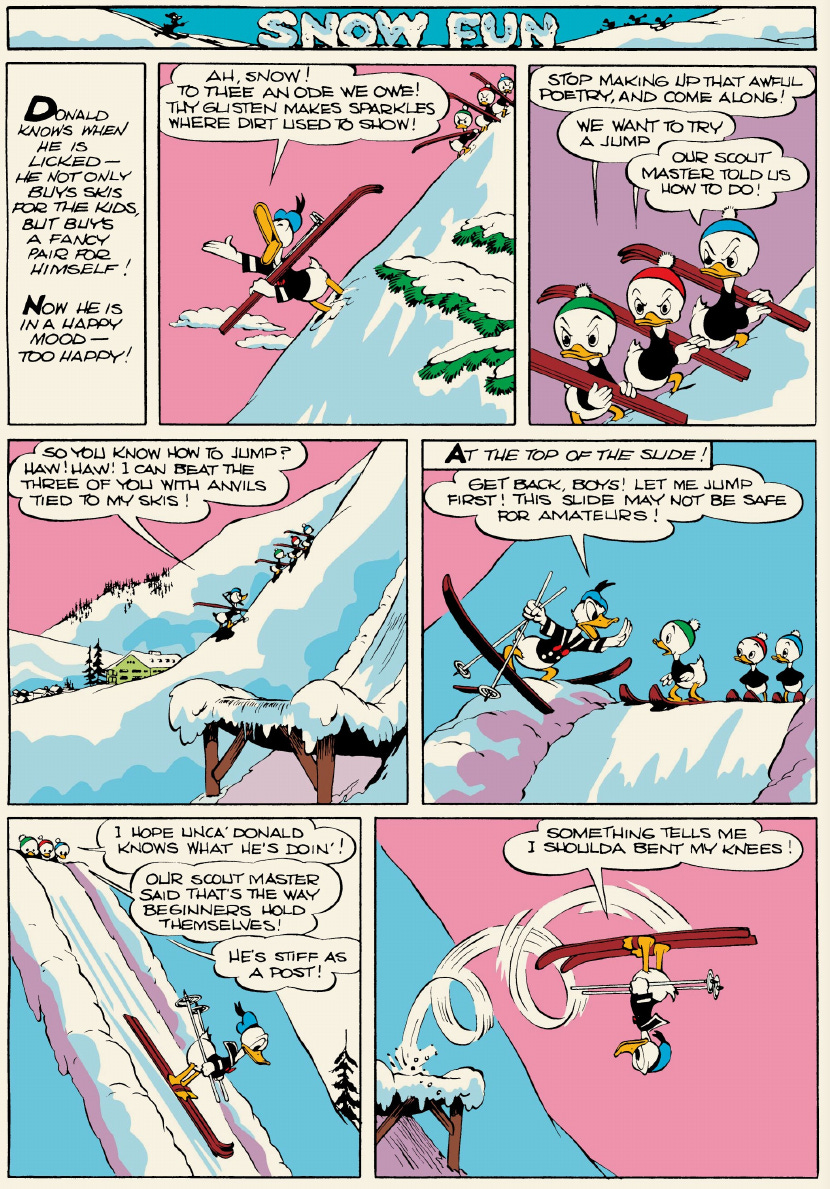
Donald shifts into his manic romantic (“too happy!”) mode, which we saw briefly before in The Limber W Guest Ranch. Donald becomes taken with some new activity, first rhapsodizing over it, then pretending to expertise that he does not have. The story and humor come from him being repeatedly deflated.

Just like in The Limber W Guest Ranch, nature doesn’t conspire to foil Donald—mostly. Until the very end, nature is blessedly indifferent to Donald, who proves quite capable of dooming himself without assistance. After his first two failures, he concludes, naturally, that he hasn’t been thinking big enough.
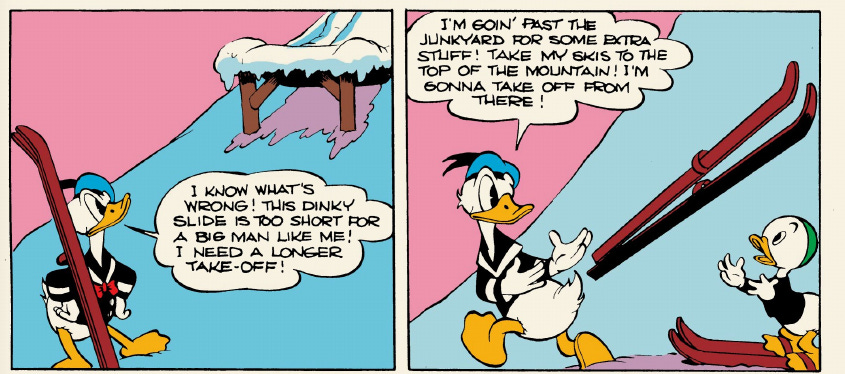
The strength of the story primarily visual. Confined to still images, Barks gets by with impressively kinetic art and distant landscapes that suggest they’re up in the Alps.
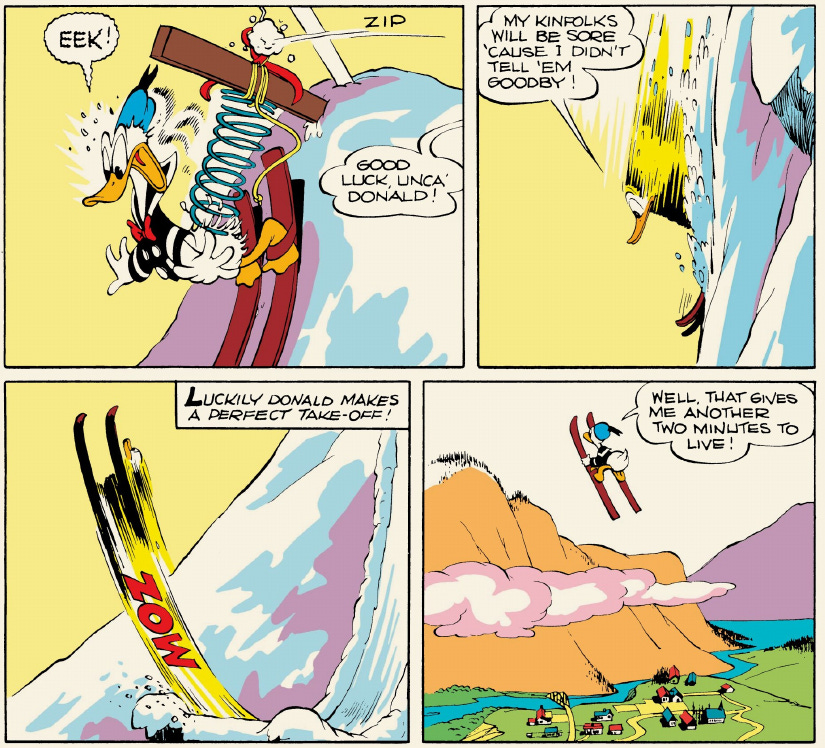
Despite the lightweight story, it’s probably Barks’s most skillful translation of cartoon gags to the comics page so far. The entire ski jump sequence plays smoothly and elegantly, as Donald thinks he’s actually going to set a new world record and, secondarily, not die:
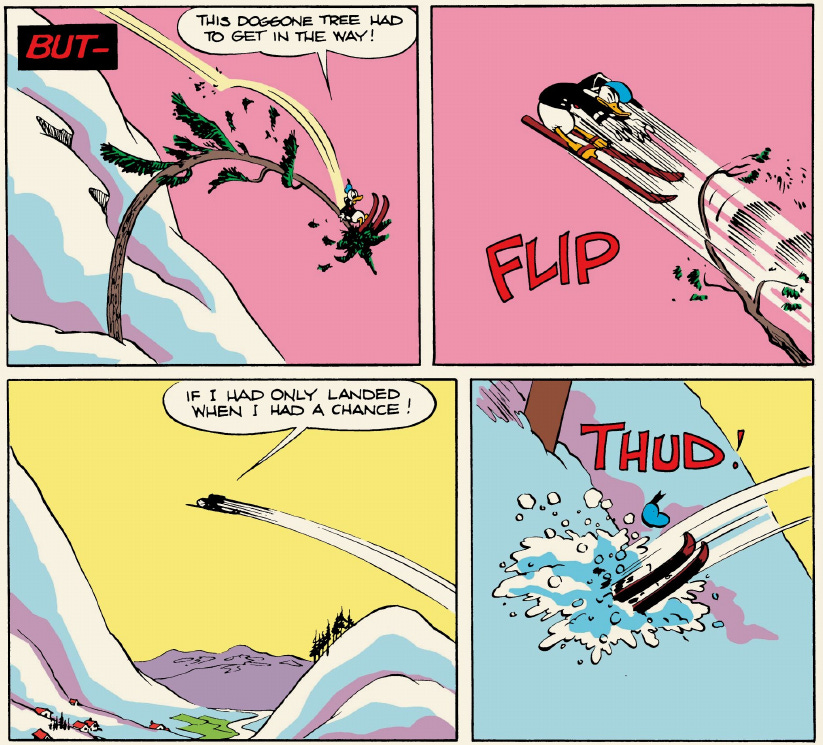
This is visually masterful, viscerally conveying the tree flip and reducing him to an out-of-control longshot blur. The large red-on-black BUT— lampshades the reader expectation that there’s no way Donald will succeed. It’s very satisfying in itself.
Donald’s final indignity seems inevitable, the point where nature finally says “Okay, no, you are not going to set a new world record by being this incompetent and irresponsible,” and throws up a tree to bounce him back. But it’s a very quick gag that doesn’t really contribute to the cohesion of the story.
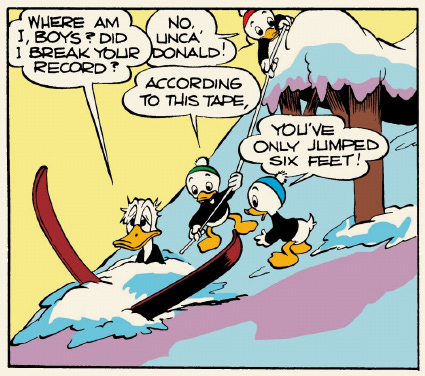
Something of a fluffy story, in total.
Anyway, by this point Barks was amassing a modular bundle of personality traits for Donald that he could select from depending on the story. Some of these traits were incompatible with one another. Sometimes Donald could be remarkably acute, at other times completely delusional and dense. He could be the nephews’ equal, their inferior, or occasionally their superior.
For Walt Disney, no connecting thread was needed at all. Barks did not go that far, the remaining unity was increasingly hazy, even leaving out the heroics of Mummy’s Ring.

Following Disney, though, the best place to look for unity is on the surface. Whatever Donald was in the cartoons, he would have that ridiculous voice that Clarence Nash gave him. Shorn of the voice, what’s left is his appearance, and specifically his face. Barks tuned Donald’s face to express four particular emotions vividly: excitement, disappointment, rage, and fear.
“So what?” you say. “Those are four of the most common human affects.” But try to name another comic character that vividly expresses all four of those affects in response to simple and complex stimuli. Asterix, Pogo, and Ignatz Mouse have far more limited affective ranges. There’s only one other famous character who comes to mind, Snoopy, though Schulz kept him mostly in fantasy worlds while his human characters remained resolutely fixed in their traits.
My proposal is that for Barks, what remained constant in Donald was only that full-spectrum emotional expressiveness—unattached to much in the way of specific personality traits or behavioral traits. Donald retained certain strong tendencies, for sure, but Barks was willing to dispose of most of them temporarily for the sake of greater story flexibility. Only the expressiveness itself is constant. Donald is always a character whose face displays excitement, disappointment, rage, and fear in a way that brings about deep reader identification. Not just an everyman, but the inner face of the everyman.
Barks portrayed transparent, ineffable emotion in the face of an anthropomorphic duck. “The face is the soul of the body,” Wittgenstein wrote, and Barks located the heart of a human being in Donald Duck’s face.