

Donald Duck the Human: The Mighty Trapper
Duck-humans and bohimatons

Donald Duck was never much of a duck. “Funny animal” stories generally use the animal aspects of their characters for incidental humor, not as essential elements. Bugs Bunny chews on carrots and Ignatz Mouse likes cheese, but they’re basically comic human surrogates, not least of all because they talk.
Instead of a duck-rabbit, Donald is a duck-human; you can’t see him in both aspects simultaneously, even though they’re both there. The aspects don’t mesh, and the nature of these stories heavily favors the human aspect. Growing up on this stuff, I took it in complete stride when “real” animals appear in these comics, as when in The Mighty Trapper (WDC&S #36, September 1943), Donald buys a big dog to disguise as a wolf so he can convince the nephews he’s a mighty trapper:
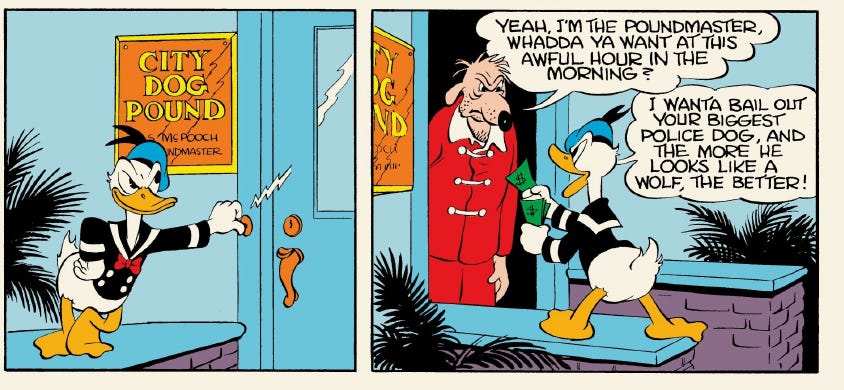
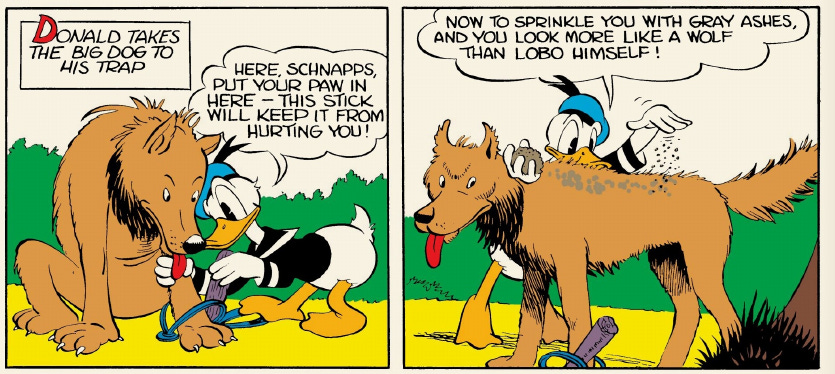
“A duck is disguising a dog as a wolf” sounds bizarre in the abstract, but you take it in stride because the art so clearly cues what is and is not anthropomorphized. Just to underscore the absurdity, Barks made the houndmaster a dog-human and named him McPooch, and echoes the gag at the end by having a mouse-human selling mousetraps.
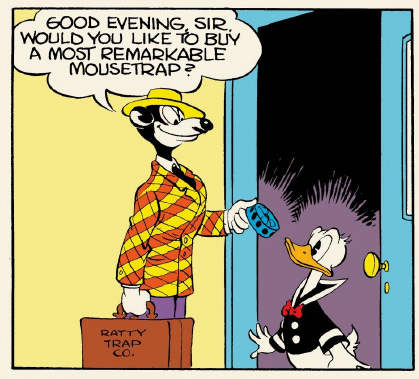
Not much more is made out of this, but I sense Barks found it amusing in a silly way. His Disney editors strictly banned any use of actual human figures (which Barks would find out in Dangerous Disguise years later), so I see him having fun with it. Nothing in his pre-Disney art suggests a particular interest in drawing funny animals; it was something that became important to him by happenstance.
The backstory is once again Donald’s braggadocio, as though Barks were trying to refine the rough formula of The Limber W Guest Ranch from the month before. Once again, the story doesn’t quite gel. He sets up the nephews in direct competition with Donald this time, but the antagonism dissolves before the story winds down.
Technically, however, Barks is improving at an incredible clip. Donald is far more expressive in this story (as are the nephews), and the visual structuring is considerably more complex. It’s a crazy advancement. The first page is the most dynamic opening to date:
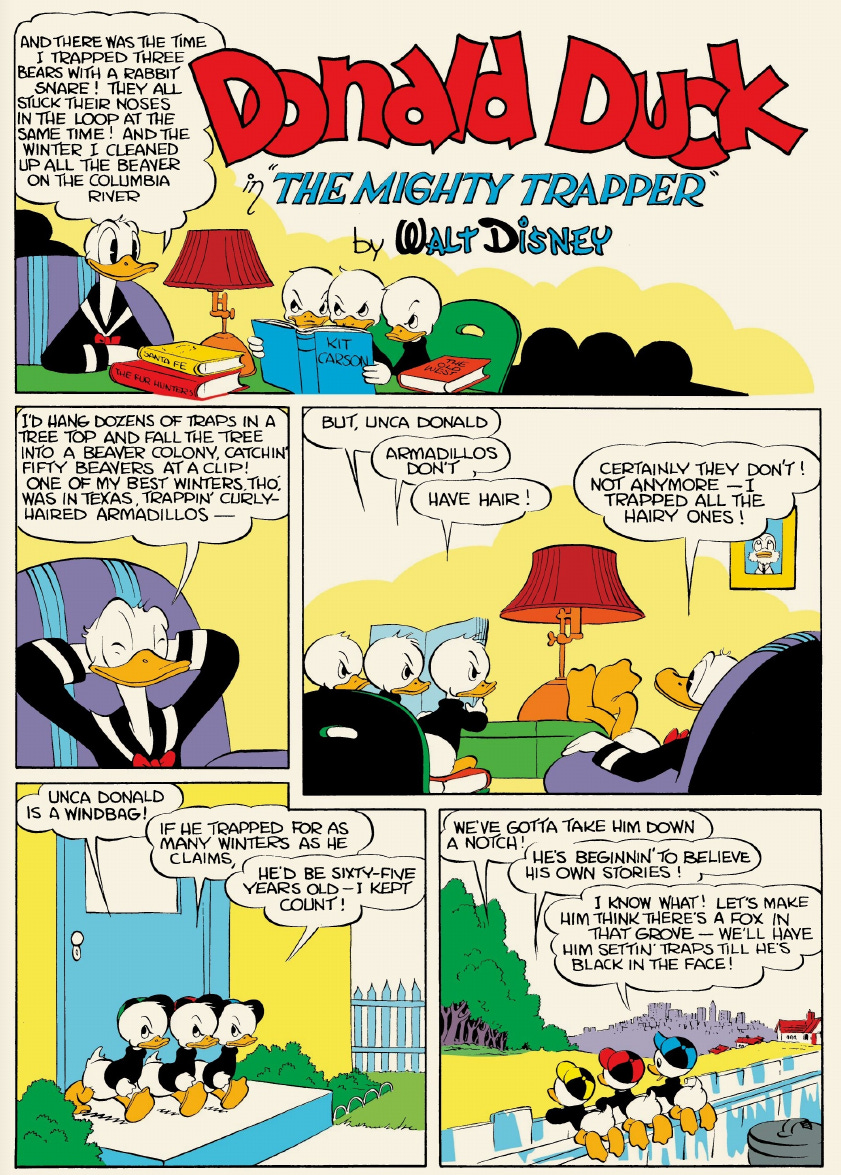
Donald’s smug windbaggery and the nephews’ annoyed skepticism come across clearly despite the increased amount of text. The irregular vertical paneling—I think Barks’s first—could be interpreted several different ways, but mainly acts to vary the pacing, drawing attention to Donald’s relaxed bloviating in the third panel, lounging with his feet up on the table.
The nephews do trick Donald with one of Daisy’s fox furs, which spurs Donald’s counter-ruse with the dog. Donald’s pride immediately returns.
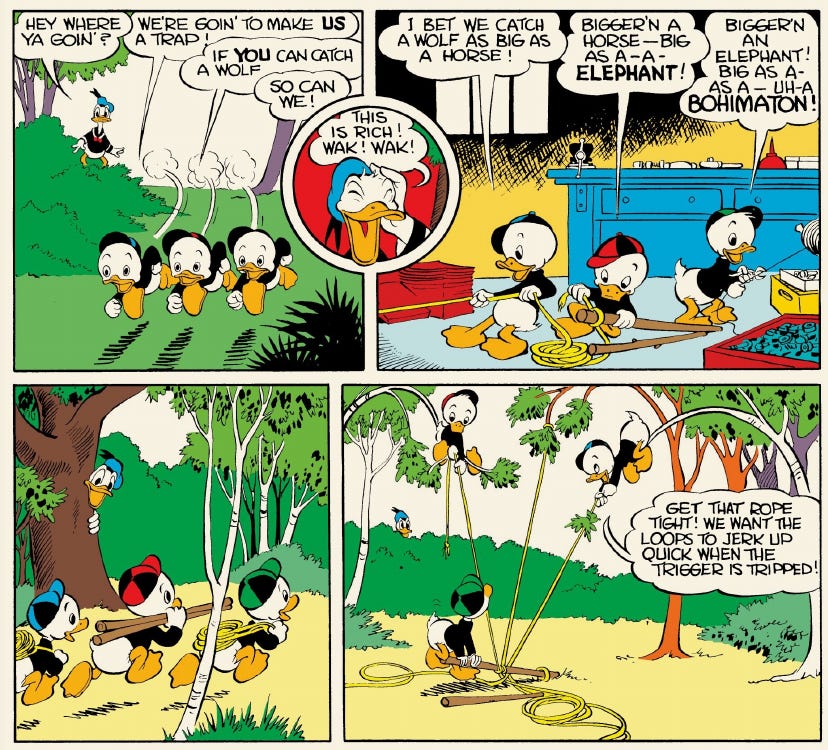
(Whatever a “bohimaton” is, this is the only documented use of the word anywhere. Barks later said he’d picked it up from an English logger, only to later say it had come from his first father-in-law. Barks’s wordplay is nowhere near as prominent as George Herriman’s or Walt Kelly’s, but he did have a great ear for it.)
Despite his bragging, Donald and the nephews do possess genuine trap-setting skills, something that’s never explained. Donald must have gotten his practical knowledge from actual experience, but unlike with Scrooge, who always had one story or another of why he knew this or that, Donald doesn’t really have a past, and so Barks always avoided filling it in.
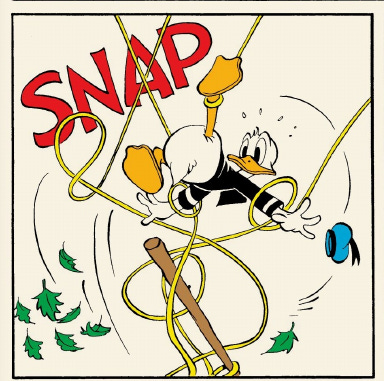
The kinetic action of the traps being set up and deploying is expertly done by Barks, particularly when Donald accidentally triggers the nephews’ trap:
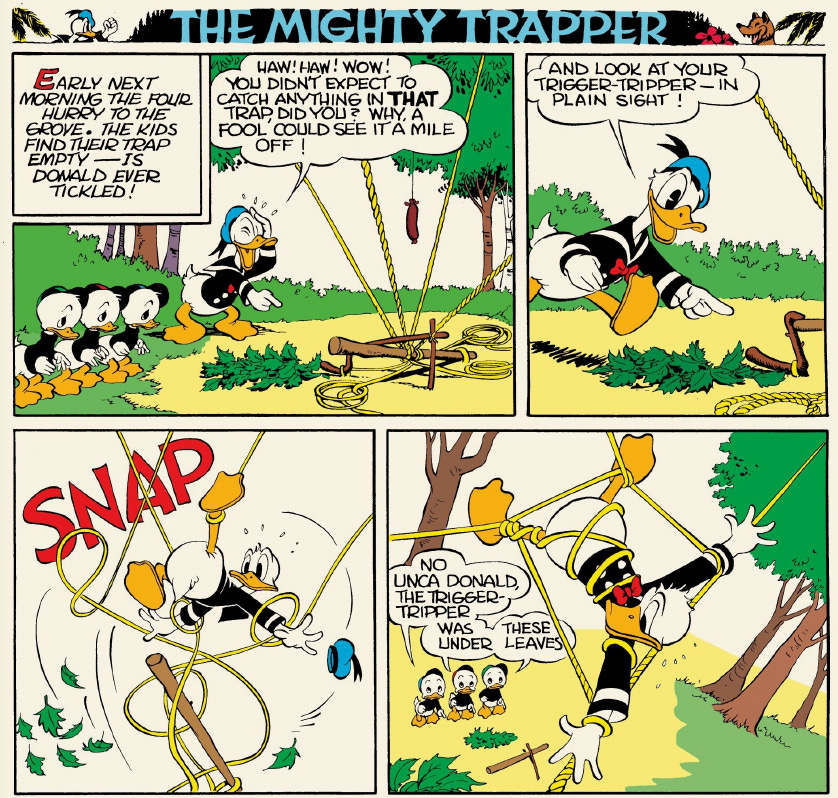
The presentation here, from Donald’s foot just above the leaves to him being hoisted into the air with some of the ropes still contracting to the downward shot of a suspended Donald, is fantastic.
Which makes it a shame that the story abruptly ends with the nephews getting caught and the need for an interstitial panel to explain their offscreen rescue, a device Barks normally was too skilled to use.
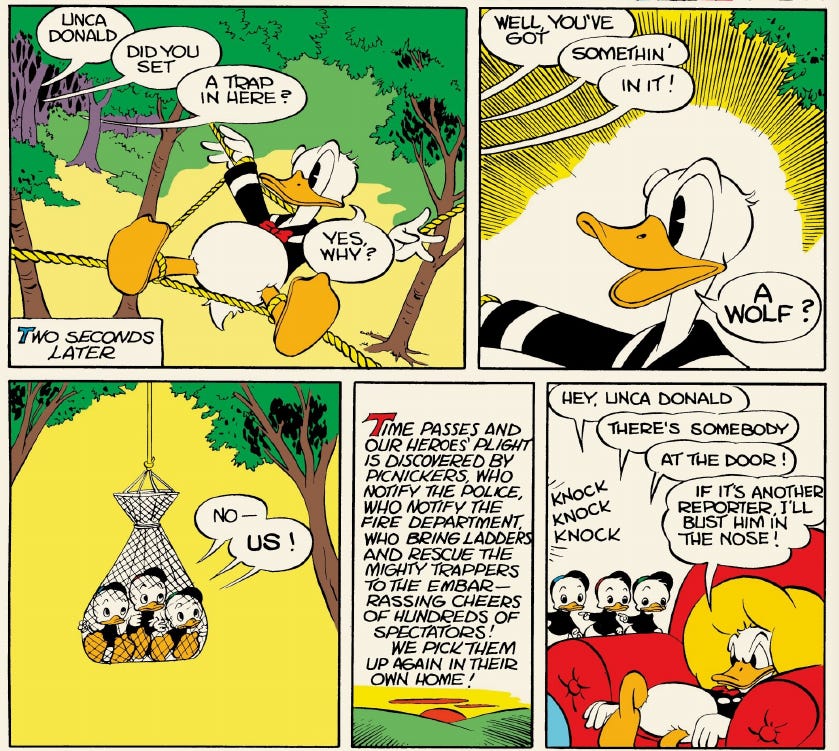
Wouldn’t you want to see Donald embarrassed like this? Barks was generating at least one story a month, but five months in, his intuitions hadn’t quite gotten up to speed to let him structure stories neatly at that pace.
Yet things are beginning to coalesce, as with the progression of middle-left panels showing more vivid emotion from Donald than he’d managed beforehand:
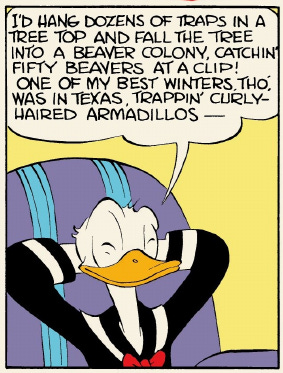
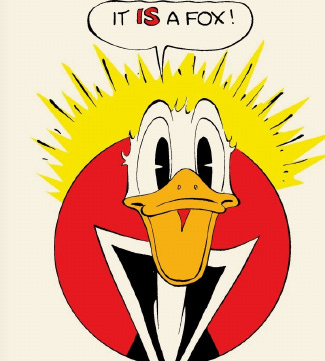
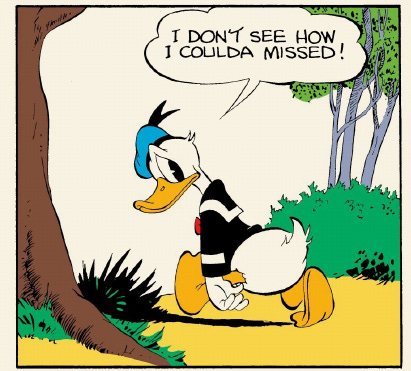
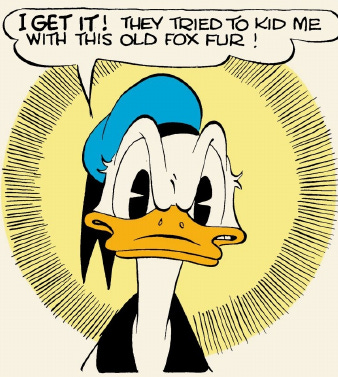
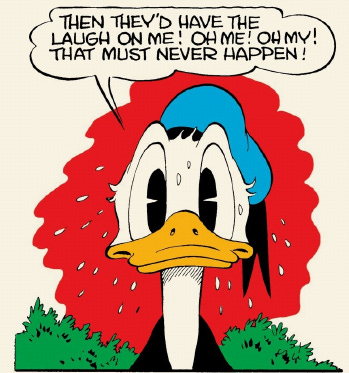
They serve as neat anchor-points for the Donald’s emotional progression and ground the pages they’re on. And they augur the more significant development of Barks’s first solo adventure story, The Mummy’s Ring.