

Donald Duck the Volatile: High-Wire Daredevils
Carl Barks and duck-human folly in a little masterpiece

High-Wire Daredevils (WDC&S 49, October 1944) is a major turning point, the first story where Barks pulls off a complicated narrative arc while holding it together thematically. Barks had been experimenting month by month and developing with each story, and this story is the first instance where it really pays off. It merits a close reading.
Despite a silly premise that only escalates to the unlikely sight of Donald walking a high wire across Niagara Falls, the story flows beautifully, united by the continuity of Donald’s folly in a variety of forms. It’s probably the best story Barks had written to this point, far more dense and richer and something of a miracle coming after just a year or two of work in the medium.
During that time, Barks had been experimenting with different versions of Donald and the world he inhabits. High-Wire Daredevils takes a bit of Donald’s psychopathic behavior of Purloined Putty but mixes it with a much heavier load of poetic justice and some flaws that are humanizing rather than alienating. Donald is not a nice person in this story, but his comeuppance comes early and often. The escalation here feels organic and satisfying.
Donald starts by searching for the nephews:
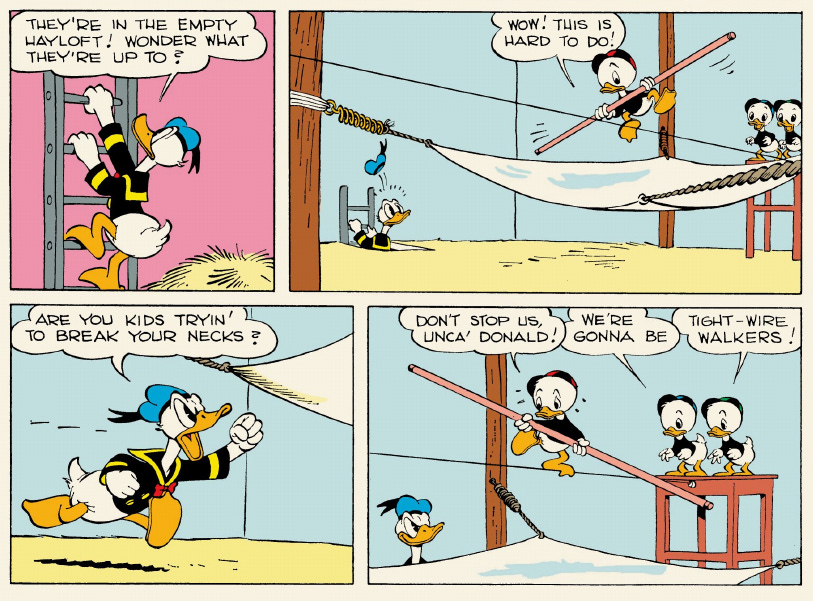
There’s newfound efficiency of development here. In four panels, Donald goes from curiosity to surprise to angry concern to malice, yet it doesn’t feel rushed or incoherent. Donald presents as volatile, excessive in all his emotions, not just the bad ones.
The winner this time, however, is malice:
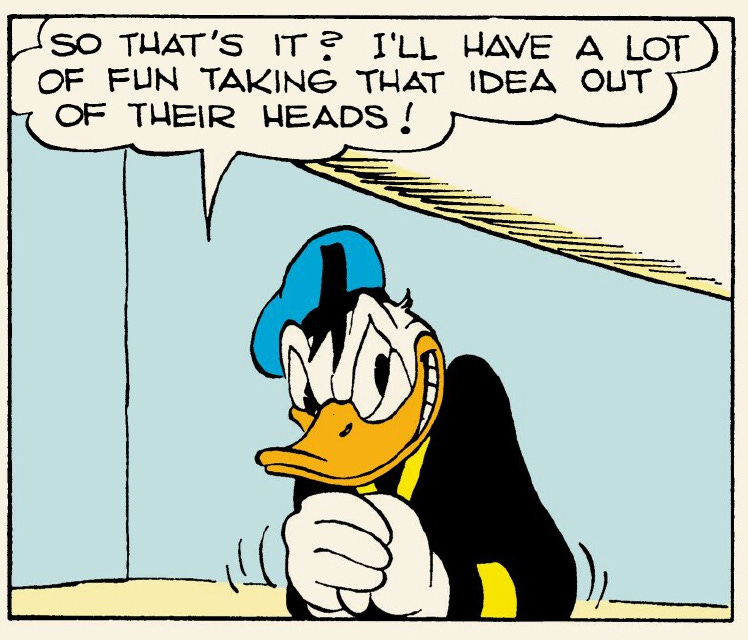
Yet Donald is much more of a comic figure here. In The Purloined Putty, Donald’s ethical pretense for acting psychotic made him ironically less sympathetic than simply being a moustache-twirling villain.
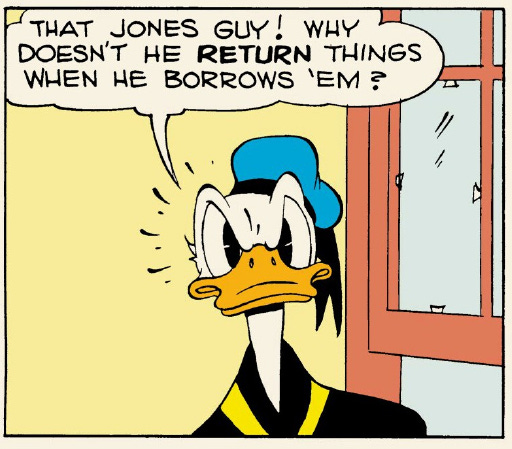

In the past, Donald competed with and sabotaged the nephews for some petty ulterior motive—money or pride. Here there’s no evident pretense at all—he just decides to mess with them. He puts ball bearings in their pole to upset their balance and generally makes a nuisance of himself.
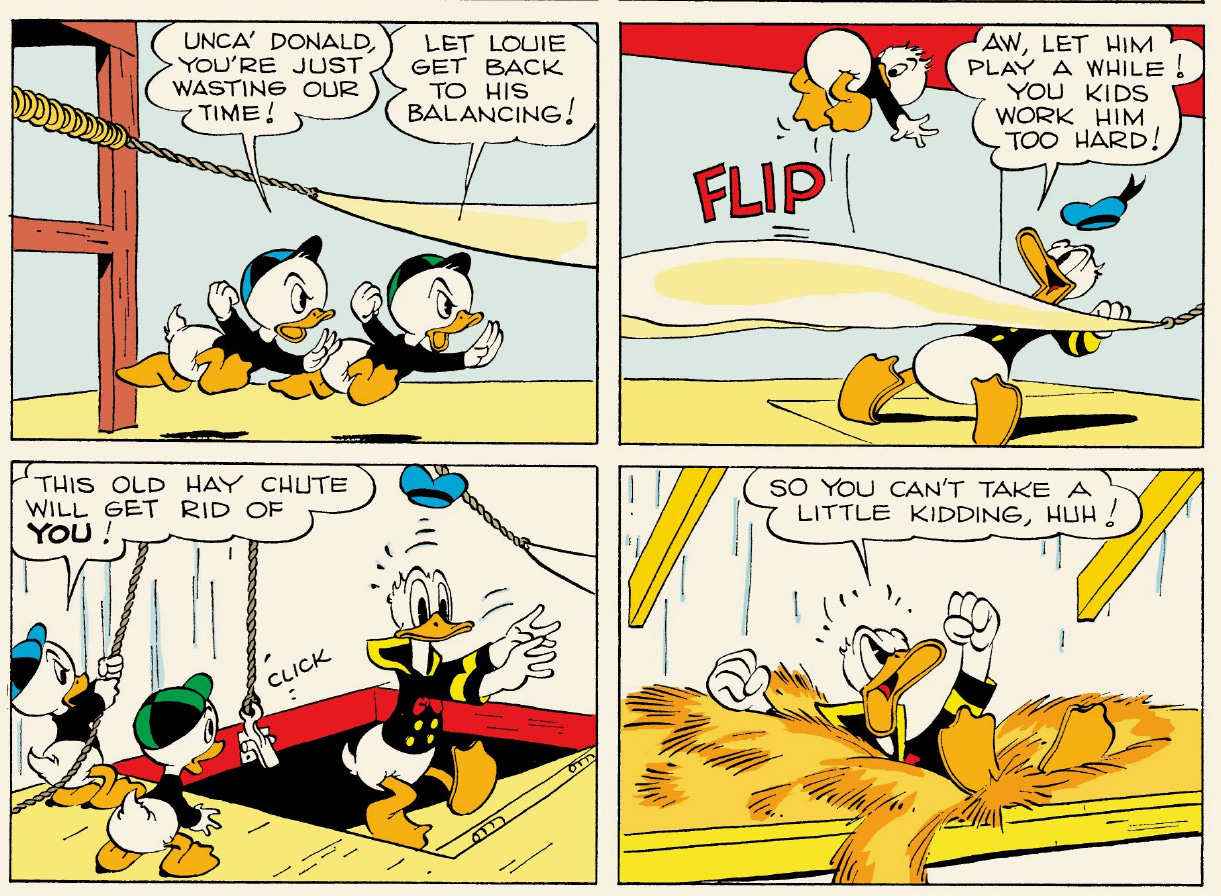
Yet the sequence plays as more pathetic than dangerous or malevolent. Donald is just being a jerk, not a psychopath, and the nephews successfully stand up to him quickly, leaving him in a defensive and helpless rage. The nephews aren’t tormented by him so much as irritated and resigned. He is that obnoxious family member you just have to tolerate. You can’t quite sympathize with Donald, but you can relate to someone so consumed by his momentary whims.
Having already done a turnaround on Donald within three pages, Barks still has seven pages left. The nephews turn out to be quite talented, and in another softening move, Donald immediately recants his disapproval:
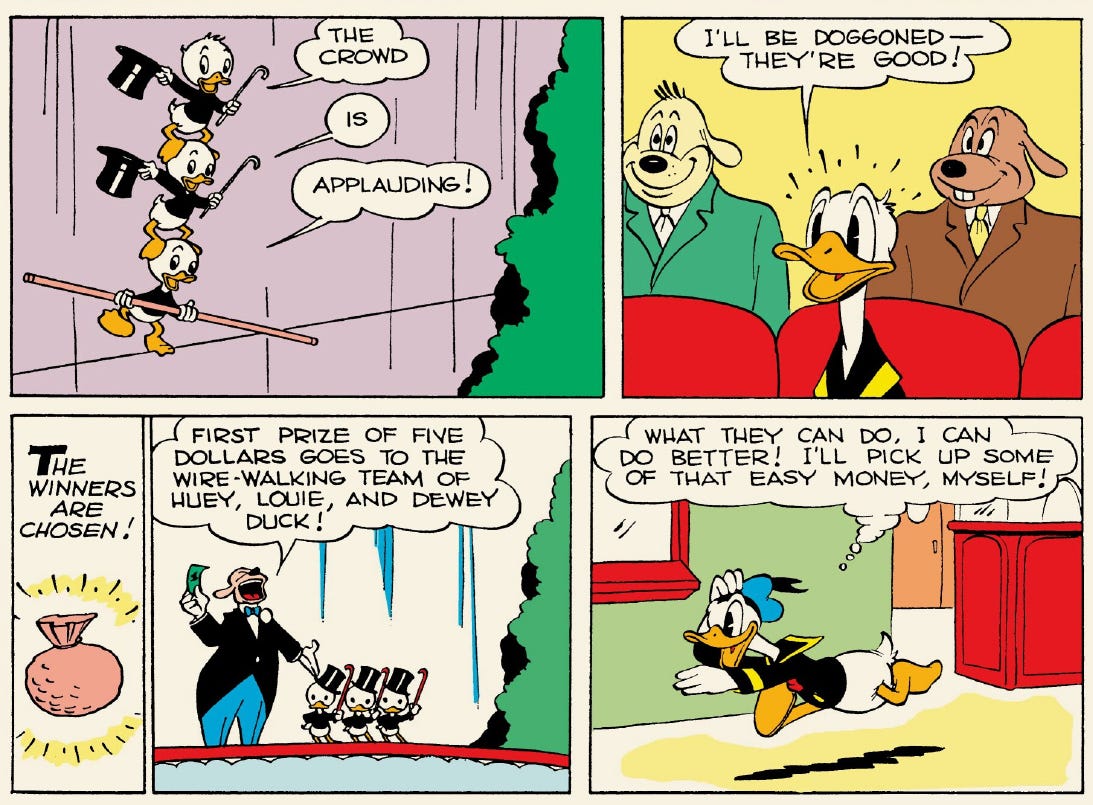
Once again, we get the compression, as Donald goes from surprised admiration to egotistical greed in three panels. Once again, Donald’s malice is softened by his volatility. Barks’s solution to the problem of comedic evil is to contextualize the bad behavior as momentary assertions of our worst selves. We relate more to Donald in this story because it is an exaggeration, not an alienating psychopathy.
The exaggeration continues when Donald, finding that he too is a talented high-wire walker, decides to go after the “BIG money”—by walking Niagara Falls.
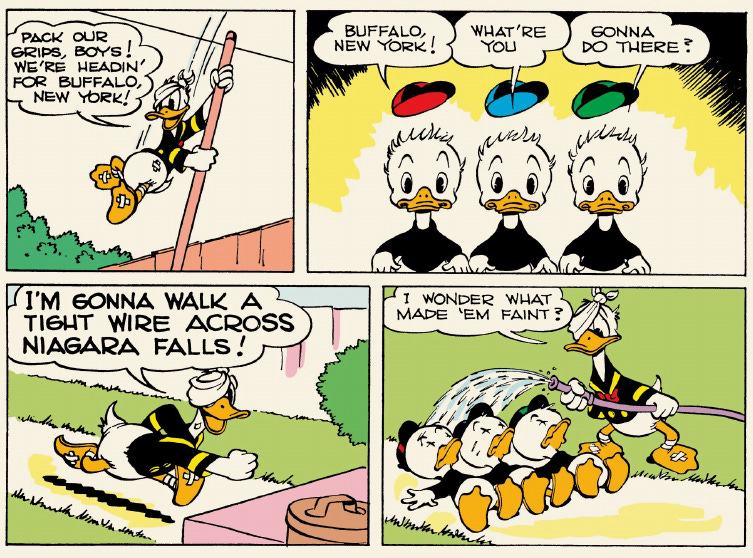
Again, Donald’s lack of reality tempers the malice. Having ludicrously raised the stakes out of ludicrously inflated ambition, fate correspondingly punishes him in the most over-the-the ways for his hubris. Donald’s initial malice now comes off more as one example of delusional emotional excess—he’s momentarily vicious, but isn’t everyone? Now he’s momentarily grandiose. Donald is human folly across its many forms, exaggerated in every instance.
Huge folly leads to a huge comeuppance. Barks gets some humor out of Donald remaining resolutely oblivious to the insanity of his plan until the very moment he starts across the falls:
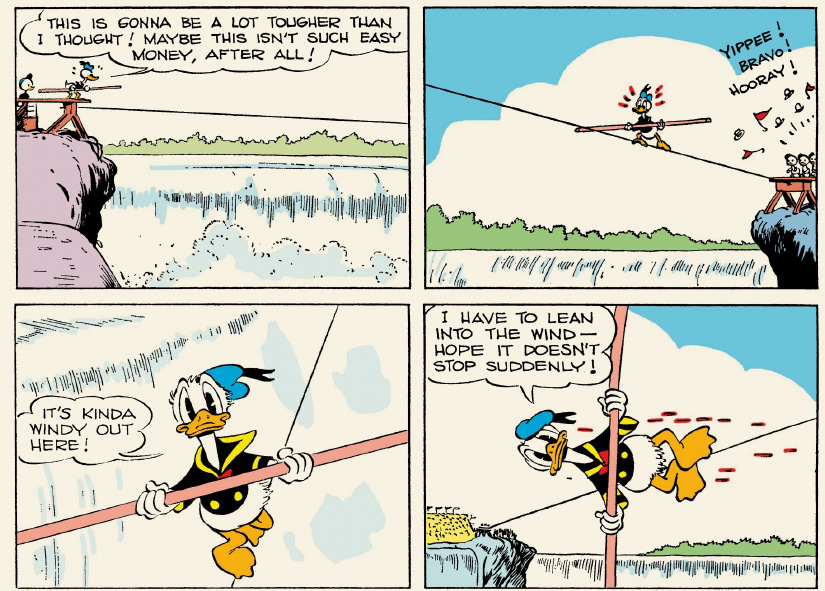
“Maybe this isn’t such easy money, after all!” The situation is crazily exaggerated, but it’s very classically constructed: a delusional Donald almost gets what he wants (money, fame), only for fate to intervene and teach him a lesson.
Even on the wire, Donald’s reactions are comically understated, like he’s finally realizing that this was a terrible idea yet rejecting that thought with all his pride. So, nature intervenes. The wind stops, he drops the pole, and a lightning storm comes in:
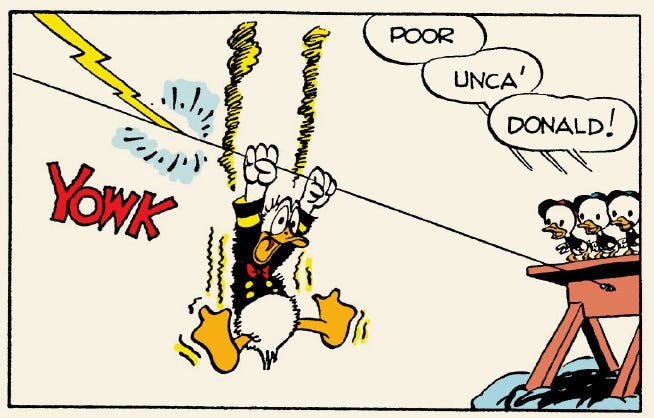
In earlier stories, nature usually remained a passive and mostly indifferent force that only occasionally intervened in the karmic machinery—as in Snow Fun, when Donald engineered a crazy, dangerous ski jump that nearly let him set a new world record, only to hit a tree and be bounced back to his starting point.

Everything is much more fleshed out here—it’s a huge leap in sophistication. Here, Donald’s hellbent (and maybe even slightly admirable) ambition won’t yield to the reality of the situation, so he’s going to be relentlessly punished until he gets the message. Barks found his recipe for grounding his physical gags in nigh-universal human experience of people just not getting the message.
The ending, too, is a marvelous construction. On his second try across the falls, Donald puts glue on the pole so he won’t drop it, neatly echoing his sabotage of the nephews’ pole at the beginning of the story. There, he made them fall off; here he’s been put in the same situation he constructed for them, except he’s chosen to engineer an unfathomably dangerous situation for himself.
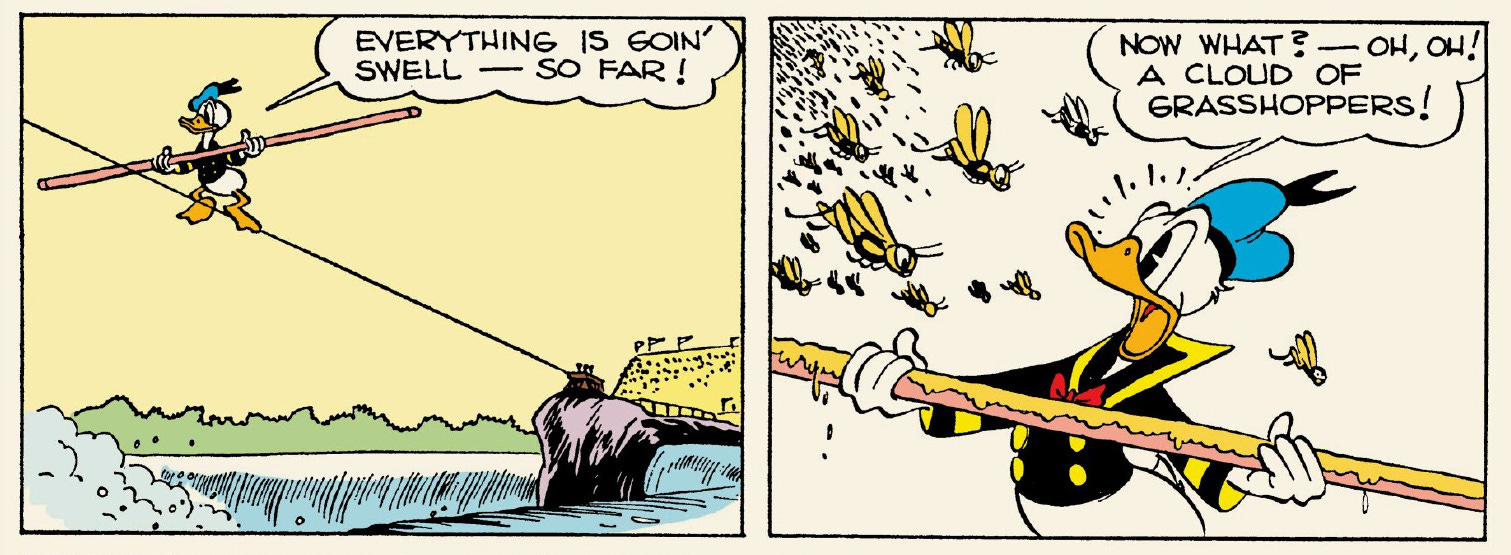
Like clockwork, every time Donald fails to learn his lesson or even see his self-engineered situation for what it is, another plague comes in. Here he’s essentially Pharaoh in the Bible, almost letting the Jews go before reneging yet again, only for another greater punishment to be dumped on him and the process to repeat.
The last page is a little miracle of compression. It’s amazing how much Barks packs into eight panels and how perfectly it completes and unites the themes.
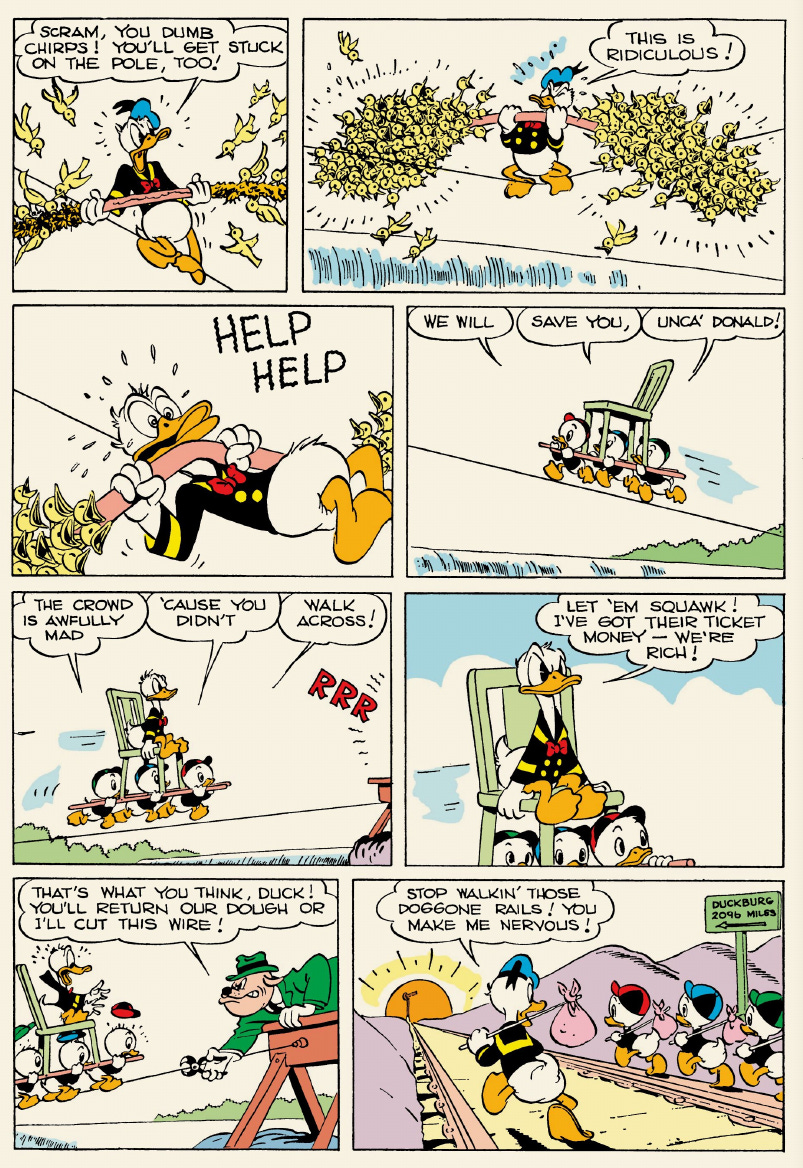
(Also, 2096 miles is approximately the straight-line distance from Niagara Falls to San Jacinto in California’s Inland Empire, where Barks was living at the time. Barks hadn’t yet specified that Donald lived in “Duckburg, Calisota,” but he’d mentally already located him there.)
After a plague of grasshoppers, we get a plague of birds. Donald still hasn’t learned, since he figures that as long as he’s got the money, it all worked out. No, says the audience member: return our money or we’ll kill you and your nephews.
(Note also how the nephews are able to blithely rescue Donald as though it were nothing, running across the wire carrying a chair with no pole, as though it were nothing. This is completely bonkers yet in the logic of the story, it makes perfect sense, since they had the same talent but remained modest in their ambitions. They, too, sought fame and fortune. Donald’s sin isn’t in wanting money and fame, but in his sheer excess and delusion.)
The angry, wire-cutting man is just one final messenger of fate, uniting nature and humanity in a single cosmic force to force Donald to recognize that he will never benefit from his folly. Pride, delusion, greed, stubbornness—they are all here, all volatile, all convincing. Everything links back to Donald’s folly. “This is ridiculous!” Donald says, and we roll our eyes because the ridiculous is only matching Donald’s own human ridiculousness.
Yet there’s an odd sense of reassurance too, since fate punished Donald in accordance with his folly but didn’t go further. Past stories saw Donald brutally injured or beaten, often without having done anything to provoke it, but he survives physically intact here, morally chastened but uninjured.
The final panel ties everything up in a final ironic reversal, going from oblivious risk-taking to hyper-vigilant parent. We see that Donald has very much learned his lesson, only to take it too far in the other direction. From the thoughtless, trolling parent of the beginning, he’s now a scolding, protective one. It is remarkably elegant.
What the story has that its predecessors lacked is balance. The machinery works very smoothly, and Donald’s initial cruelty gets nicely dwarfed by what he subsequently brings upon himself. His motives are just human enough to provoke empathy, yet they are just exaggerated as his subsequent comeuppance.
Barks prodigiously joins pieces of the previous stories into a coherent unity, where Donald can be volatile yet coherent, an icon of human folly. There’s a depth here that Barks had hinted at before but never reached. It’s never quite obvious, because the comic surface belies the elegance of the construction, but especially in the context of the preceding stories, it is a major milestone in Barks’s development.