

Donald Duck's Arctic Adventure: Frozen Gold
Carl Barks and heroism as escapism

Over a year after Mummy’s Ring, Carl Barks published his second Donald Duck adventure—and a third. January 1945 saw two 24-page adventure stories from Barks (Frozen Gold and Mystery of the Swamp), as well as his usual comedic ten-pager. Like its predecessor, Frozen Gold (FC #62, January 1945) tries to find a place for Donald and the nephews in a serious plot. Mummy’s Ring did so by making Donald more generic. Like other Disney icons, Donald was made to be flexible, but if there was a flaw in the quite proficient Mummy’s Ring, it’s that Donald wasn’t much of anyone at all for a lot of the story. Frozen Gold fixes that. Donald is finally both himself and a hero—sort of.
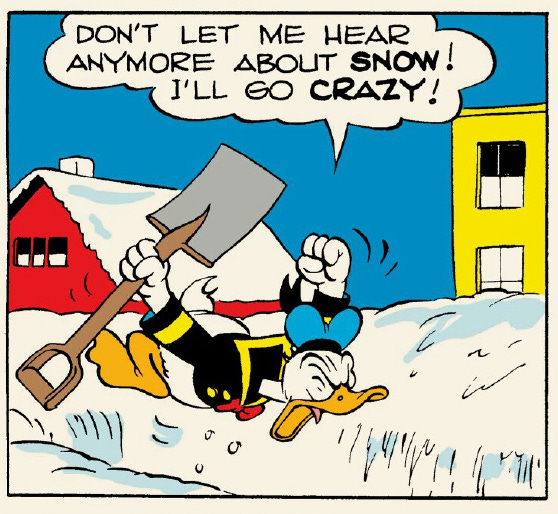
Mummy’s Ring began with Huey being kidnapped in what seemed to relate to a political dispute over Egyptian sarcophagi. Frozen Gold starts with a much more recognizable Donald, fed up with winter, buying a plane to travel to warmer climes. He’s cold, grouchy, and temperamental. This panel could have come straight out of one of the comedic ten-pagers.
And the setup indeed could have generated comedy. Donald trades his house for a plane, only for the city’s mayor to ask that he fly a humanitarian cargo mission.
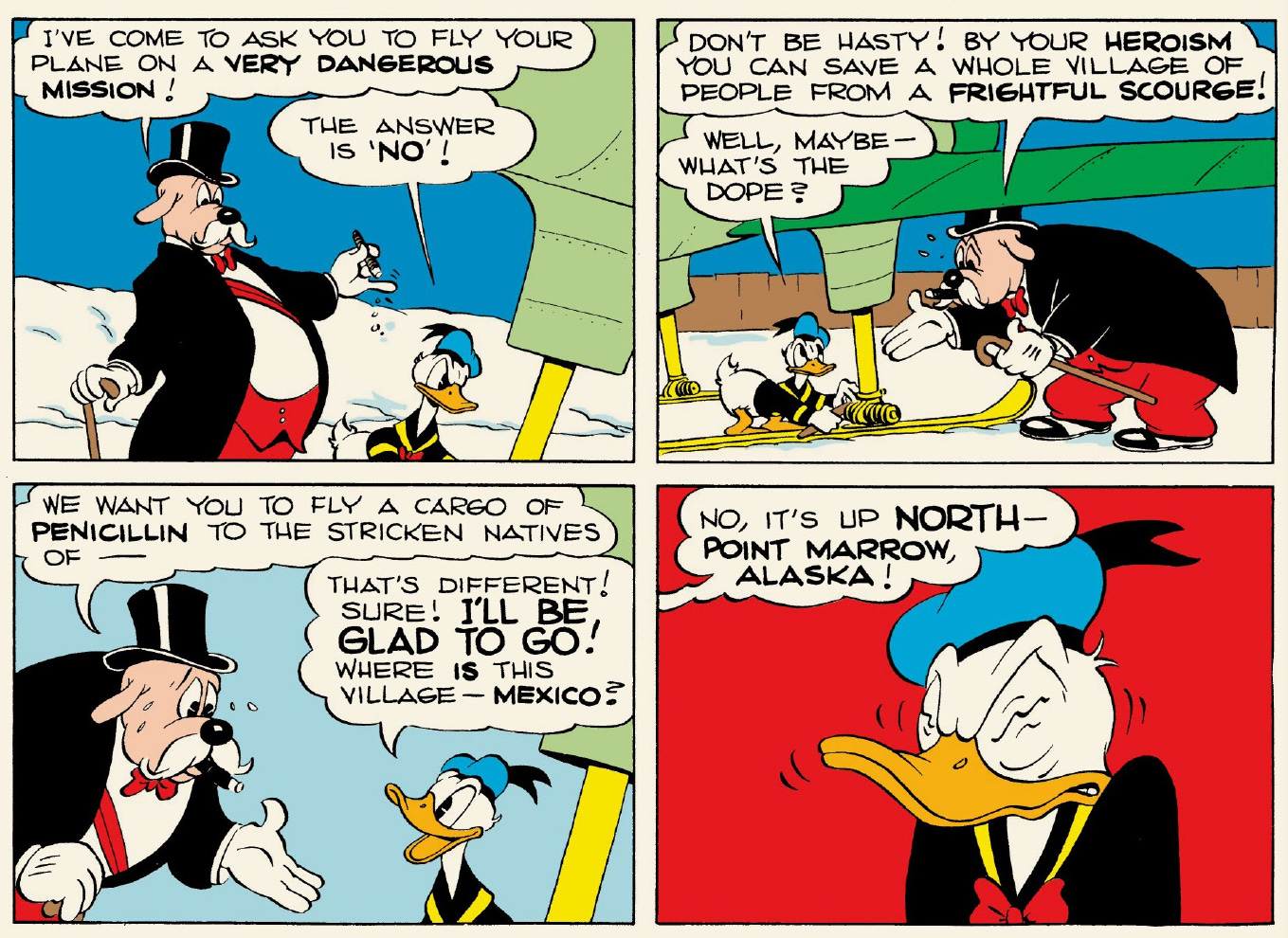
Again, Donald’s emotions are present in a way they weren’t in Mummy’s Ring. He has no interest in adventure or trouble, but signs on to do charitable work, only to get the classic switcheroo and find out he has to fly somewhere even colder than Duckburg. Again, we’re in the realm of comedy.
The intrusion of adventure comes on the third page, when shadowy figures (one named “Scarface” no less) plant a “package” on the plane for Donald to smuggle unknowingly, then send a telegram to “Pete de Fox” saying that “it” is on Donald’s plane.
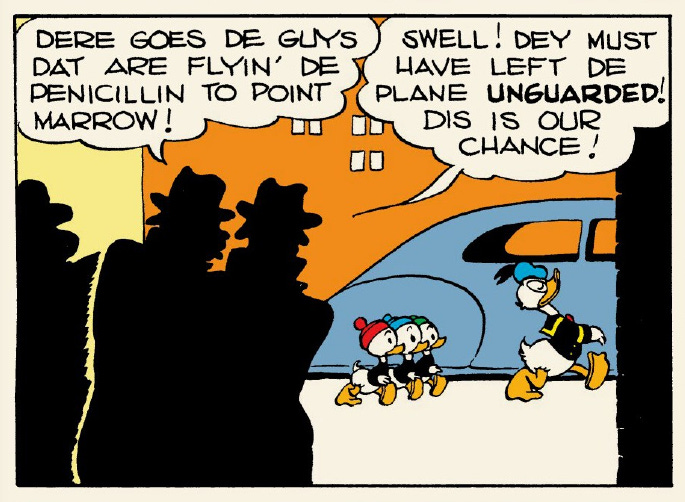
Barks’s approach here is subtler, setting up a different world from Donald’s own comedic one, but keeping them separate for the time being. The smugglers look on at Donald, who’s puffed up about being called a hero by the town, like they’re pulling Donald and his world into their different one.
From there, Barks transitions into adventure mode. Once airborne, Donald and the nephews fly straight into a snowstorm, but where it would have been disaster in a comic story, here Donald rises to the occasion. He remains recognizably Donald—in that he has a distinct personality, even if it’s more heroic and competent than usual—even as he’s put in genuinely testing situations. In Mummy’s Ring, the events mostly happened to Donald and the nephews. I’ve observed that Donald’s personality is very flexible—the issue comes when he lacks a personality, which was the difficulty with Mummy’s Ring. Here, Donald is able to be an agent without losing his identity.
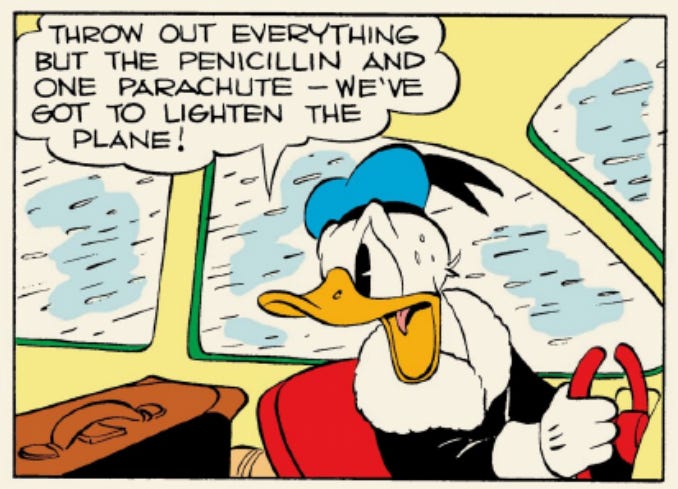
It’s on throwing out the stuff that they find a metal box belonging to “Klondike Joe,” a prospector who supposedly has millions in gold buried somewhere in Alaska. It’s the MacGuffin of this story, but it has no significance to Donald yet, who remains focused on the penicillin.
Alaska is very cold and very snowy. Barks uses a light touch, but natural weather chaos here feeds the drama just as it fed the comedy. Nature isn’t a force of fate here as it was in the ten-pagers. It’s just a fact of the world, sometimes hostile but mostly indifferent and sometimes manageable.
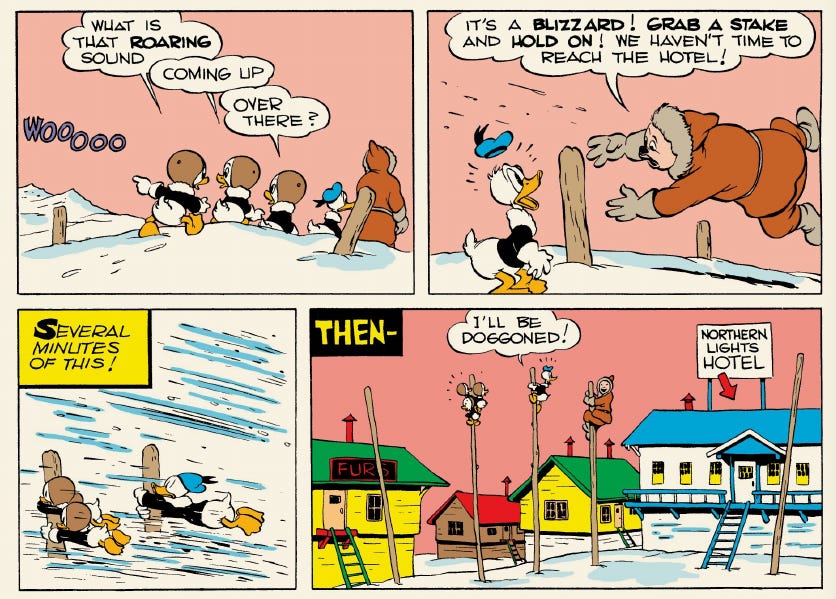
We see very little of the Inuit characters, but Barks does draw them to be recognizably Inuit and quite welcoming.
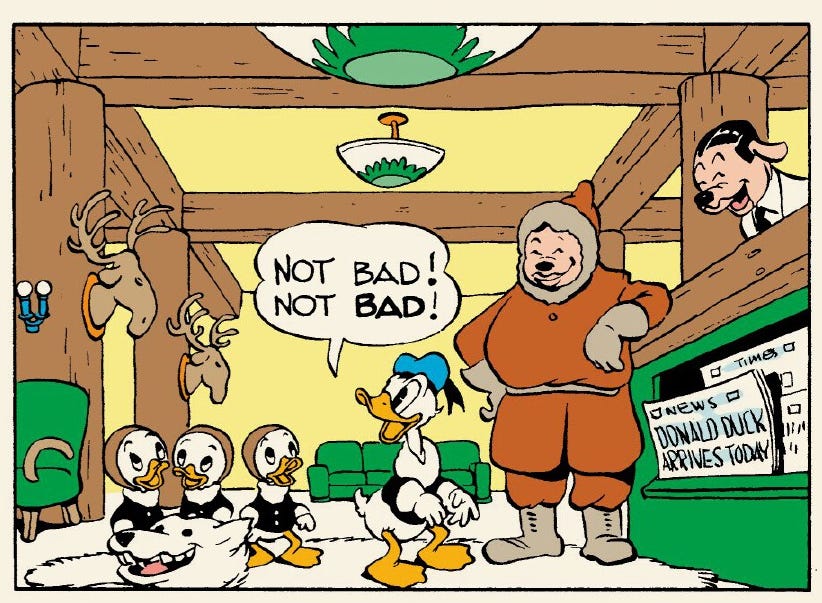
Even the bear rug is smiling! Again, this is a major development from Mummy’s Ring, where the world was primarily a political backstory and some detailed Egyptian scenery, but not particularly interactive. In a few panels, Barks suggests a functioning and friendly Alaskan community.
Pete de Rat and his henchman show up that evening to steal the box from Donald, only to kidnap him when he wakes up.
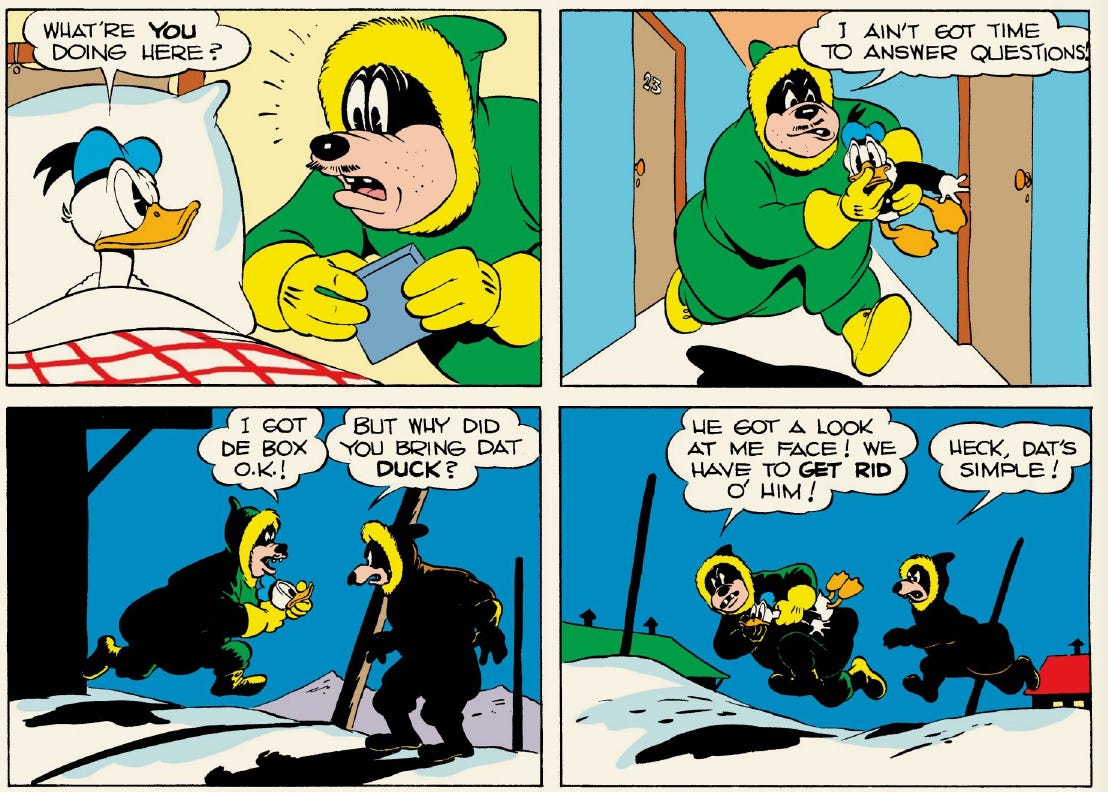
This version of Pete is far more serious and violent than previous iterations. He’s still a comic villain on some level, but he immediately announces his intention to kill Donald. Murder wasn’t in the cards in Mummy’s Ring, nor did we see Donald’s life endangered. (Huey’s life was, but we never quite saw Huey endangered, since he was sealed in a sarcophagus.)
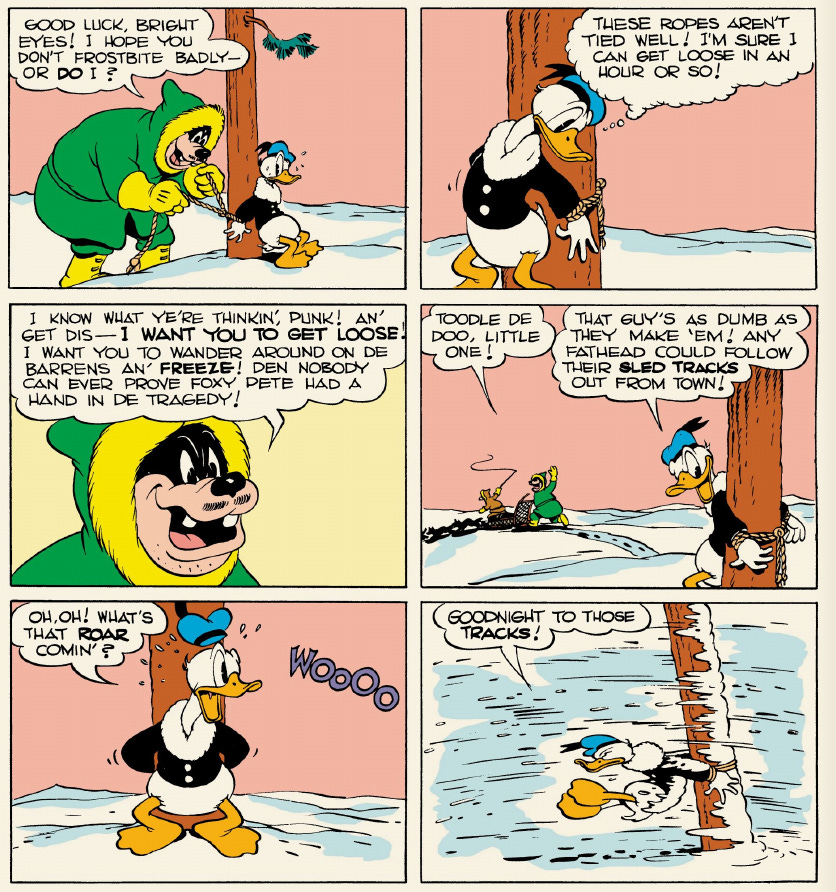
We now get to the long middle of the 24-page story, where Barks sets Donald loose in the barren wilds of Alaska. He reappropriates the typical physical comedy Donald’s used, but places it in an alien, life-threatening setting. In turn, he makes Donald much more capable. Throughout the story, Donald is unfailingly competent and clever without losing his animated expressiveness and emotional excesses. He always has a plan and never sinks beyond worry into despair. When nature foils his plans by blowing away his tracks, it feels less like antagonistic fate and more like the way of nature. But it remains close enough to the comic stories that it links this Donald back to his comic iterations, far more than in Mummy’s Ring.

Barks cuts back and forth between the nephews rescue attempt and Donald lost in the wilderness. It’s the Donald plot which is more comedic, despite him being lost, alone, and eventually snowblind.
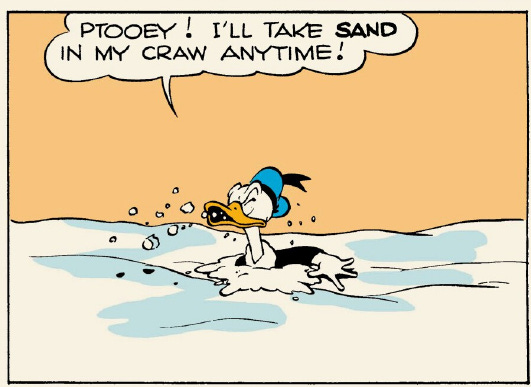
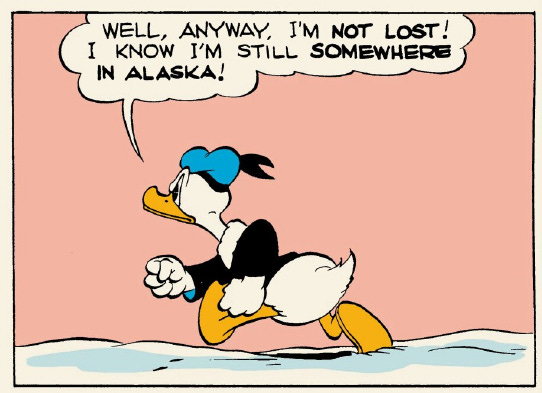
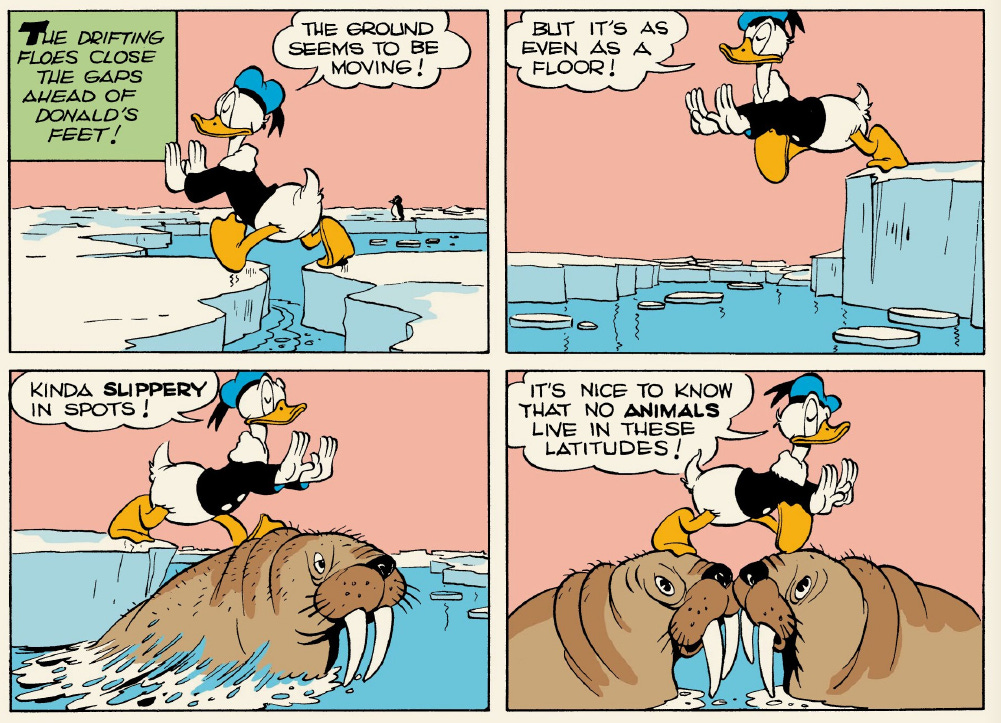
The latter panel is an example of Donald’s talent for self-delusion, which we’ve seen doom him to disaster elsewhere. Here it lightens the tone by allowing him to be determined, heroic, yet flawed all at once. The most memorable sequence involves a snowblind Donald stumbling across an oblivious community of walruses:
Then later stumbling across a much less friendly polar bear inexplicably residing inside an igloo:
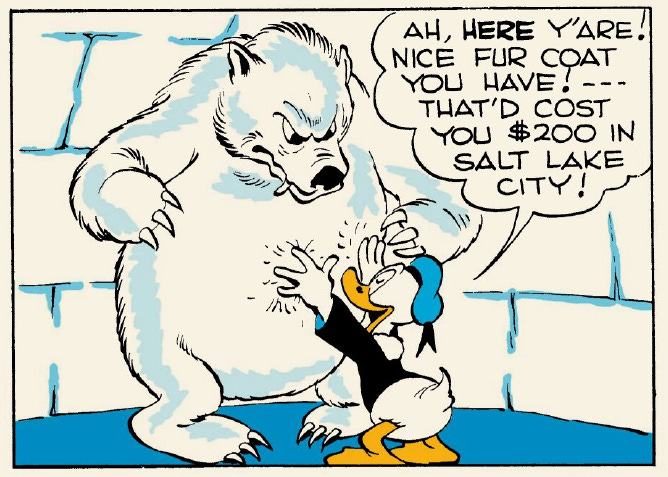
These are vintage holy fool gags. Barks filled out the middles of both Pirate Gold and Mummy’s Ring with gags too, but they were more disconnected from the story. Intercutting with the nephews’ serious rescue mission helps, as does the gags stemming from the foreign environment. The polar bears and walruses are slightly anthropomorphized, but not so much that it removes the overall feeling of threat and isolation. Donald is naive, heroic, and indefatigable all at the same time without coming off as haughty. The story still freezes up during these gags, but we are invested in seeing Donald overcome this crazy situation as Donald.
The rescue itself is pure action, Donald accidentally hurling himself off a cliff and being caught in a parachute by the nephews. The nephews don’t overshadow or one-up Donald here—instead, they play the supporting role of serious characters to ground the story when Donald has to hold on to being a bit of a comic buffoon. Barks ingeniously pulls this off while keeping Donald as the main character.
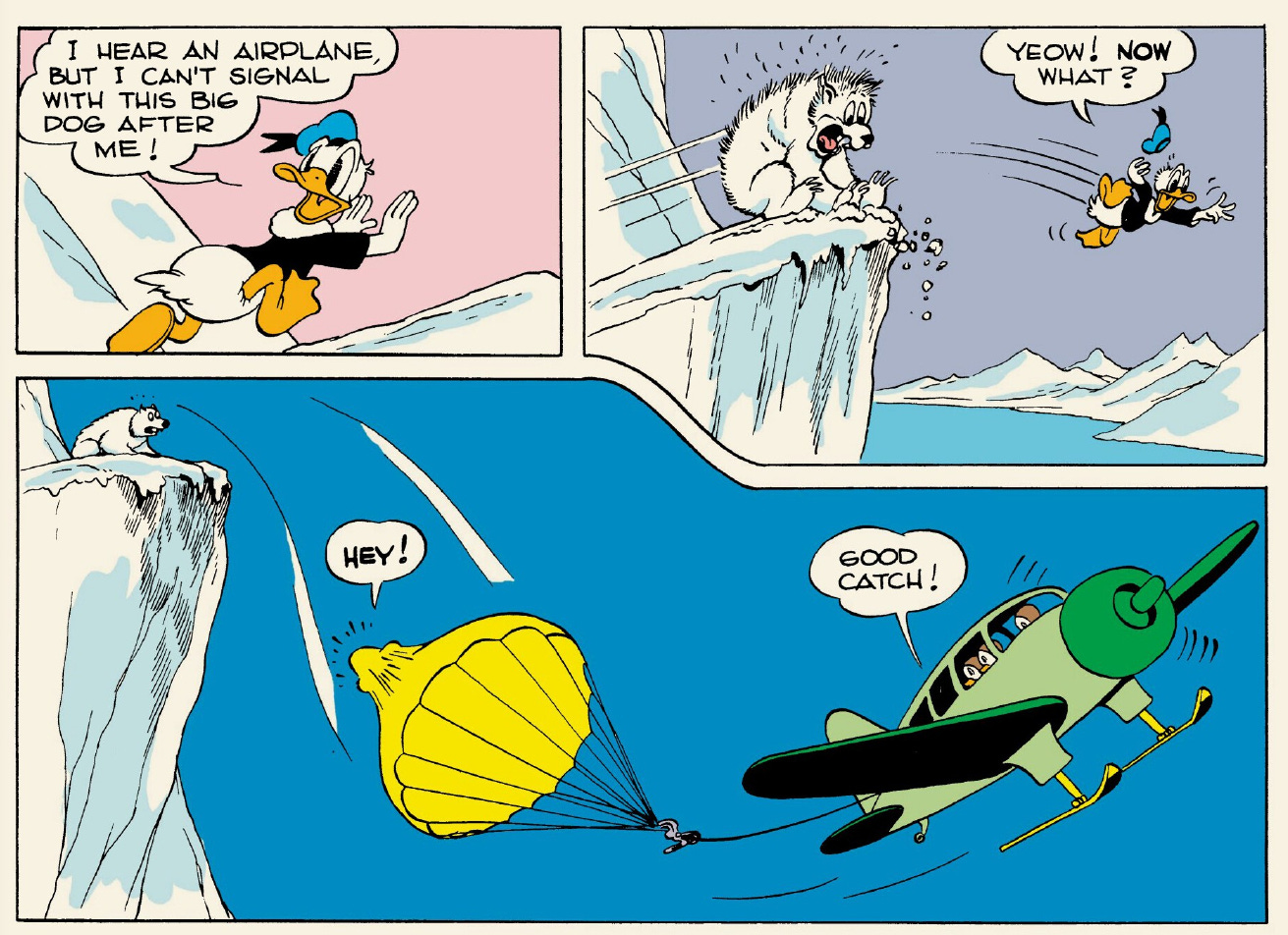
They leave the bear behind, technology and smarts trumping the brute force of nature. (The look on the bear’s face as it skids to a halt at the cliff edge is hilarious.) The whole thing has the feel of Donald having been in an amusement park, which may seem bizarre, but read on.
Their plane runs out of gas, and Donald and the nephews walk until they find a cabin, which just happens to be Pete’s.
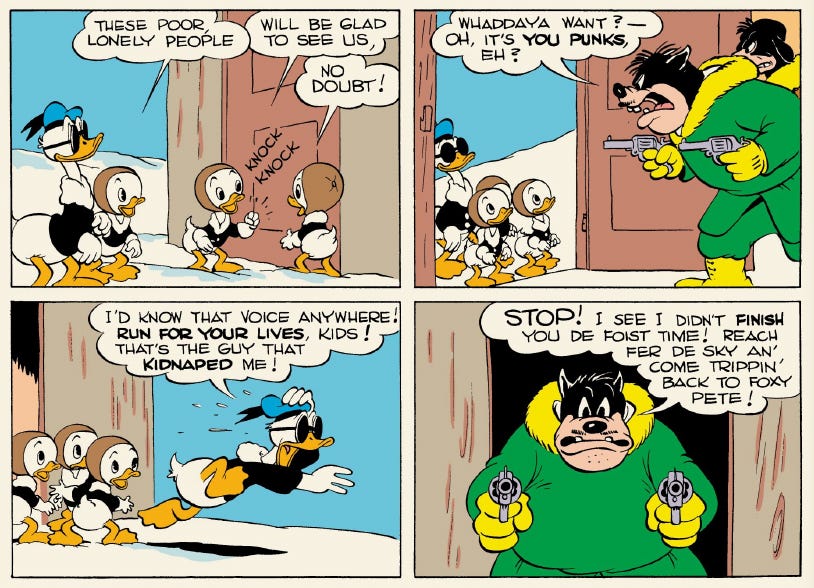
Donald’s blindness, now with dark sunglasses, is peculiar. It prevents him from having a true confrontation with Pete—or even recognizing him until he hears his voice. (You’d think the nephews would be a bit wary when Pete points two guns at them and calls them “You punks.”) Pete ties them up and plans to burn down the cabin with them in it, but the nephews are able to escape through the chimney and let Donald out.
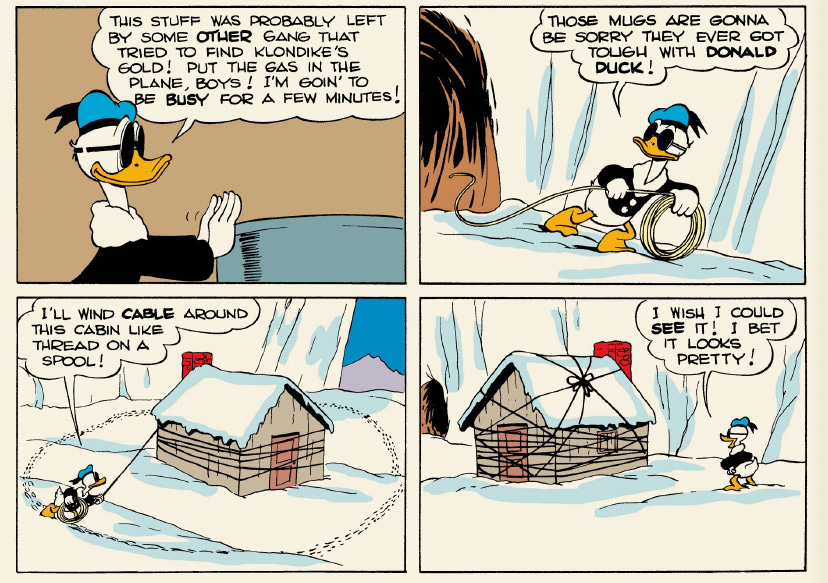
Donald’s triumph over Pete is abstract, clever rather than confrontational. One of Barks’s running themes is that Donald cannot profit from genuine good deeds, and this is a subtle variation on it. Donald has confidence and pride, but he doesn’t get the catharsis of defeating Pete. He doesn’t get to proclaim the triumph of good over evil. He doesn’t even see it. Barks doesn’t even portray Pete and his partner brought to justice. Their last appearance is of them trapped in the cabin as the nephews fly away with it.
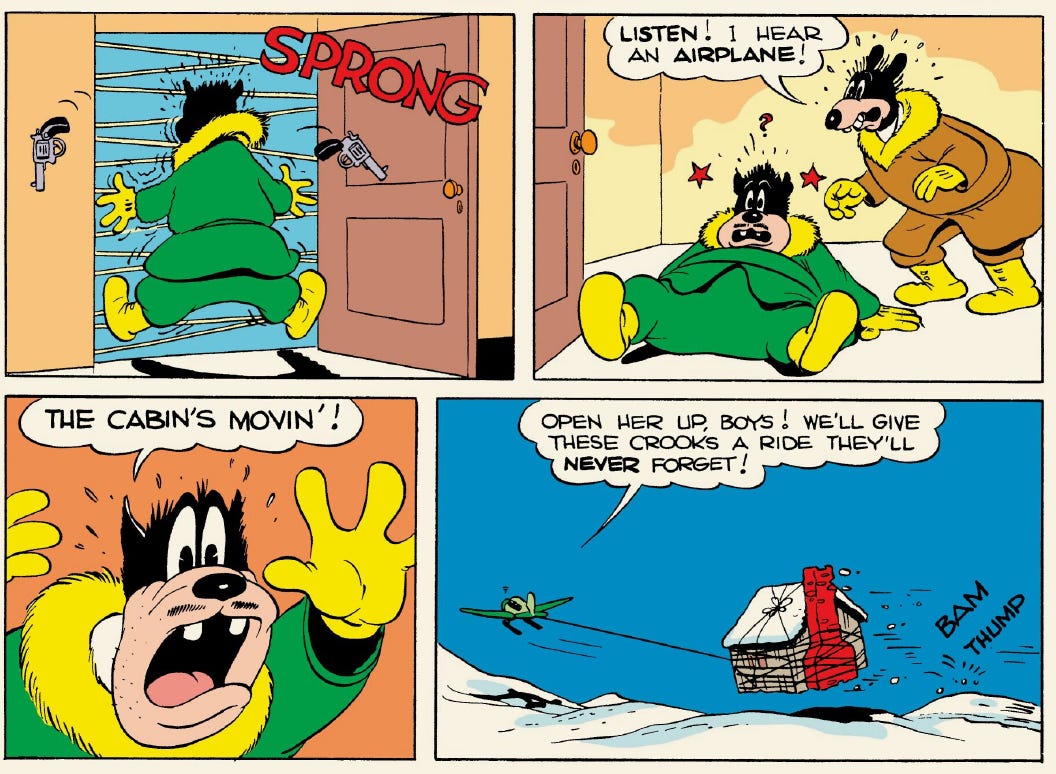
The whole business with Pete is left to a quick narrative sum-up, while Donald and the nephews forget the whole business.
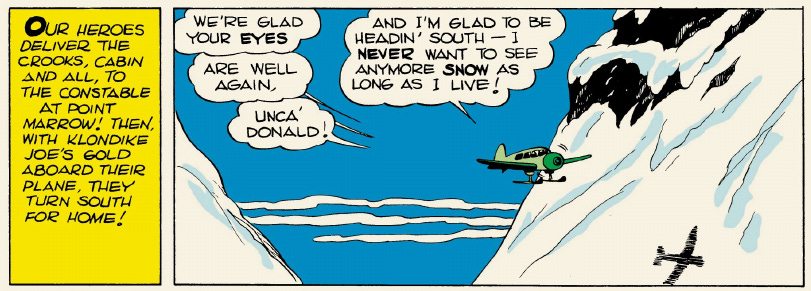
Barks seems almost bored with the idea of showing the resolution. Donald does return home and receives the key to the city, but all Donald wants to do is get back to the original plan to fly south, putting the whole thing behind him.
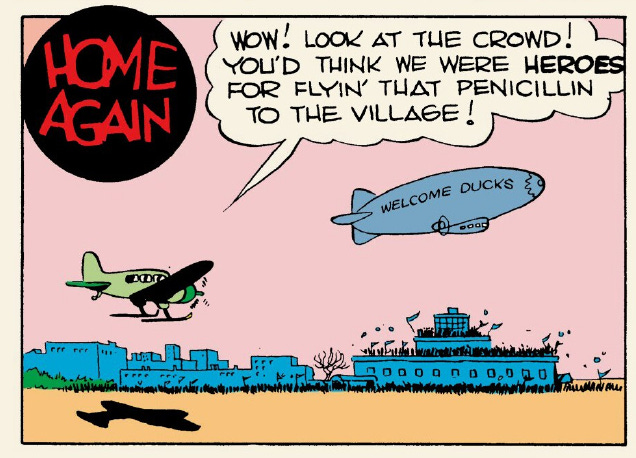
Donald has become indifferent to the town’s celebrations compared to his initial pride. It’s as though the visit to the Arctic made it all seem trivial, and he’s realized what’s really important: going someplace warm. It’s not enlightened, but it represents a certain kind of humble confidence that Barks did esteem and occasionally let Donald experience.
Throughout the story, in fact, Donald never quite grasps the situations as they are. Whether blind in the Arctic, unknowingly smuggling Klondike Joe’s box, or tying up a cabin with cable, he always stands a bit at a remove from the reality and the danger of the situation he is in.
Donald’s usual everyday troubles have mostly disappeared to make room for the story drama. Removed from the dreary problems of his hometown—the very circumstances he was trying to avoid at the story’s start—he enters a more dangerous world, but one free of the quotidian annoyances, exploiters, and responsibilities that haunted the ten-page story. Pete de Rat is a killer, yet Barks doesn’t portray him with the venom he reserves for con men and millionaires. He’s just a thug, albeit a deadly one.
Donald, in turn, is hero and even heroic. It comes naturally to him in this story. Compared to the ten-pagers, this might make Donald unrecognizable, but his humanity, fallibility, and clowning remain—touches of pride, doubt, and fear keep him as Donald.
The setting changes everything, though. However deadly the situation is, there is still a blessed escape from the daily grind, the forces that Barks views as darker than escapist espionage thriller plots. That’s why Donald and the nephews return so quickly to the issue of going somewhere warm. That’s the reality of the situation, while Klondike Joe’s gold and Pete’s machinations were more of a fantasy playtime.
If this risks making the adventures feel low stakes, it also provides the setting in which Donald can be heroic. It’s only outside of “real” life, Barks implies, that heroism comes to people, when the normal forces that vex it are removed. If not a fantasy, it’s not quite reality.