

Donald Duck's First Adventure: The Mummy's Ring
Carl Barks's creation of a world for ducks

The Mummy’s Ring (FC 29, September 1943) was the first adventure tale Barks penned, having only drawn Pirate Gold before it. In effect, he had to invent narrative structures for putting purely comedic characters into a genuine adventure story. It’s rough around the edges, but what’s remarkable again is how much of Barks’s characterization and narrative style is already developed.
Barks put a lot of care into it as well. Since he must have been drawing it concurrently with the last few comic ten-pagers, it’s easy to see his effort being diverted into this story. Over 28 pages, he maintains a good flow and strong coherence to the story, and the art is more carefully worked-over and almost Hergé-esque in places, as with this shot of the Nile:
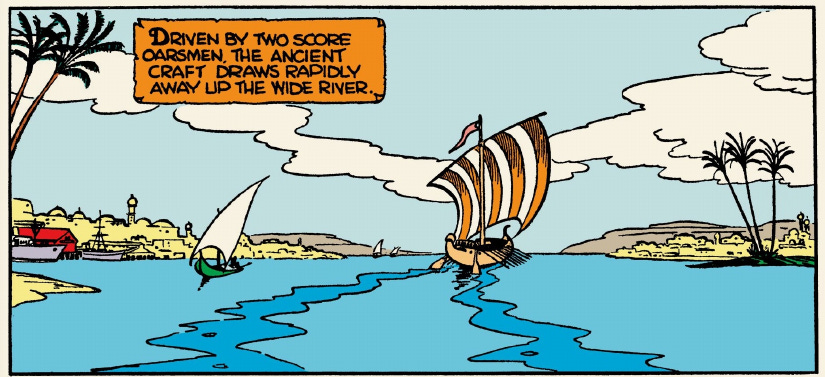
Peter Barks Kylling locates Barks’s primary research as a November 1941 issue of National Geographic, which would continue to be a major source of ideas for Barks. There are meticulous photo-references of Egyptian landmarks, and Barks is clearly putting far, far more effort into his work than anyone would require.
Barks begins the story by echoing The Rabbit’s Foot.

Here, the totem is a ring. The nephews suspect the ring may be related to the mummies at the local museum, which are part of a controversy as the “Bey of El Dagga” has sent emissaries to reclaim them for his country.
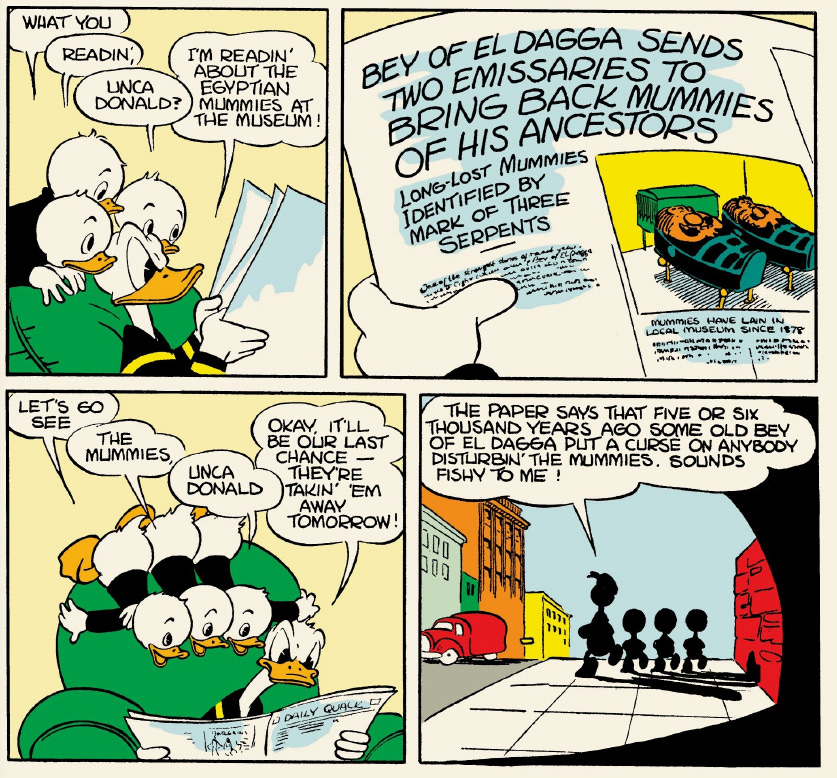
They visit the museum and the mummies, learn some background, then leave when the menacing emissaries show up. Then Huey goes back into the museum by himself to get his cap and…vanishes. That spurs Donald and the remaining nephews into action.
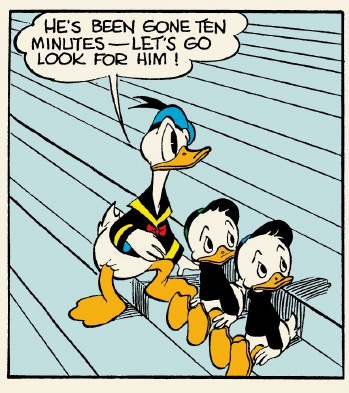
It’s a good setup, because the presence of only two nephews feels viscerally wrong. The nephews are such an integral unit that it’s alarming to see only two identical figures next to Donald. Donald concludes the emissaries kidnapped Huey, and so they are off to Egypt.
Already the scope is far larger than any duck story to date, international and firmly set in the present-day of 1943. With this story, Barks had to flesh out an entire world for the ducks, not just background sets for gags. For this, his reference points were other adventure strips of the day: Terry and the Pirates, Prince Valiant, and especially Floyd Gottfredson’s Mickey Mouse, which was the closest prototype for what he needed to generate: reasonably serious stories starring a “comic” character.
Mickey, however, was a self-starter and devoid of any innate personality defects. Barks had been experimenting with Donald in the 10-pagers, but some sort of comic flaw always remained at the heart of his character. For this adventure, he decided that Donald would remain a bit irascible, a bit grouchy, a bit petty, a bit skeptical, a bit dumb, and a bit cowardly—but he also decided that these traits could go into abeyance when the story required, revealing a degree of courage and cleverness.
The comedy is still there, particularly with a cute sequence where they try to sneak onto a boat as foreign dignitaries.
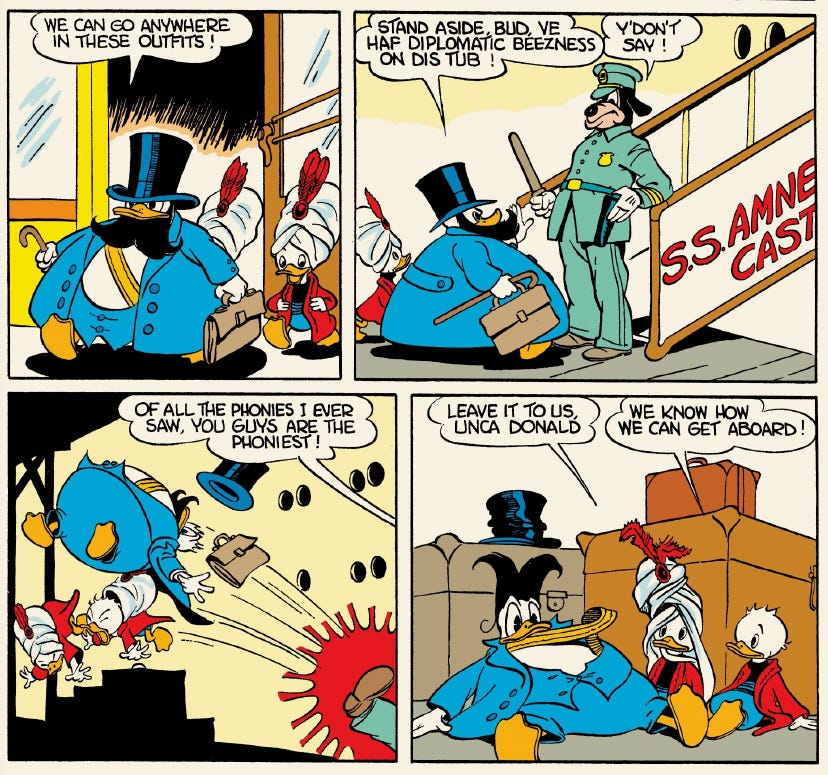
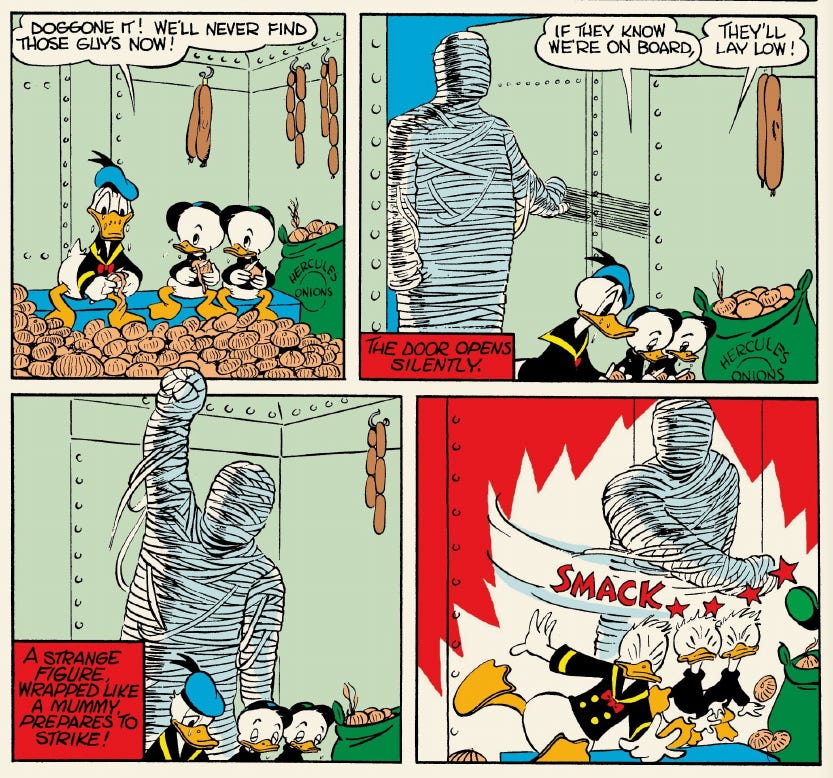
Overall, however, Barks reins in the gags far more than in Pirate Gold to avoid dampening the suspense. The more subdued tone means that when the mummy does show up a few pages later, the threat feels much more real than it did in Pirate Gold.
In turn, Donald becomes an active agent. Barks had already had Donald show his bravery whenever the nephews were in true danger, if you look back at Lifeguard Daze:

This story, though, is the first time Donald is more hero than comic relief. The transition is a bit uneasy; at times “Donald” seems to vanish and become a generic adventure hero. Barks’s early adventures are about integrating these pieces: how a comic figure of folly can also be an active protagonist—if not a true hero.
Barks also had to deal with the issue of just how villainous to make the baddies. Black Pete in Pirate Gold was a comic buffoon:

But putting Black Pete into a “serious” story wouldn’t work—would it? Gottfredson had put outright psychotic murderers into Mickey Mouse, like the Phantom Blot and his Rube Goldberg murder machines:
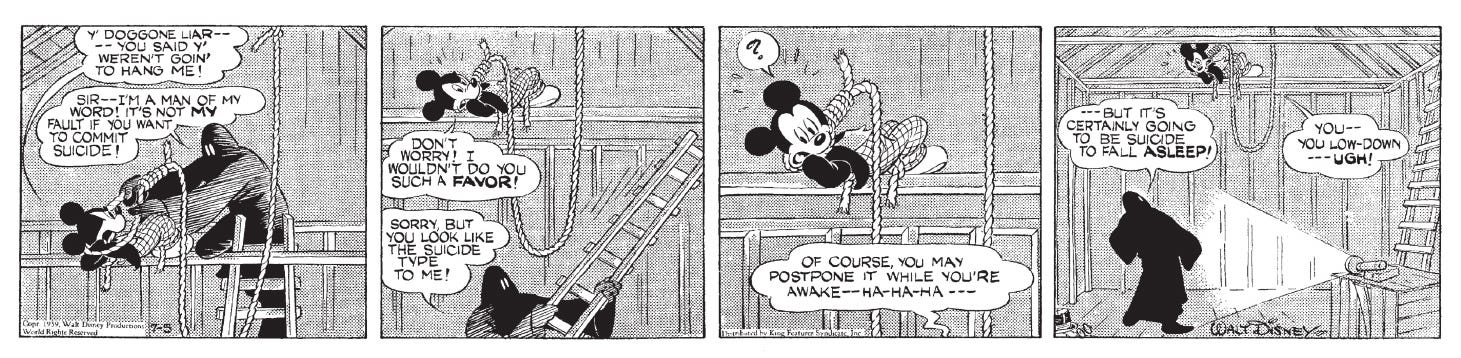
Donald Duck’s character, though, doesn’t mix well with serious malevolence and darkness, because such a villain inevitably elevates the hero to a level of non-petty virtue, and on a fundamental level, that’s inimical to what Donald Duck is—or at least what Barks considered him to be. For Barks, Donald could be heroic, but he could never be a full-on hero. (Other Donald Duck writers and artists felt no such hesitation, and their stories always ring hollow to me. Who is this duck?!)
Barks did experiment with a few similarly psychotic villains, but he generally stuck with less threatening bad guys of varying competence. Uncle Scrooge would later allow Barks get around this limitation by providing a character who could be uncomplicatedly noble—at the cost of making the stories less distinctive. It’s precisely because Donald is at the helm that Barks’s adventure stories get their tension and sense of artistic challenge.
The Mummy’s Ring engineers a genuine threat—first the abduction of one of the nephews, then a seemingly supernatural mummy monster—only to deflate it all at the end. This mummy—
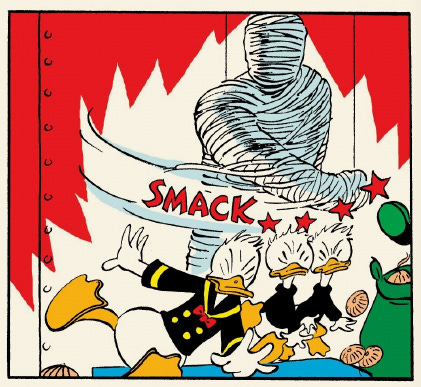
—that provoked this reaction from Donald—
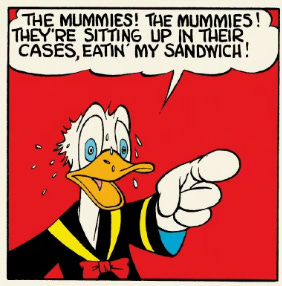
—turns out to be this guy:
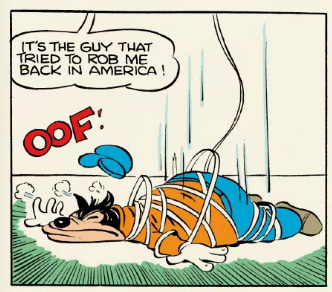
The villain, who disguised himself as a mummy, turns out to be a dopey Black Pete clone after all, the thug from the beginning of the story who wanted Huey’s ring. He looks nothing like the imposing mummy earlier in the story, seemingly having shrunk and put on dozens of pounds in the interval.
The entire drama of the story turns out to have been accidental, a combination of petty thievery and cosmic bad luck. The Bey’s emissaries had nothing to do with it, nor did anyone intend to kidnap Huey. The thug’s attempt to steal the mummy’s ring from Huey set off a chain reaction of events that led to him and Huey being shipped over to Egypt and nearly interred alive.
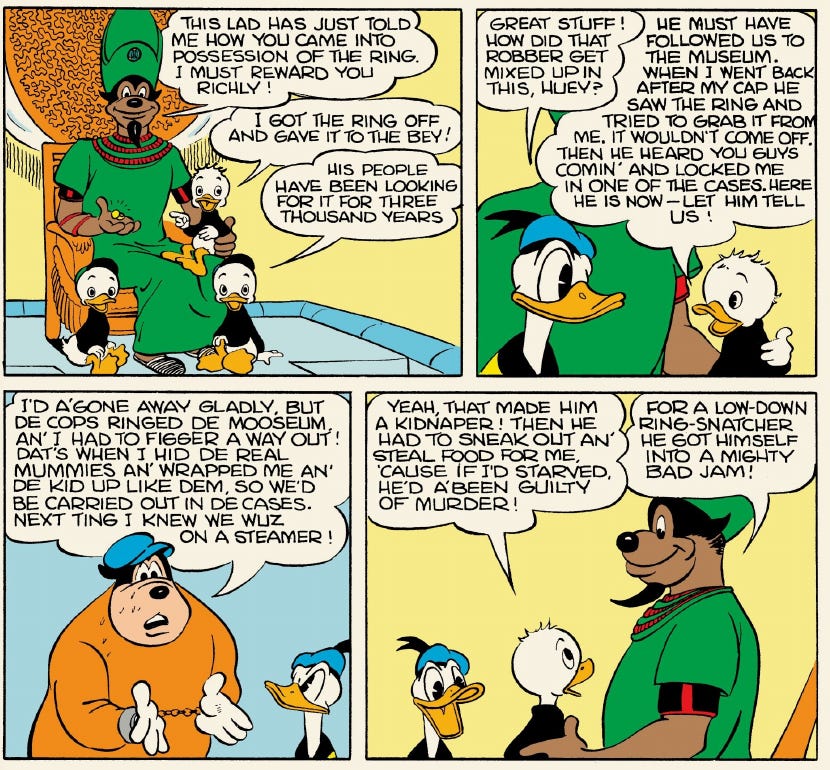
It’s admittedly a contrived situation, but it works anyway because of the overwhelming sense of fate and misfortune. The unnamed thug (he’s not significant enough to get a name) was as much a victim of fate as Huey, since the action of the story was not something anyone intended.
The greatest malice, in fact, comes when the Bey of El Dagga discovers that there are two living people (Huey and the thug) in the sarcophagi and orders them to be sealed up anyway.
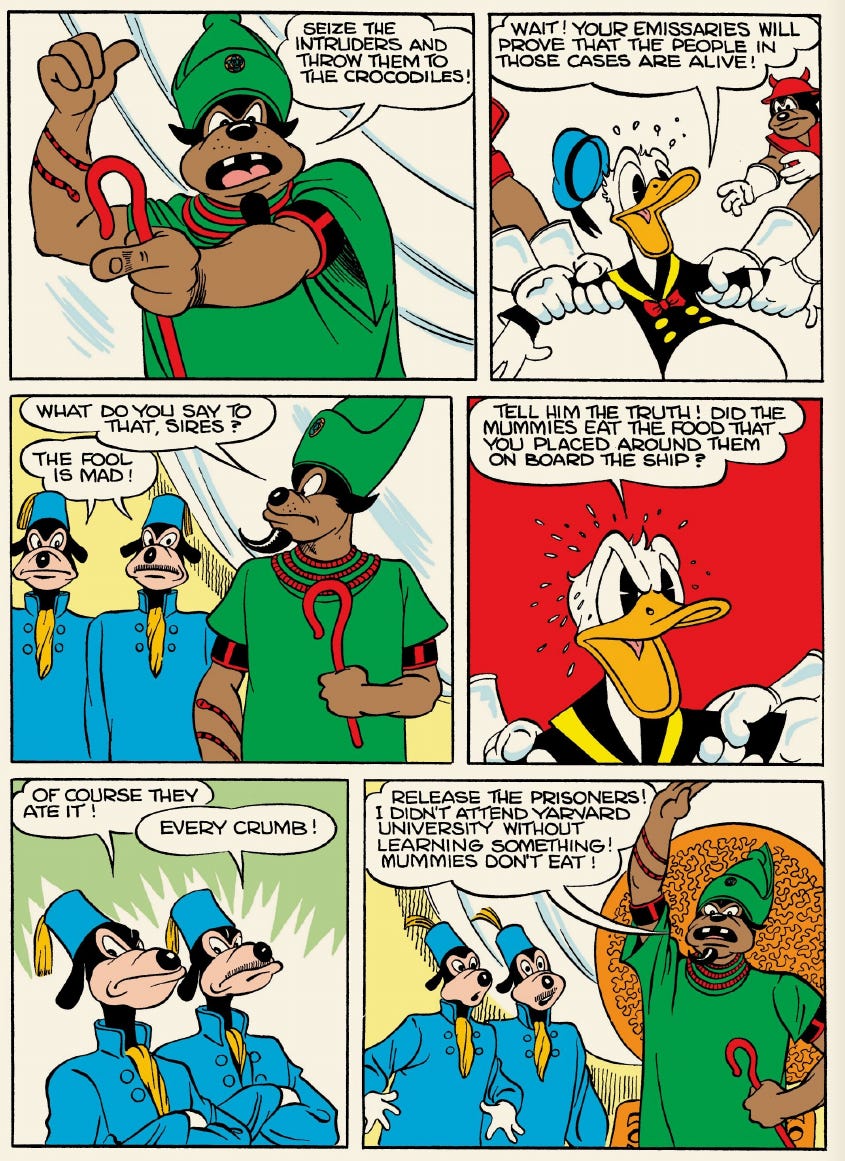
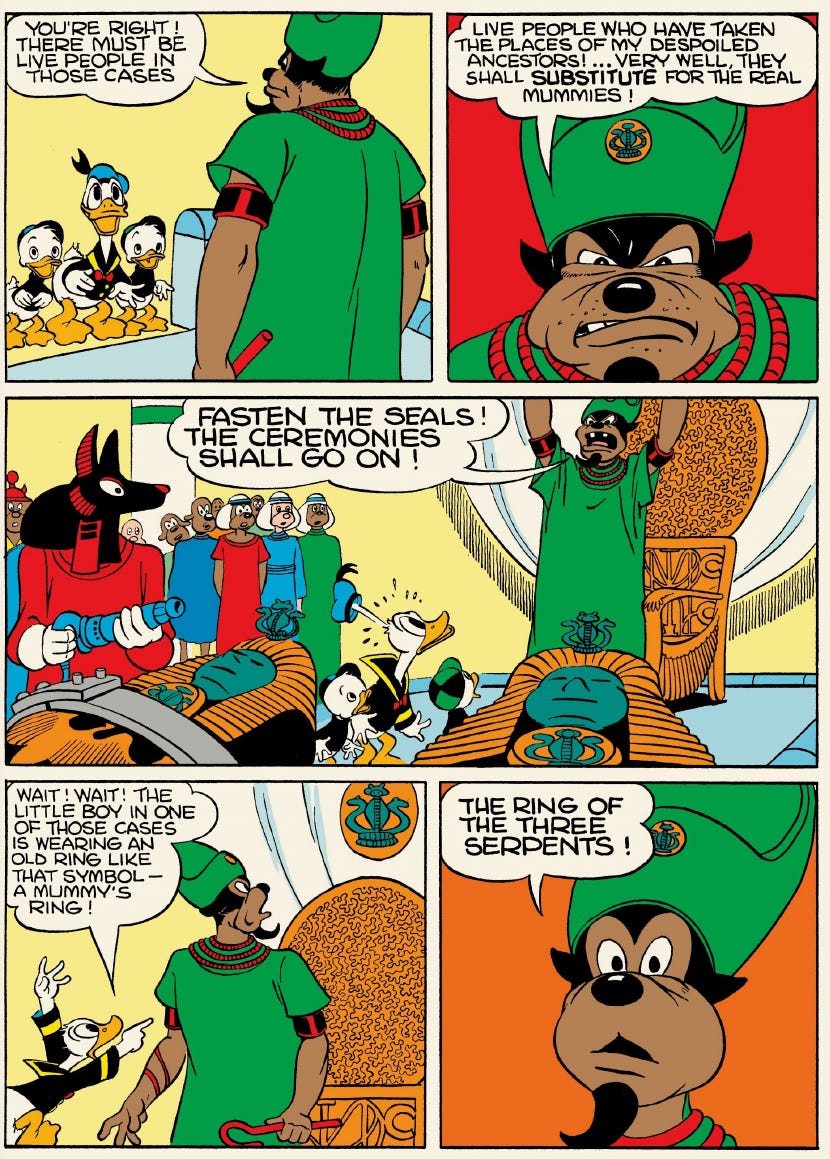
The Bey is a curious character. A bey is a Turkish title used in the Ottoman period, so it only refers to rulers of Egypt during the time Egypt was colonized by the Ottoman Empire. It had ceased to be used in the 19th century when Egypt regained some degree of independence.
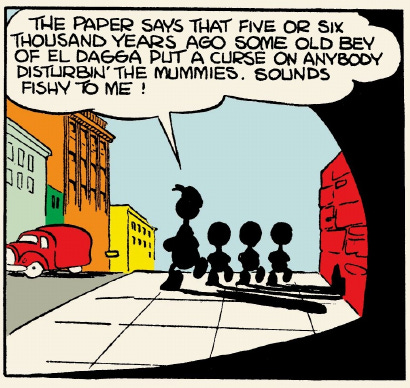
Moreover, there certainly couldn’t have been an Egyptian “Bey of El Dagga” in ancient Egypt, which provides the setup of the cursed ring:
I’m inclined to think this is just a mistake on Barks’s part, but it’s a fascinating one. The “Yarvard”-educated Bey threatens other countries for his supposed ancestors’ artifacts because he’s “sore at modern life,” but his population is apparently ignorant enough that they think mummies eat.
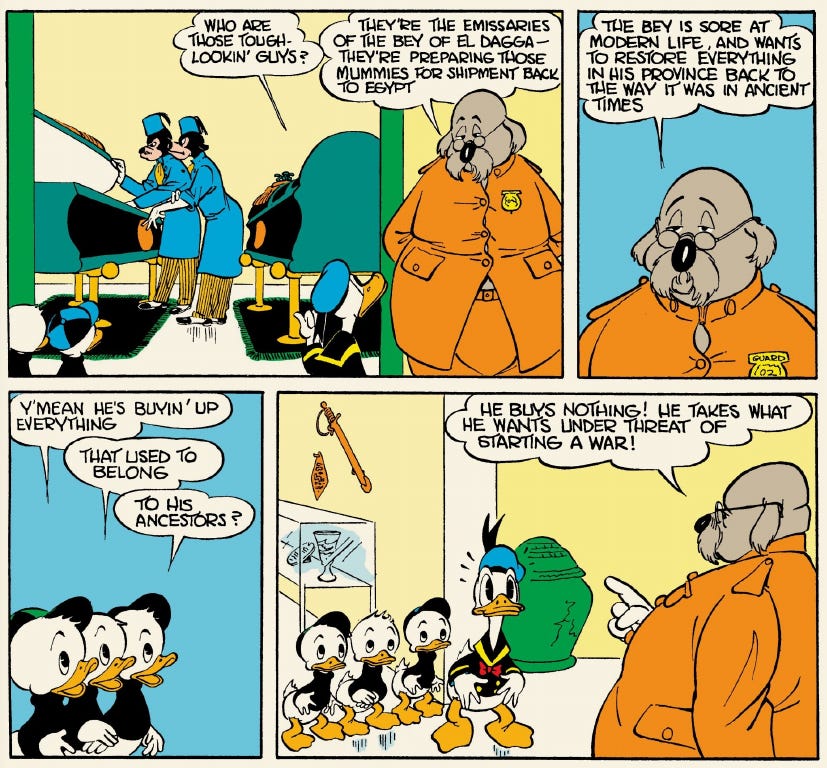
You can easily see this through an Orientalist light, and that’s probably there, but in Barks’s case I think it speaks more to his anti-authoritarianism. I imagine Barks wouldn’t have much of a stake in the debate over who the mummies should belong to, seeing it as the squabbling of those without real worries. Barks disdained high culture and intellectuals, and the “Yarvard” reference designates the Bey as a very suspicious person: an elite, hardly different from Western elites as Barks would portray them.
The Bey is, to put it bluntly, full of crap, bullying other countries and willing to kill a child on false pretenses. Whether intentionally or not, Barks underscored the point by giving him a colonial title and a false lineage. After all, Donald does say the whole thing sounds fishy. Maybe I’m not giving Barks enough credit, and it was intentional….
Regardless, it’s still quite jarring when Huey is saved just because he has the ring, and the ducks and the Bey become pals. I suppose the massive reward for the ring smoothed over the tensions, but I’m not sure that would quite get me to sit on the lap of someone who’d just ordered me interred alive.
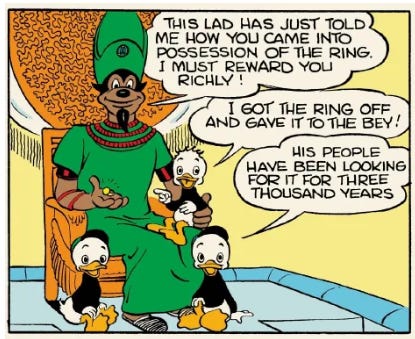
Was the ring actually cursed? Donald speculates that their luck turned around exactly when they got rid of it, and there’s enough in the story to suggest the curse is real, even if the Bey makes no mention of it. Fate wouldn’t be enough, though, without human greed (the robbers) and false pride (the Bey). Fate engineered the situation, but human folly helped it along every step of the way. Those two forces, which can never be defeated, prevent Donald from ever fully triumphing in his adventure tales, and they ultimately are what keep him a comic character even in the most dramatic moments.
Been enjoying these posts. The Carl Barks comics are criminally underrated, at least besides everyone trotting out Life and Times of Scrooge McDuck.