

Donald Duck's Very First Nervous Breakdown: Ten Cents Worth of Trouble
Carl Barks and the maddening finger of fate

Just as High-Wire Daredevils refined Donald-as-troublemaker into something deeper and more resonant, Ten Cents Worth of Trouble (WDC&S #50, November 1944) refines Donald-as-victim into something more realistic and far more disturbing. Reading the stories chronologically, you see Barks assembling disparate versions of Donald into crafted, dark, semi-moral tales.
Donald took a lot of punishment in earlier stories like Farragut the Falcon, but there was little more to it than fate pointing the finger at a random person (Donald) and deciding that Donald would be its target for a while. Ten Cents puts more of the emphasis on Donald’s reaction to metaphysical persecution, and the result is the darkest story Barks had yet written. Farragut ended with an assertion of autonomy. This story ends with Donald losing whatever autonomy he had.
Donald begins the story in an unusually contented, domestic mode, with a sudden interest in coins:
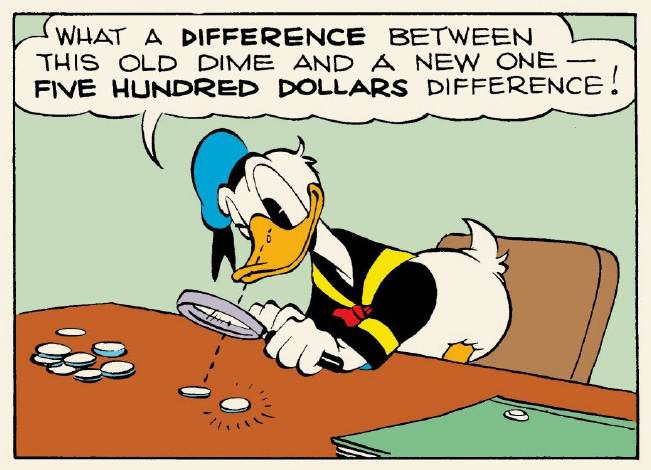
We haven’t seen this hobbyist Donald before. He is solitary and content with his coins, polishing them without a thought for the troubles of the larger world. There’s no trace left of the arrogant, delusional high-wire walker from last month, just a man in temporary ataraxia, wanting nothing he doesn’t have.
That changes when the nephews ask for ice cream money and Donald accidentally flips them his rarest coin, a dime worth about $10,000 in 2026 dollars:
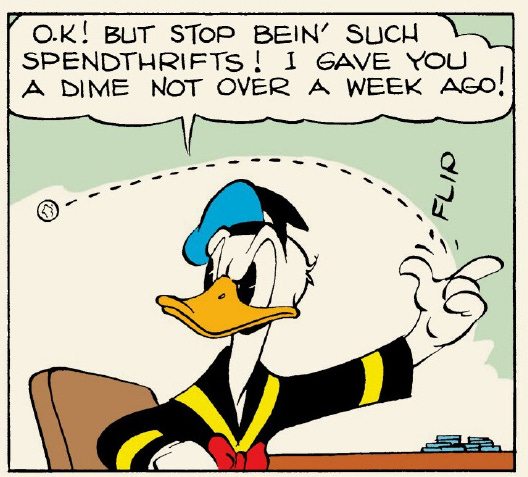
Thus:
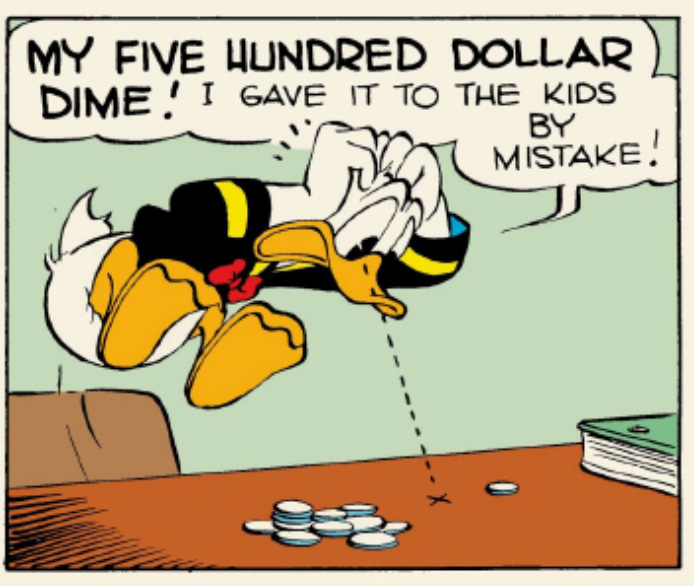
By the last panel of the first page, Donald’s well-being has collapsed. The unity of the first page is remarkable, going smoothly from idyll to crisis. All three panels of the above use dashed lines—the first and last have are Donald’s eyes to the coin and the missing coin respectively, but the middle is the arc of the coin. Donald took his eye off the coin for a moment and lost it.
Donald chases after the nephews:
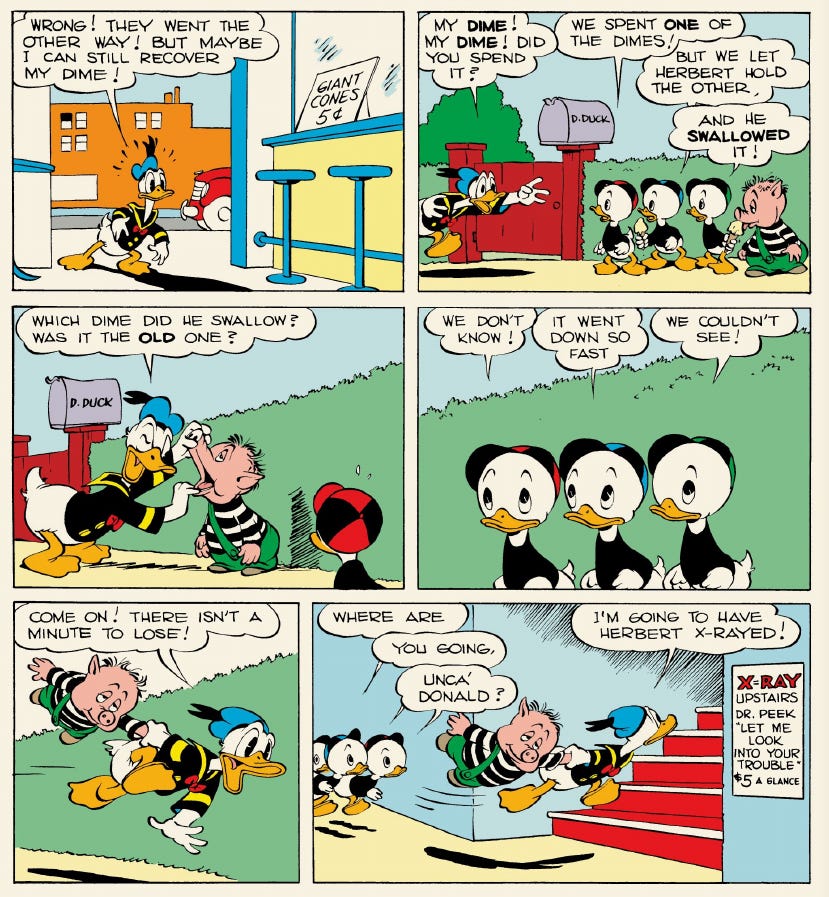
Herbert is back! This is his second and last appearance, but damn if he wasn’t hilarious for such a limited character. I love how Louie is feeding him the ice cream and his absolute obliviousness and lack of reactivity, holding the same expression no matter what is going on. Here, he’s not just a gag character, though, since he contrasts with Donald’s discontented urgency.
The dime, it turns out, isn’t in Herbert’s stomach. It’s ended up in the hands of a snooty and contrary rich man who will have no sympathy for Donald’s accident.
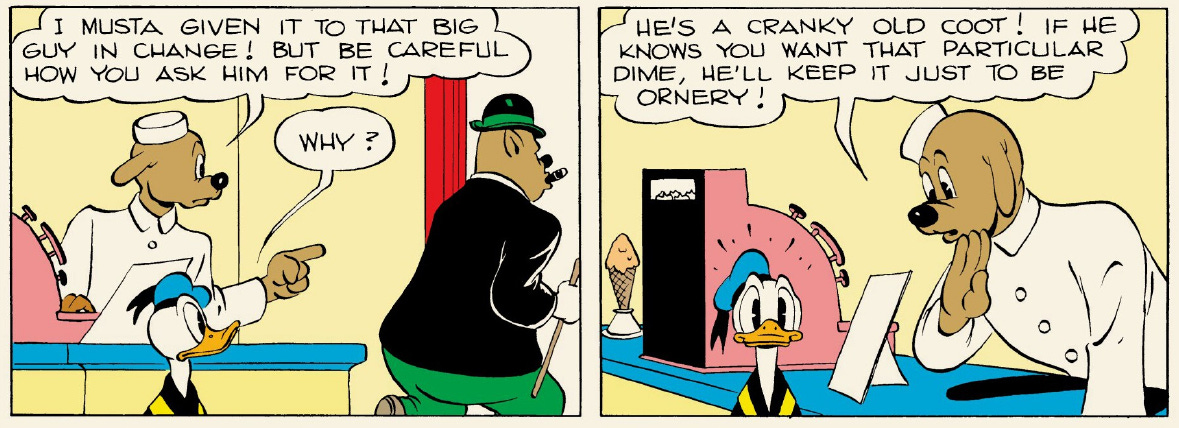
There are then three pages of Donald trying various tricks to get his dime, all ending with humiliation or violence. During all of them, that dashed line appears again as the arc of the coin:
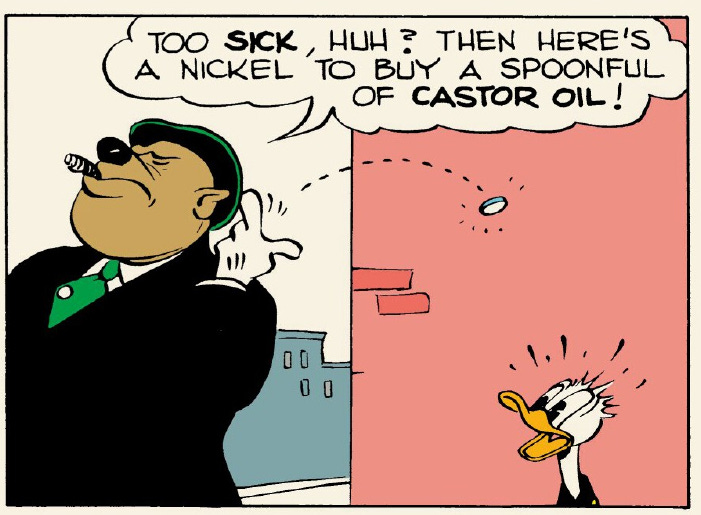
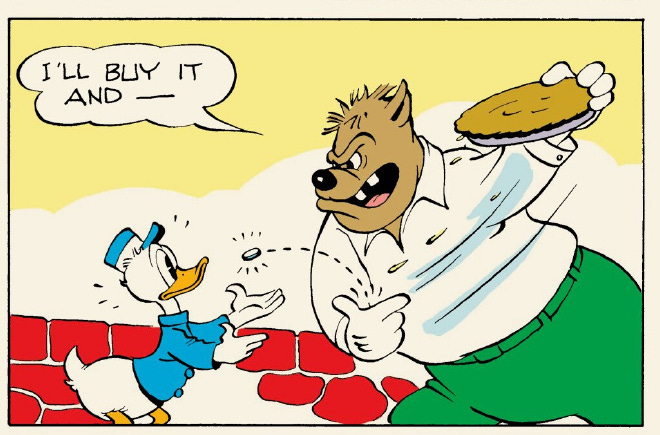
The dashed line of the coin arc is the literal depiction of the traveling of Donald’s wayward coin.
Yet on the third try, it works:
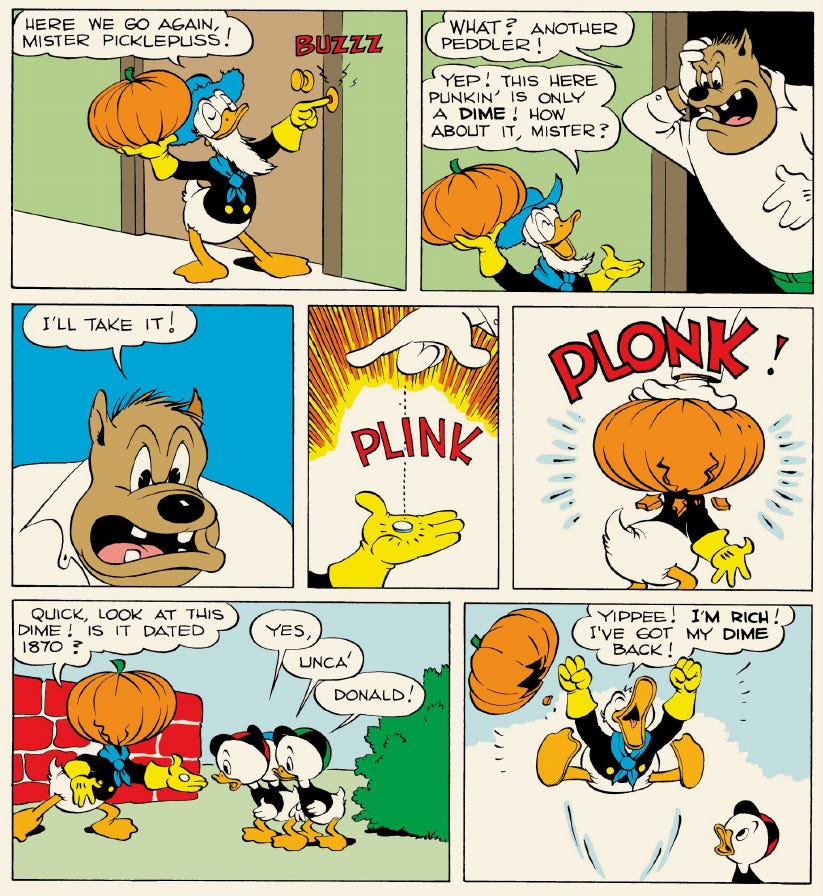
The coin lines reach a payoff in the middle panel here. Surrounded by a majestic aura, the right coin (before Donald or we know it to be) lands in Donald’s hand with an enormous PLINK. Barks is nailing down his visual language of fate’s workings.
Donald has a moment of bliss before a tramp steals it:
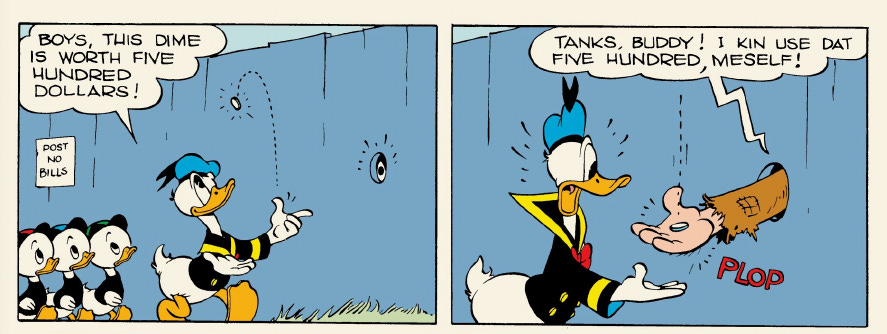
Once again, the dashed line is the arc of the coin’s fate. The nephews bop him on the head, causing him to drop the dime:
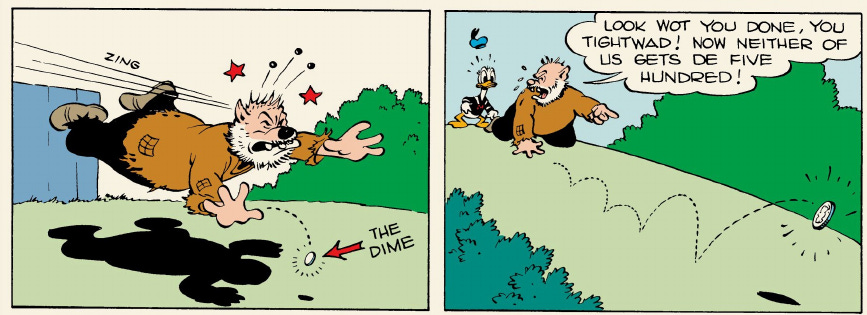
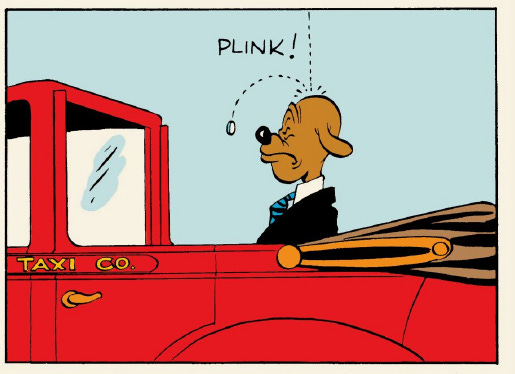
For all the nastiness of the rich guy and the tramp’s theft, the dime is becoming a character itself, highlighted and foregrounded, eventually landing in the hands of a well-mannered rich man:
His pilot warns him that the dime will bring him bad luck
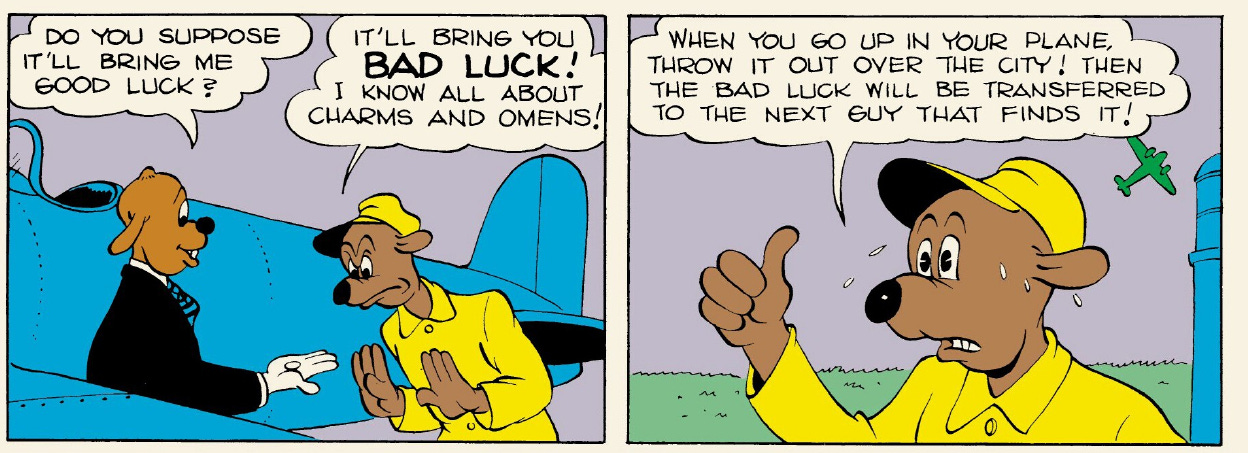
The rich man is skeptical, but tosses the dime out of the plane anyway…only for it to land right back on Donald’s desk.
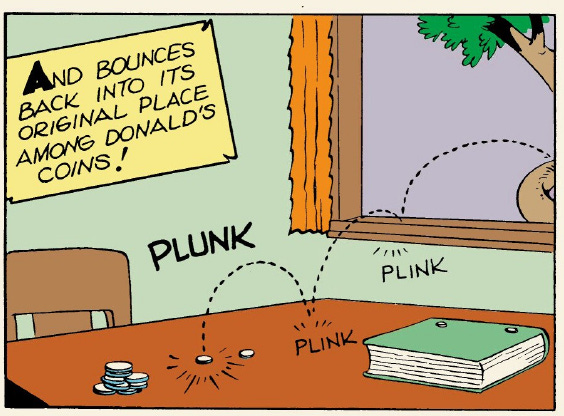
And not just on Donald’s desk, but into the precise location it was in before Donald picked it up and flipped it to the kids, as though his entire mistake has been undone. He and the nephews return to their house in despair, only to find the coin there. Donald’s reaction to fate’s blessing, however, is a mental breakdown:
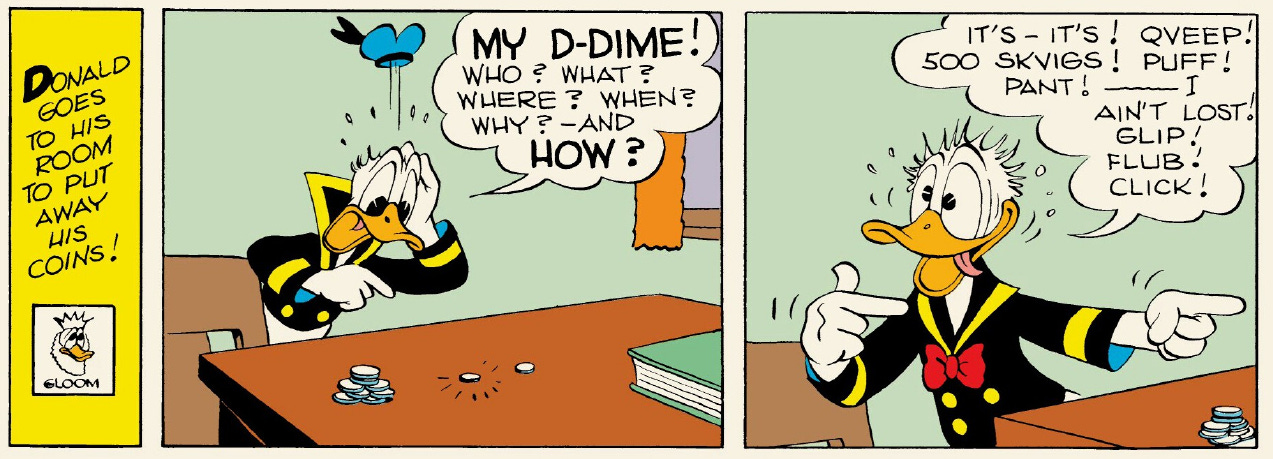
This is unnerving stuff. I read it as Donald having reconciled himself to having lost the coin in spite of his extraordinary and exhausting efforts, only for fate to having overrode them all. The pressure arises from the blessing being so devoid of agency. He got his coin back, yes, but without rhyme or reason. (We saw just how fortuitous the process was, but Donald doesn’t even have that.)
Donald cracks. The doctor has no diagnosis other than “delirium.”
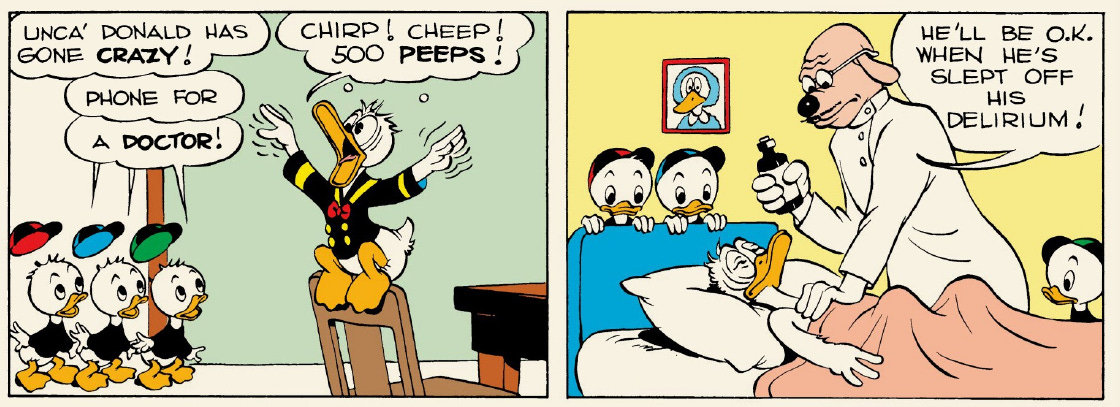
Again, it’s disturbing. Donald could have just been thrilled at being so bizarrely and inexplicably blessed and having his mistake undone, yet the workings of fate are more unsettling to him than his accidentally throwing away his $500 dime.
He does recover, however, seemingly returned to his contented state at the start of the story. Any sense that the events were reversible aberrations, however, is cut short when Donald finds out the nephews accidentally paid the doctor with all the money on Donald’s desk—including the dime. Barks ends with this final panel:
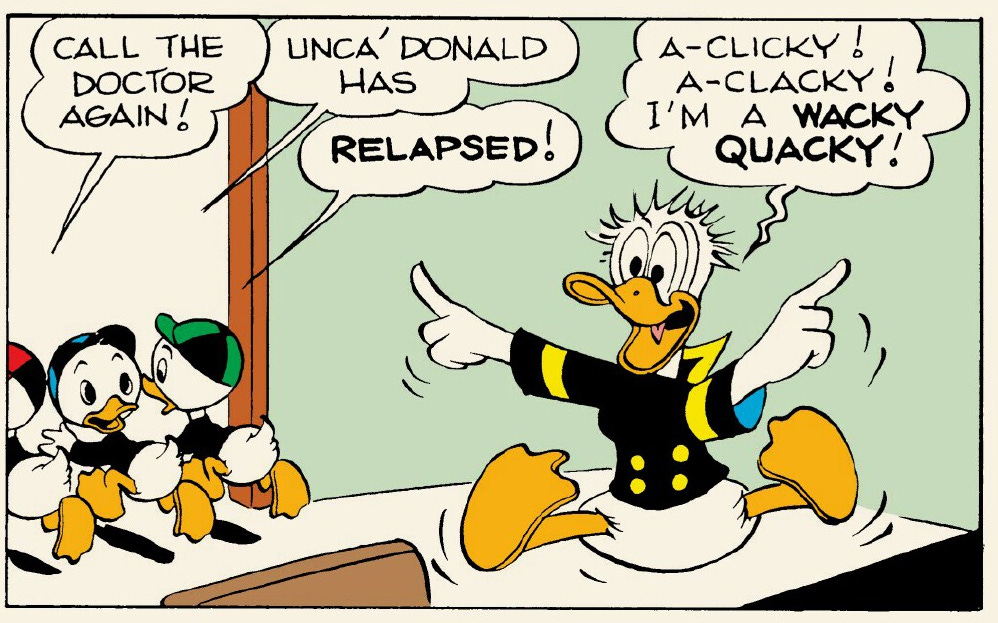
Cartoon characters have funny nervous breakdowns all the time. What makes this one disturbing instead of funny is that the situation is not a caricature. We saw Donald as an ordinary everyman at piece, not some loud-mouthed jester. The story put up stakes that were fundamentally realistic, and even when it devolved into cartoon violence with the pumpkin, Donald received it as a human being. This is the nervous breakdown of a human being.
The pupils of Donald’s eyes went haywire only once before, when he was bonked on the head and went into a genius fugal state in The Mad Chemist.

Here, they again signal transference into an alternate state of mind—this one deranged.
There is no further resolution either. Donald’s final state plays like he’s been the recipient of some gnostic revelation of fate’s perversity, and the shock has driven him mad. The curtain has been pulled back on the workings of causality, and it trivializes his existence. Don’t think I am being hyperbolic in this analysis—Barks would return to this sort of plot many times in the next ten years, and the end result would always be the truth of an individual’s powerlessness.
The dime’s arc lines suggest volition on the part of fate generally and of the dime specifically. Broadly speaking, what happens is coincidence, yet the architecture of this setup is so artful—malicious even—that anyone would think that someone had planned it. The pilot, who said the dime was an omen of misfortune, was not so off the mark. After all that happened, that dime might well be cursed. We don’t get to know, but we do see enough to make us doubt that it’s purely random.
There’s also the theme of taking one’s eye off the ball. When Donald flips the coin, he’s not looking at it. Is one little slip of attention enough to justify what happens? There is a quasi-Jewish paranoia that kicks in here, where the questions of responsibility and cause and effect remain unresolved.
After half a dozen stories hinting at fate’s workings and showing Donald as powerless in the face of arbitrary malice and chaos, here Barks finally shows us the details of the workings, not that we get an explanation for them. Donald is at his most human when Barks depicts him wrestling with a world that is both inexplicable yet not wholly chaotic. We can relate.