

Donald Duck and Fairness: The Hard Loser
Carl Barks and the conventions of society and story

The Hard Loser (FC 29, September 1943) is one of Barks’s strongest early 10-pagers, a very tight and complex tale told neatly. Considering Barks drew all the stories in the 64-page Four Color #29, his ability to produce superior work at a rapid clip was fully established.

While The Mummy’s Ring in the same issue expanded his scope to ambitious adventure stories, The Hard Loser refines his lifelong obsession with integrity and (un)fairness. The Rabbit’s Foot was the prototype, and this is a significant advance. That it simultaneously comments on its own genre is a remarkable achievement, not least because Barks was still only six months into his comic book career.

The Hard Loser is another tale of ironic turnarounds. The difference this time is that it’s not unseen fate doling out rewards and punishments, but the judge of the “Screwball Derby” horserace. The setup immediately puts Donald and the nephews in competition to get “Grandpa’s old buggy horse” (who is Grandpa?!), and Donald promptly pulls a dirty trick to beat the nephews.
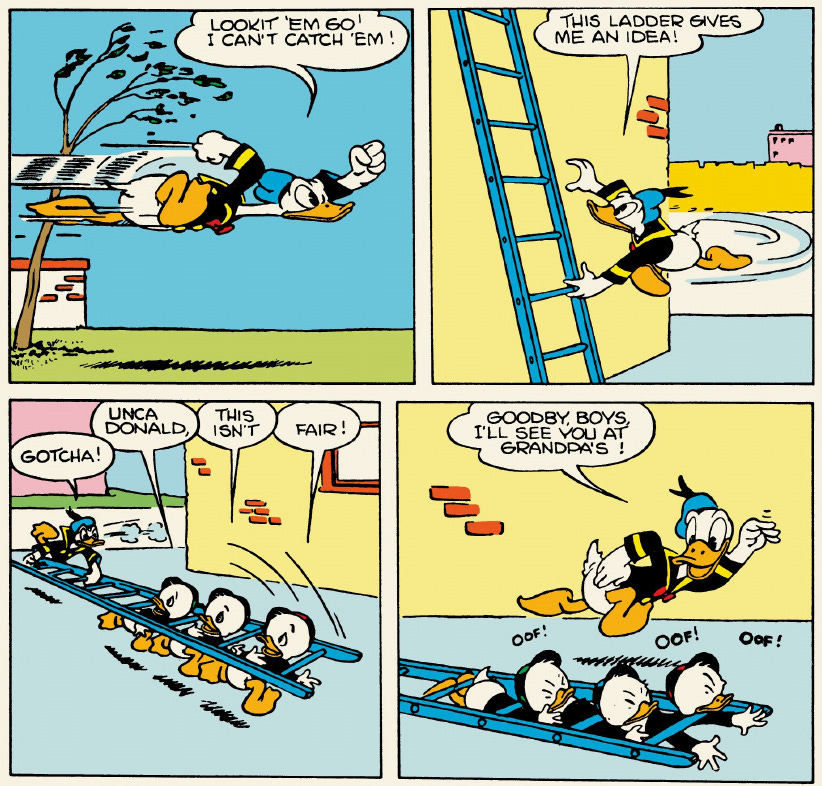
“This isn’t fair!” No actual competition was declared; Donald sussed that the nephews were ahead of him and tripped them with the ladder. Is it unfair, or is it just mean? That’s our theme.
The nephews get a weak horse from a junk peddler, who assures them that the horse will do great in the race. This in turn spooks Donald enough that he dumps “fizz water pills” in the nephews’ horse’s feedbox to sabotage them. Except the nephews figured Donald would pull a trick and swapped stalls, so Donald sabotaged his own horse:
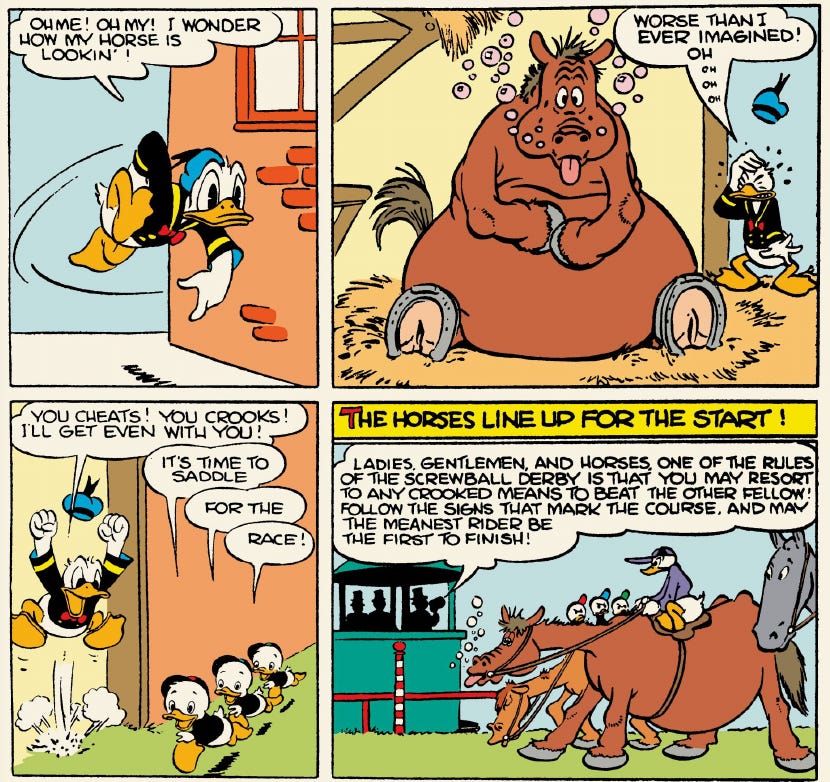
Now it’s Donald yelling at the nephews for breaking the rules: “You cheats! You crooks!” His indignation is nicely absurd, but like the nephews, he’s appealing to some set of rules that the nephews supposedly broke, not in the race itself but in life.
Then comes the first twist, which is that the Screwball Derby has no rules. Suddenly, Donald’s way of being is at home—or so Donald thinks.
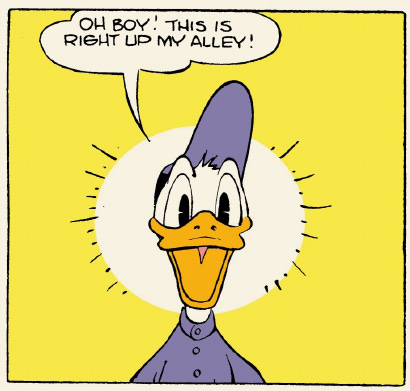
A few panels earlier, he was calling the nephews cheats and crooks. Now he’s quite aware that a race with no rules that permits “any crooked means” is his kind of race.
The other riders quickly take each other out, leaving only Donald and the nephews. The nephews do not cheat; had Barks had a few more panels (as he soon would), he ought to have filled in the nephews’ side, since we never get to hear their opinion of the Screwball Derby. The rest of the story is Donald sabotaging the nephews and them trying to recover and catch up to Donald’s fizz-impaired horse.
After his first gambit doesn’t work, Donald tries to trick the nephews into thinking he’s been injured so he can steal their horse:
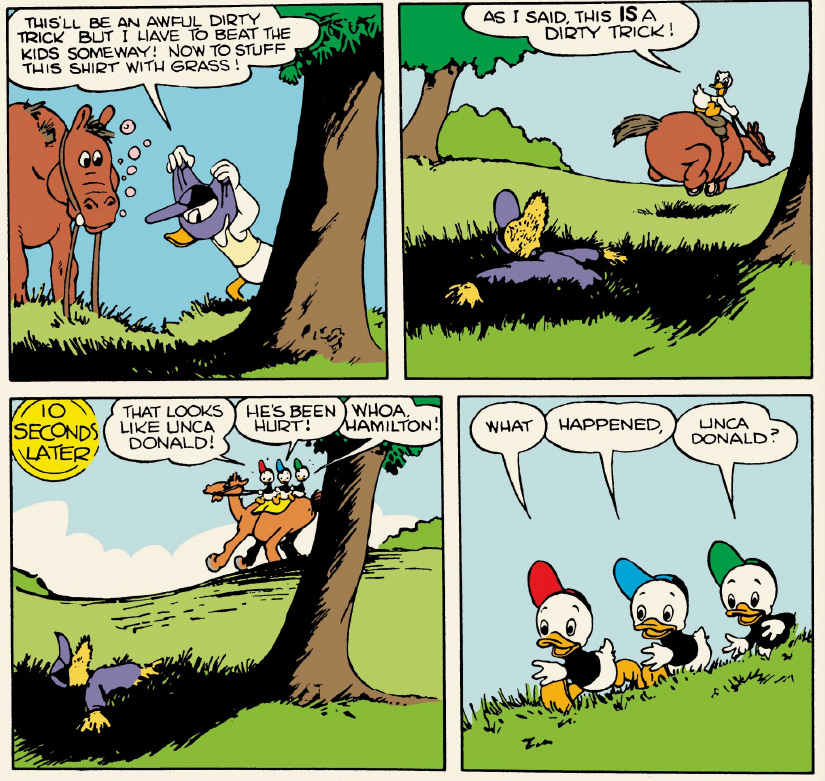
Note Donald’s pride at the dirty trick he’s pulling. He’s acting as though he’s somehow breaking the rules, even though he isn’t. It’s nasty indeed to play on family sympathies in that way, but by entering the race, both he and the nephews signed up for it. Yet they all seem resistant to acknowledging that truth.
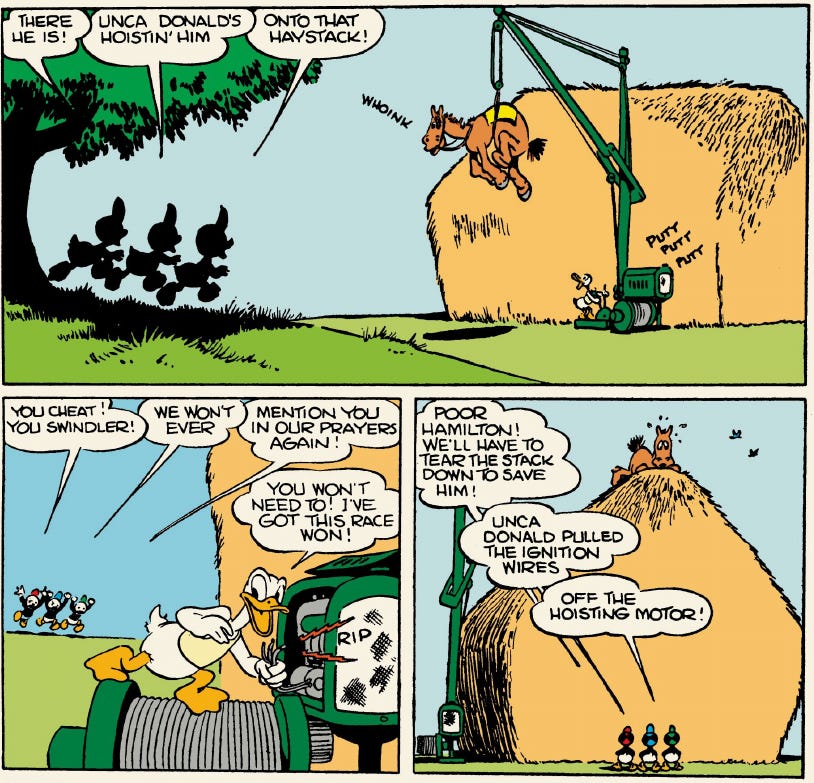
The nephews, in fact, never do. They never cheat, and they appeal to a higher authority, saying that they’ll take Donald out of their prayers—as though the Screwball Derby itself was a violation against God. Neither Donald nor the nephews can fully internalize a situation where societal rules of fair play have been suspended. Donald thinks he’s being bad, and the nephews think he’s being bad.
Because Donald thinks he’s still transgressing, he misses the bigger picture. The punchline comes when Donald (barely) beats the nephews, only to find out that he’s actually lost the race. The goateed, cigar-chomping judge smugly announces that the whole race has been a joke on the racers, who didn’t know that the slowest horse would win.
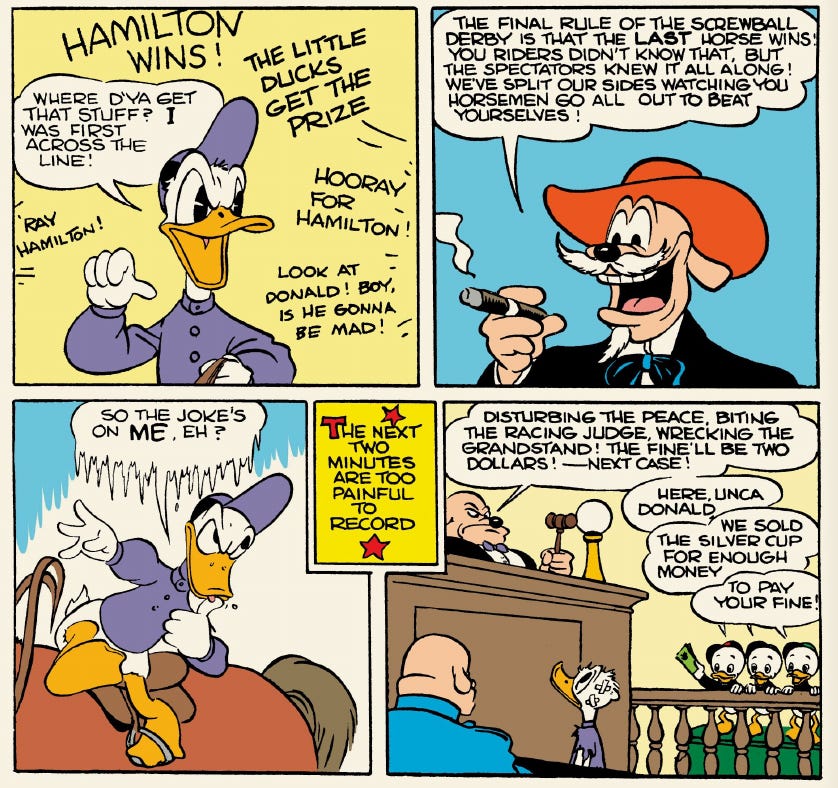
Donald goes ballistic in a one-duck riot. Barks has never had Donald wreak such havoc before, so the question is why this scenario specifically provoked him.
The answer is that Donald has not only been publicly humiliated, but his very sense of self has been annihilated. He imagines himself as the superior being to whom the rules uniquely don’t apply. A race without rules puts no obstacles in the way of his superiority: this crooked race is the one race I should not, by definition, be capable of losing. How could the nephews, who behaved honorably despite not needing to, win? His violent indignation, echoing his unjustified rage at the nephews earlier, spills out of the race toward life itself: how dare the Screwball Derby seem to favor me, only to make me the butt of the joke!
Donald’s reaction is the final irony. He bites the judge and wrecks the grandstand, ending up in court. In one important sense, Donald is vindicated: Screwball Derby be damned, Donald proved that there were still rules that he could violate. Sure, he got caught, beaten up, and fined, but the stern court judge (clearly several ranks above the goofball race judge) reestablishes that yes, society has set rules, rules that Donald can (theoretically) flout proudly. Like most children, Donald wants a world in which he doesn’t have to follow The Rules, but everyone else does. He needs a world in which the concept of a “cheater” has meaning, so that he can be that cheater.1
The nephews seem unfazed by the outcome. On a larger level, their sense of fairness and integrity has been vindicated, so holding a grudge against Donald would be meaningless. They can afford to be magnanimous and bail him out, offering up one final humiliation to him. They even sell the Derby prize cup for the fine money, since what value is a trophy for a race with no rules?
The story itself is ultimately a comment on the basic Donald-comeuppance plot, since Barks creates an artificial situation where Donald doesn’t quite break any rules despite doing his best to act badly and cheat. Donald loses his sense of how he construes himself, causing the comeuppance plot to self-destruct. His final reaction is violent not because he got his comeuppance, but because his comeuppance came about in the “wrong” way.
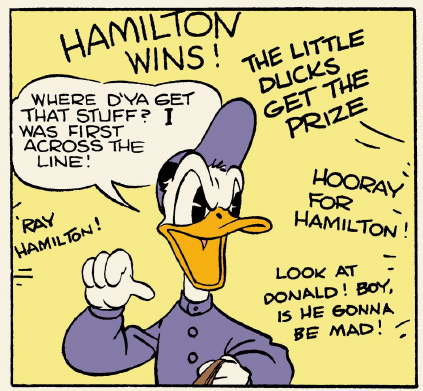
And that in turn reflects the dual effect of this entire genre of moral comedy. The unseen spectators are easy stand-ins for the readers, and the Derby judge is playing the author of the whole contrived situation. One spectator even yells, “Look at Donald! Boy, is he gonna be mad!”, as if they know he’s the protagonist. Donald’s final words are an icy, infuriated “So the joke’s on me, eh?”, as though that weren’t the raison d’être of at least half the stories Barks put him in.
Like the judge, Barks creates an artificial situation of moral comeuppance and a setting for gags and humiliating misfortune. That’s what the story is asking: can it be both? Does the Screwball Derby make sense as a site for moral instruction? For that matter, does the world?
I’m talking about this particular version of Donald, of course. When Donald takes on the role of the honorable downtrodden, the situation flips and while he rarely wins, he is often spared humiliation. As to what unifies these versions…wait and see.